Sales teams can look busy and productive while still leaving important questions unanswered – who owns the next step, where responsibility hands off, what really moves a deal forward.
As roles multiply and teams grow, those gaps become harder to see and more expensive to ignore.
We’ll break down sales team roles and responsibilities by stage, clarifying who you need, what each role owns, and how structure supports consistent execution as complexity increases.
Key Notes
- Sales department functions must be explicitly owned to prevent role drift and execution gaps.
- Clear boundaries between sales team roles improve pipeline quality, forecast accuracy, and accountability.
- Sales team structure should change by growth stage, not by headcount pressure.
The Functions of Sales Department
Before breaking down individual sales team members, it helps to zoom out.
A sales department is not a list of job titles. It is a set of functions that must be covered for revenue to move cleanly from first touch to long-term value.
These functions exist whether you name them or not.
New Business Acquisition
This function covers everything required to create and close new revenue.
It includes:
- Prospecting and inbound conversion
- Qualification and opportunity creation
- Discovery, solutioning, and negotiation
- Closing and contracting
The mistake many teams make is collapsing all of this into one role for too long. It works early, but it breaks at scale.
Expansion & Retention
Revenue does not stop at close.
Expansion and retention are commercial motions that require ownership, timing, and discipline.
This function includes:
- Renewals
- Upsells and cross-sells
- Commercial account strategy
Whether this sits with sales, customer success, or a hybrid model is a design choice. Leaving it undefined is not.
Enablement & Operations
This is where most teams underinvest.
Enablement and operations turn intent into repeatable execution. They own the mechanics that let sellers sell.
This includes:
- CRM structure and hygiene
- Process design and enforcement
- Training, onboarding, and playbooks
- Reporting and insight
Without this function, every improvement relies on heroics.
Leadership & Governance
Leadership is a function, not a title.
This function owns:
- Revenue strategy and targets
- Hiring plans and capacity models
- Compensation and territory design
- Forecasting cadence and accountability
When leadership abdicates this function, teams drift even if individual contributors perform.
Core Sales Team Roles and Responsibilities
Now we get specific.
These are the most common sales team roles. The value here is not the titles, but the boundaries.
SDR & BDR
Sales development exists to create qualified pipeline.
Nothing more. Nothing less.
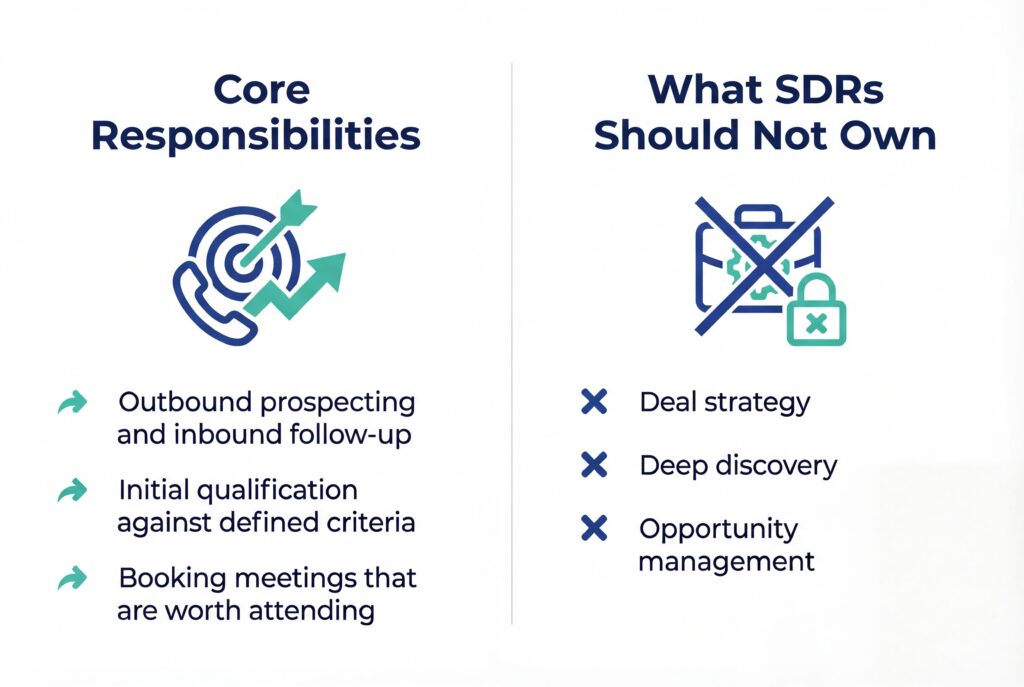
Most SDR problems are not talent problems. They are definition problems.
When “qualified” means different things to different people, noise floods the system.
Account Executive
AEs own the deal.
That means:
- Running discovery that surfaces real business problems
- Controlling the sales process from first meeting to close
- Managing stakeholders, momentum, and risk
- Closing cleanly
AEs should not be long-term owners of:
- Implementation
- Ongoing support
- Custom product promises
The fastest way to burn out strong AEs is to turn them into unpaid project managers.
Account Manager & Customer Success Manager
This is where many sales departments quietly lose revenue.
Someone must own the post-sale commercial relationship. In some models, that is an Account Manager. In others, a Customer Success Manager with commercial responsibility.
The split matters less than clarity.
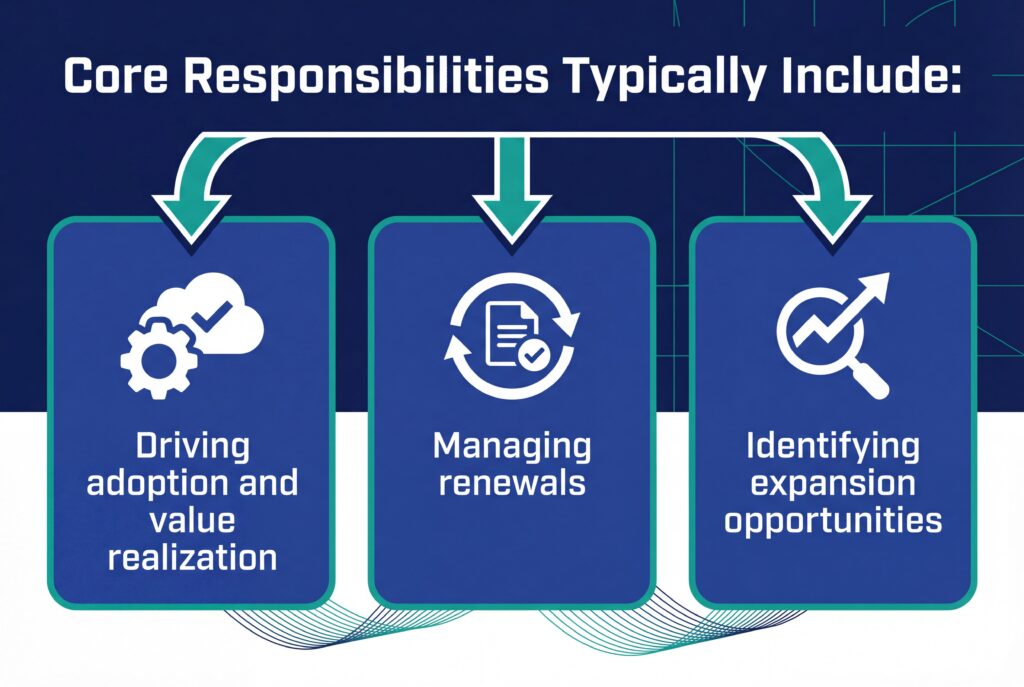
When renewals are “everyone’s job,” they become no one’s job.
Sales Engineer or Solutions Consultant
This role exists when complexity demands it. Sales engineers support technical validation, complex demos, and proof points that AEs cannot credibly deliver alone.
They do not own the deal.
When AEs outsource deal ownership to technical roles, deals slow and accountability blurs.
Sales Operations
Sales ops is the connective tissue.
Responsibilities include:
- CRM structure and governance
- Territory and quota administration
- Reporting and data integrity
- Process documentation
The mandate is simple – reduce friction, increase signal.
When sales ops is missing, sellers compensate with spreadsheets and guesswork.
Revenue Operations
RevOps emerges when growth creates interdependence. This role aligns sales, marketing, and customer success around a single revenue model.
Responsibilities include:
- End-to-end funnel visibility
- Cross-functional metrics
- Systems integration
RevOps only works when it has authority. Otherwise, it becomes a reporting service.
Sales Enablement Team Roles
Enablement is not content production.
Enablement exists to improve execution.
Core responsibilities:
- Onboarding and ramp
- Ongoing skills development
- Playbooks that really get used
- Tool adoption
If enablement cannot point to behavior change, it is noise.
Sales Leadership
Managers, directors, VPs, CROs.
Different scope. Same responsibility.
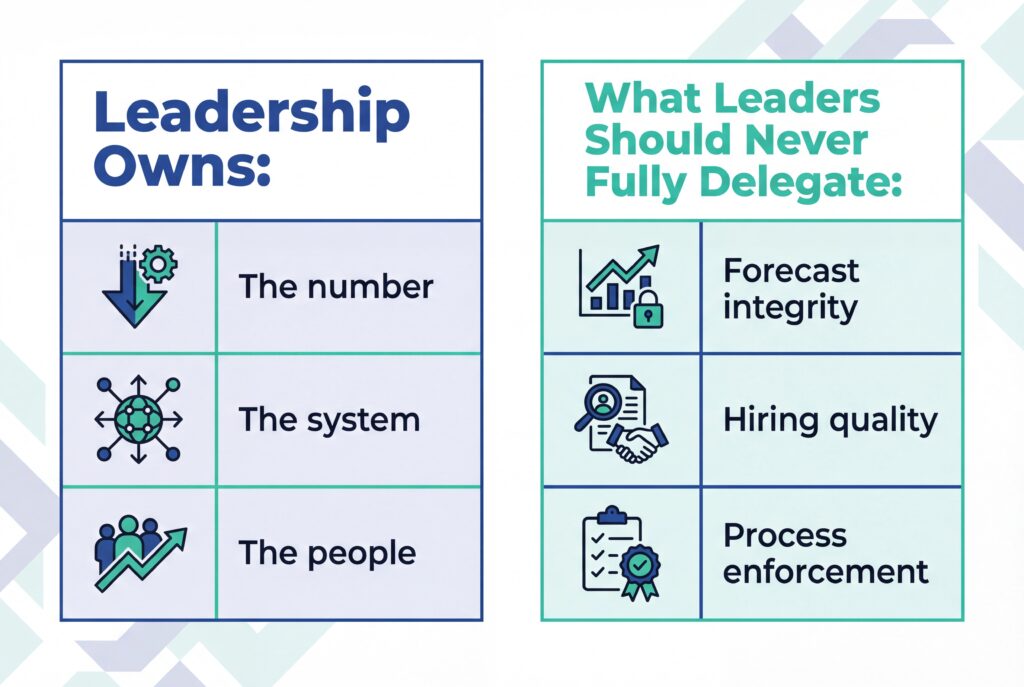
When leaders become top closers, the system weakens.
Sales Team Structure by Growth Stage
Roles do not scale linearly. Stages matter.
Stage 1: Early Stage & Founder-Led Sales
At this stage, efficiency beats specialization.
The founder sells. Or they should.
Why? Because learning matters more than leverage.
Early responsibilities:
- Founder owns discovery and messaging
- First sellers act as player-builders
- Minimal process, maximum feedback
Hiring senior sales leadership too early is a common and expensive mistake.
Stage 2: Scaling & Repeatability
This is the inflection point.
Demand becomes predictable enough to specialize.
Roles typically added:
- Dedicated SDRs
- Multiple AEs
- First-line sales managers
- Sales ops
- Customer success or account management
- Enablement
Responsibilities shift from individuals to process. Founders step back. Systems step in.
Stage 3: Growth & Enterprise
Complexity arrives quietly.
Segmentation by region, vertical, or product becomes necessary. Forecasting requires rigor. Governance matters.
At this stage:
- Enablement and ops become force multipliers
- Leadership focuses on inspection, not intuition
- Exceptions are minimized
Without structure, scale amplifies dysfunction.

Responsibilities Sales Should Never Own
Some responsibilities creep into sales by accident.
They should be pushed back deliberately.
Sales should not own:
- Product roadmap decisions
- Custom feature commitments
- Implementation and support
- Billing and collections
- Demand generation in isolation
Every hour spent here is an hour not spent selling.
How Responsibilities Work In Practice
Theory breaks under pressure. Execution exposes truth.
What High-Performing Sales Teams Do
They do a few things relentlessly well:
- They follow a defined process
- They maintain CRM hygiene
- They coach continuously
- They inspect leading indicators
None of this is glamorous. All of it compounds.
Documenting and Reinforcing Roles
Role clarity lives in three places:
- Job definitions tied to outcomes
- Playbooks that define handoffs
- SLAs between teams
If it is not written, it will be ignored.
Role Drift
Role drift is inevitable. Ignoring it is optional.
Watch for:
- Duplicate effort
- Missed handoffs
- Blame shifting
Periodic responsibility audits prevent decay.
Common Role Mistakes & How to Spot Them
Most issues show up in the data first.
Misalignment Patterns
- SDRs passing junk
- AEs hoarding accounts
- Managers rescuing deals
- Renewals slipping quietly
These are symptoms, not causes.
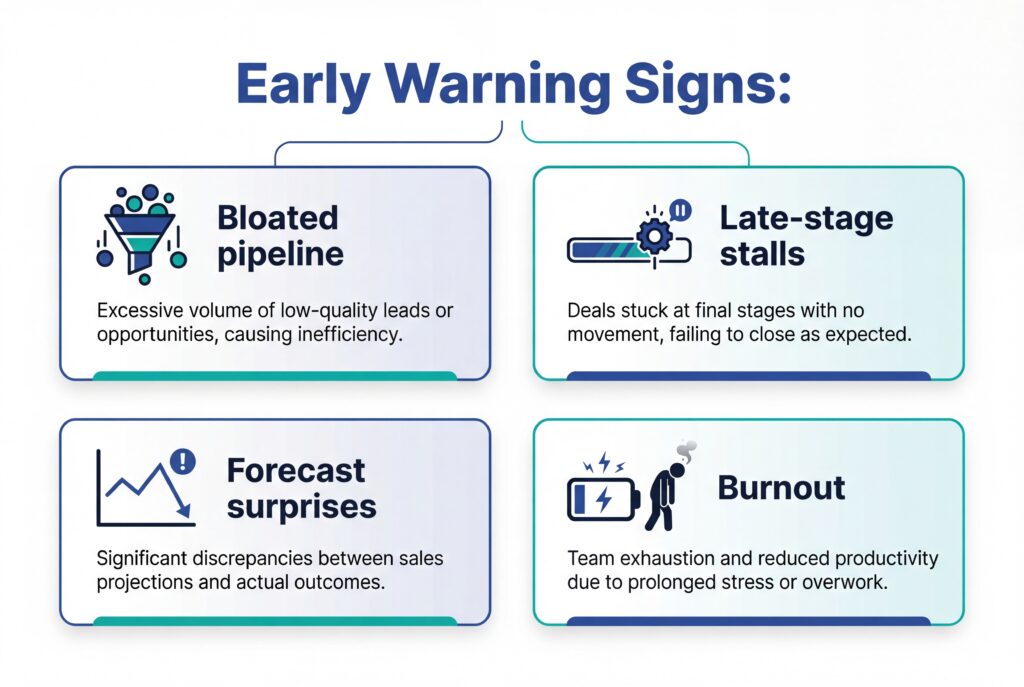
When you see these, look at roles before headcount.
Process or Headcount?
More people rarely fix broken structure.
👉 Clear ownership often does.
Measuring Role Effectiveness
Metrics should match responsibility.
Role-Specific Indicators
- SDRs: qualified pipeline creation
- AEs: win rate, cycle time, deal quality
- Managers: team attainment, forecast accuracy
- Enablement: ramp time, adoption
- Ops: data integrity, friction reduction
If everyone is measured on everything, no one is accountable.
Frequently Asked Questions
What does a sales team do?
A sales team converts qualified demand into revenue by managing opportunities through a defined process. Beyond closing deals, the sales department is responsible for pipeline quality, deal progression, and producing reliable revenue signals the business can forecast against.
How do sales team roles change as a company scales?
Sales team roles shift from generalists to specialists as volume and complexity increase. Early-stage teams rely on flexible sales team members, while scaling organizations require clear separation between prospecting, closing, enablement, and operations to maintain execution discipline.
What are the most important sales team roles in a modern sales department?
The core sales team roles typically include SDRs or BDRs, Account Executives, Sales Managers, and Sales Operations. As the sales department matures, sales enablement team roles and revenue operations become critical to improving consistency, ramp time, and forecast accuracy.
How do you know if your sales team structure is wrong?
Warning signs include stalled deals, inconsistent pipeline quality, forecast misses, and sales team members routinely doing work outside their role. When responsibilities overlap or shift informally, the sales team loses clarity and execution becomes unpredictable.
Conclusion
Sales team roles and responsibilities decide whether growth feels controlled or chaotic.
When ownership is clear, deals move, forecasts tighten, and leaders can see what’s working. When roles blur, teams compensate with effort instead of execution, and results start to wobble.
The strongest sales departments don’t win by adding more people. They win by defining who owns what, enforcing handoffs, and designing structure around how revenue flows at each stage. That clarity compounds – it shows up in ramp time, pipeline quality, and confidence in the number.
To make your sales team roles and responsibilities work in practice, start a free trial of EnableU. Our platform helps you design and validate sales structure using execution data, modeling team size, span of control, and reporting lines so roles stay clear, teams stay balanced, and growth stays controlled.
Leave a Reply