There’s a moment every GTM team hits where activity is high but progress feels uneven.
Leads come in, deals move, meetings stack up, yet it’s hard to explain why some things work and others stall. That’s usually the signal that strategy exists, but execution doesn’t line up.
We’ll break down what a SaaS go-to-market strategy looks like when it’s built to be run & cover the core decisions, models, and mechanics that turn GTM from a plan into a repeatable system.
Key Notes
- Strong SaaS GTM starts with narrow ICP definition and explicit anti-ICP disqualification rules.
- Positioning only works when one vocabulary and proof-led messaging are enforced across teams.
- Channel and sales motions must align with ACV, buyer behavior, and time-to-value realities.
The Problem: “We Have a Product, But Growth Is Random”
The most common GTM moment is not a dramatic collapse, but a quiet drift.
- The homepage says one thing.
- The sales deck says another.
- Reps improvise discovery because the “playbook” is a folder.
- Forecast changes every week because your stages are vibes.
This is not a marketing problem. And it’s not a sales problem. It is a system problem.
👉 Where The GTM Strategy Framework Steps In
A go to market strategy framework exists to solve the coordination problem. It is the connective tissue between product, marketing, sales, and customer success.
If the strategy is real, three things become true:
- You can explain who you are for in one breath.
- You can explain why you win in one sentence.
- You can point to a repeatable path from first touch to renewal.
If any of those are missing, you are building pipeline on sand.
What Does Great GTM Look Like?
GTM Is An Operating System, Not A Launch Plan
A launch plan is a calendar.
A SaaS go to market strategy is a model for growth that gets revisited and refined as you learn.
It forces decisions that most teams avoid:
- Which segment do we say no to this quarter?
- What do we stop doing if conversion drops?
- What do we require before a deal advances?
- What proof do we need before we hire the next rep?
That last one matters.
Most early teams hire to feel momentum. Great teams hire to scale a repeatable motion.
What Outcomes Look Like When GTM Is Tight
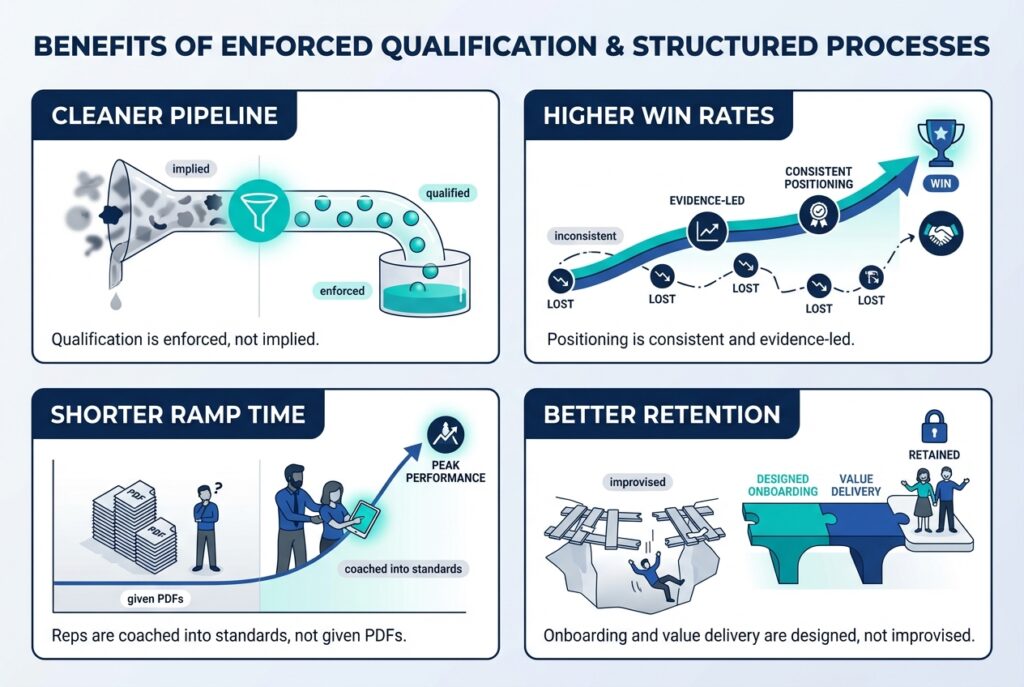
A strong GTM does not just increase lead flow; it also makes execution predictable.
You should see:
A Practical GTM Strategy Framework
Here is your founder-friendly go to market strategy for SaaS products framework that covers all bases without mixing concepts:
- WHO you are for (market definition and ICP)
- WHAT you promise (positioning, value, and messaging)
- HOW YOU REACH them (channels and demand model)
- HOW YOU WIN (sales motion, conversion, monetization)
- HOW YOU KEEP AND GROW (retention and expansion)
WHO: Market definition and ICP (bullseye customer)
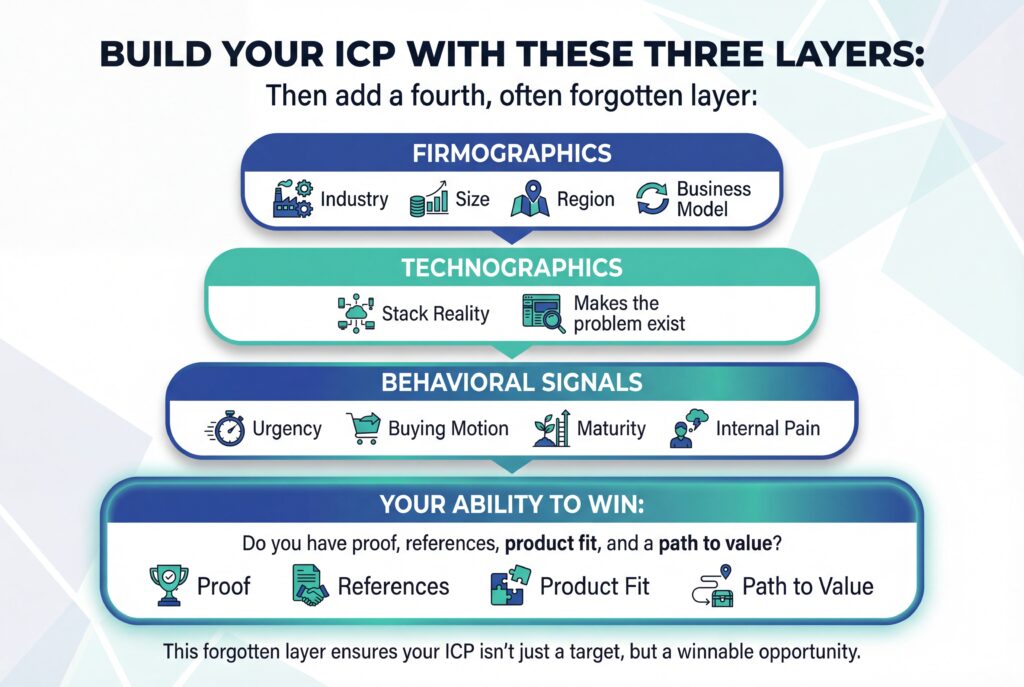
The fastest way to waste a year is a broad ICP. Early-stage SaaS teams want optionality, so it’s common to keep the ICP wide to avoid missing revenue.
What happens next is predictable:
- Messaging becomes generic.
- Sales learns five different use cases.
- Demos become feature tours.
- Retention becomes a coin flip.
A useful ICP is not “companies 50 to 500 employees.” That is a directory. A useful ICP is a bet that creates focus.
Anti-ICP Is Mandatory
If you do not define who you will not sell to, your team will do it for you in the messiest way possible. Usually through churn.
A simple anti-ICP filter:
- If onboarding requires custom services you cannot scale
- If the buyer cannot access the data you need to deliver value
- If there is no clear economic owner
- If time-to-value is inherently long and you cannot bridge it
Validation plan:
- Run 10 to 15 customer interviews across your top 2 segments
- Pull win-loss notes and tag patterns in why you win and why you lose
- Look for signals of pull: referrals, inbound intent, repeat use cases
If you are pre-PMF, treat ICP as a hypothesis that evolves quickly.
If you are post-PMF, formalize it and enforce it.
WHAT: Positioning, value prop, messaging
Positioning is not copywriting. It is a decision.
A common failure mode here is inconsistent terminology across touchpoints.
It sounds small, but it’s really not. If your homepage says “revenue leakage” and the deck says “sales gaps,” you are forcing the buyer to do translation work (…they will not).
A strong value proposition has four parts:
- The audience (specific)
- The problem (real, costly)
- The outcome (measurable)
- The differentiation (why you, not alternatives)
Example structure:
For [ICP], we [deliver outcome] by [mechanism]. Unlike [alternative], we [differentiation].
Messaging Pillars Should Be Proof-Led
It’s common for teams to write three benefit pillars and stop there, but you should attach proof types to each pillar:
- Operational proof (what changes in the workflow)
- Customer proof (a quote, a metric, a story)
- Product proof (a mechanic, not a feature list)
Make Positioning A Team Sport
When sales and marketing build messaging separately, conversions drop and both sides blame each other. The root cause is lack of unified positioning.
The fix is simple:
- One positioning doc
- One message map by persona
- One vocabulary
Then enforce it in every asset and conversation.
HOW YOU REACH: Channels & demand model
Channel strategy is where teams accidentally become “busy.” They try to run SEO, paid, outbound, partnerships, webinars, and communities at the same time.
It looks like ambition.
But it’s usually dilution.
Early-stage teams should focus on a few channels where the ICP congregates, rather than trying to be everywhere.
Pick your primary demand model:
- Inbound-led (content, SEO, community, brand)
- Outbound-led (targeted accounts, sequences, direct outreach)
- Product-led (trial or freemium, product as funnel)
- Partner-led (ecosystems, marketplaces, integrators)
Most B2B SaaS ends up blended, but you still need a primary model.
Here Is A Practical Way To Choose Channels:
| Channel | Why It Fits This ICP | Success Metric You Will Watch |
| SEO / Content | Buyer searches for problem and solutions | Non-branded signups, demo rate, CAC trend |
| Outbound | Targeted buyers are hard to reach via search | Meetings per 100 accounts, opp creation |
| Partnerships | ICP already buys via trusted vendors | Partner-sourced pipeline, win rate |
The key is to focus on the second column – “everyone does it” is not a reason.
Inbound Vs Outbound Is Not Ideology
Outbound often works early because it is controllable and teaches you fast. Inbound often wins later because it compounds.
If your outbound is not working, it is usually not the channel, but the message.
HOW YOU WIN: Sales motion, conversion & monetization
Your GTM strategy needs to define the mechanics of conversion.
👉 Start with the customer journey, not your funnel stages.
Define the moments the buyer goes through:
- Problem recognition
- Internal alignment
- Evaluation
- Decision
- Implementation
Then map your funnel stages to those moments, with owners.
Stage Exit Criteria Matters More Than Stage Names
If your CRM stages are not tied to buyer behavior, forecasting becomes hope.
A simple example of behavior-based criteria:
- Discovery complete means you have a quantified problem and a defined economic owner.
- Evaluation means mutual plan exists and key stakeholders have engaged.
- Commit means procurement path is known and timeline is agreed.
You can adapt this to MEDDIC-style discipline, but the principle is universal.
Monetization Choices Are GTM Choices
Pricing and packaging are not finance decisions. They determine your motion.
- If you price low but sell high-touch, CAC will crush you.
- If you price high but offer no path to early value, sales cycles will drag.
A rule of thumb:
- Lower ACV and short time-to-value supports self-serve or product-led entry
- Higher ACV and higher complexity supports sales-assisted conversion
Competitive Differentiation Must Show Up In Sales
If you cannot explain why you win deals beyond “better product,” you will lose to inertia.
Build a simple competitor table internally:
| Competitor | Their Claim | Where They Win | Where You Win |
| X | “All-in-one” | breadth | speed to value |
| Y | “Enterprise-grade” | brand trust | flexibility |
That table becomes enablement.
HOW YOU KEEP AND GROW: Retention & expansion strategy
Retention is not customer success “doing their job.”
Retention is a GTM decision. If you sell a promise you cannot deliver quickly, churn is not a surprise. It is design.
Retention Starts At Onboarding
Time-to-value is one of the most honest signals you have. If customers get to an outcome quickly, they stick. If they do not, churn becomes predictable.
Design your onboarding around a single outcome:
- What is the first measurable win they can achieve in 7 to 14 days?
- What must be true in their environment to reach it?
- Where do customers typically stall?
Then operationalize interventions:
- If usage drops in the first month, treat it as a churn leading indicator and intervene early.
Expansion Should Be Trigger-based
Seat growth, usage thresholds, new departments, new pain.
If expansion is only “CS asks for more money at renewal,” you are leaving revenue on the table.
Choosing GTM Models (& When To Switch)
There is no ‘best’ GTM model. There is only fit.
Product-led growth (PLG)
PLG works when:
- Time-to-value is short
- The product can be experienced without heavy setup
- The buyer can start small and expand later
PLG requires operational excellence:
- Onboarding that drives activation
- Product-qualified lead definitions
- Lifecycle messaging tied to product behavior
The trap is assuming PLG means “no sales.” It often becomes product-led entry with sales assist for larger accounts.
Sales-led (sales-assisted)
Sales-led fits when:
- The deal requires multiple stakeholders
- The customer needs confidence, not just features
- Pricing is high enough to justify human involvement
Sales-led also requires discipline. If reps wing it, you get inconsistent messaging and noisy pipeline.
Hybrid motions (PLG + sales)
Hybrid is common and powerful, but it needs rules.
When does sales engage?
Examples of handoff triggers:
- Usage threshold reached but no upgrade
- Multiple users from one domain
- High-intent behavior (pricing page visits, integration setup)
Partner-led
Partner-led is great when:
- Your ICP buys through existing trust networks
- You fit naturally into a broader solution
Partner-led is also slow to build. Do not start here because you do not want to do outbound.
The SaaS GTM Playbook: Turning Strategy Into Daily Execution
Here is the uncomfortable truth: Most GTM strategies are correct. They still fail because nobody executes them consistently.
A SaaS GTM playbook is not a document you write once. It is a set of execution standards that show up in daily work.
Build The Repeatable Revenue Path
A repeatable path is:
- One ICP
- One primary use case
- One dominant value narrative
- One conversion motion
The Minimum Viable GTM Team (By Stage)
A practical stage view:
- Founder-led sales: You are learning. The “process” is your learning loop.
- First reps: You are standardizing. You need repeatable messaging and stage criteria.
- Scaling: You are enforcing. You need enablement and coaching in the workflow.
The risk is hiring ahead of clarity. When you hire sales into unclear positioning, the reps will create their own story. Then you will spend months unlearning it.
Sales Process Standards (Not Scripts)
Scripts do not scale. Standards do.
Three standards that matter early:
- Discovery must quantify pain and impact
- Stakeholders must be mapped and engaged
- Next steps must be mutual and dated
If you do not enforce these, your forecast is a narrative.
Measurement: GTM Metrics That Diagnose Problems
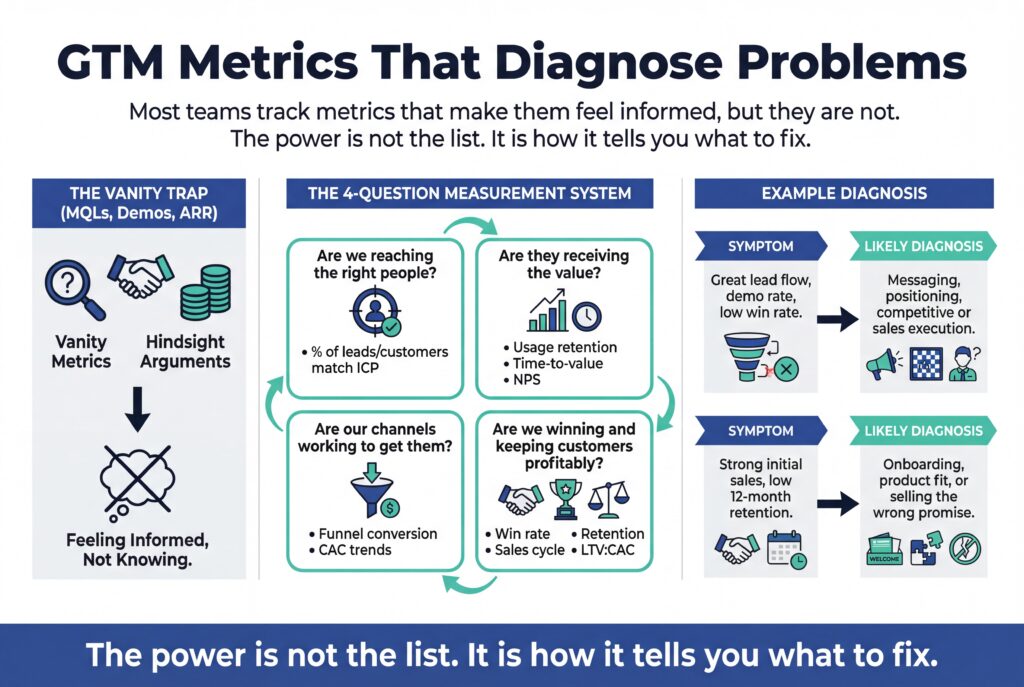
Leading vs Lagging Indicators
Lagging indicators tell you what happened.
Leading indicators let you course-correct.
A lightweight dashboard split:
- Leading: signups per week, activation %, pipeline created, meetings booked
- Lagging: new ARR, churn %, NDR, CAC payback
If you are early stage, do not overcomplicate this – count what matters, segment it, learn fast.
Common GTM Failure Patterns (& How To Prevent Them)
ICP Drift
You keep saying yes to “close” revenue. You lose focus. Your message gets generic.
Prevention: Anti-ICP rules and deal qualification standards.
Message Drift
Marketing tests new language. Sales keeps old language. Product uses different language.
Prevention: One vocabulary, one narrative, enforced across assets.
Channel Sprawl
You add channels before you have conversion.
Prevention: Commit to 2 to 3 channels, instrument them, earn the right to add more.
Motion Mismatch
Your pricing implies self-serve, but your process requires five calls.
Prevention: Align monetization and motion. If you need high-touch, price for it.
Playbook Rot
You write a playbook. Nobody uses it.
Prevention: Make it show up in the workflow, with coaching and inspection.
How EnableU Helps Teams Operationalize GTM
A GTM strategy is only valuable if it turns into repeatable execution. EnableU exists to close that execution gap.
The product mechanic is straightforward:
- Upload your frameworks, content, and playbooks
- Translate them into real-time guidance in the flow of work
- Capture signals from execution
- Feed insights back into coaching and improvement loops
This matters because “enablement” alone is not enough. You need playbook enforcement and methodology adherence.
Not once a quarter. Every day.
What If GTM Ran Itself?
Enforce playbooks, coach in-flow, fix execution gaps.
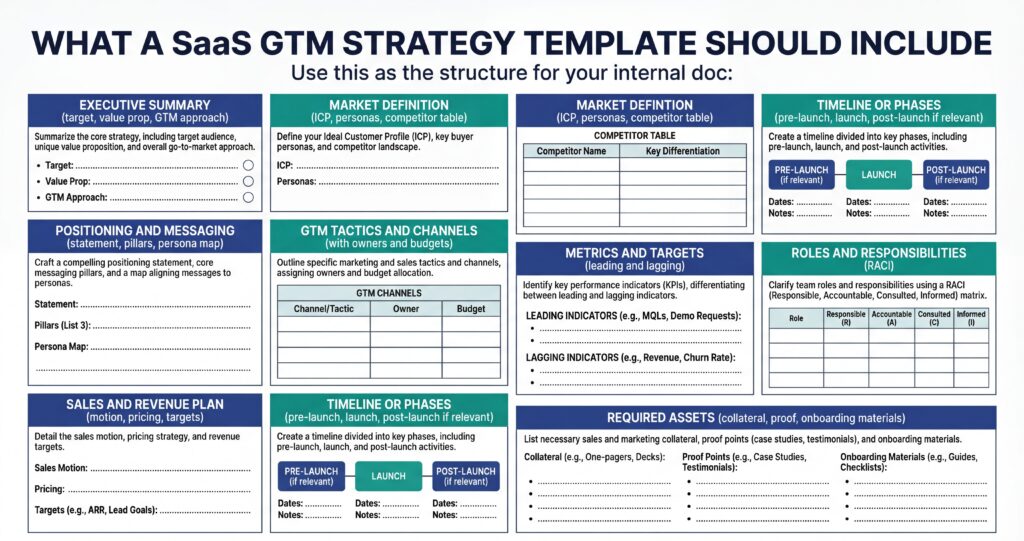
What A SaaS GTM Strategy Template Should Include
Use this as the structure for your internal doc:
- Executive summary (target, value prop, GTM approach)
- Market definition (ICP, personas, competitor table)
- Positioning and messaging (statement, pillars, persona map)
- GTM tactics and channels (with owners and budgets)
- Sales and revenue plan (motion, pricing, targets)
- Timeline or phases (pre-launch, launch, post-launch if relevant)
- Metrics and targets (leading and lagging)
- Roles and responsibilities (RACI)
- Required assets (collateral, proof, onboarding materials)
👉 or save this image and use it as your worksheet:
Frequently Asked Questions
What is a good go-to-market strategy for SaaS companies?
A good go-to-market strategy for SaaS is one that creates repeatable revenue, not just initial traction. It clearly defines the ICP, sales motion, and channels, then enforces those choices through execution standards, metrics, and feedback loops.
How is a SaaS go-to-market strategy different from a SaaS marketing plan?
A SaaS marketing plan focuses on demand generation tactics. A SaaS go-to-market strategy is broader. It aligns marketing, sales, product, and customer success around a shared revenue model, including positioning, pricing, sales motion, and retention.
Do go-to-market strategies differ for different SaaS products?
Yes. Go-to-market strategy for SaaS products depends heavily on complexity, ACV, time-to-value, and buyer behavior. A self-serve developer tool and an enterprise workflow platform require very different GTM models, messaging, and sales involvement.
When should a SaaS company revisit its GTM strategy?
You should revisit your SaaS GTM strategy when conversion rates stall, churn rises, sales cycles lengthen, or ICP drift appears. Most teams wait too long. GTM should be reviewed any time the product, market, or growth stage materially changes.
Conclusion
A strong SaaS go-to-market strategy is not a slide deck or a launch checklist.
It is a set of hard choices made visible in daily execution. Who you sell to. What you promise. Which channels matter. How deals actually move forward. How customers get value fast and grow with you.
When those pieces are clear and enforced, growth stops feeling random and starts feeling explainable.
If you want to see what this looks like in practice, start a free trial of EnableU’s Sales Excellence Framework. Turn your GTM decisions into guided execution across the eight pillars and see how strategy holds up when real deals are on the line.
Leave a Reply