Going to market has a way of exposing the cracks. The pitch sounds solid, interest shows up, and then momentum fades for reasons no dashboard explains.
Some teams push harder. Others stall.
The difference usually isn’t effort or ambition. It’s readiness.
We’ll break down what GTM readiness looks like, how to assess it honestly, and how to use a practical GTM checklist to decide what to fix before you scale.
Key Notes
- GTM readiness depends on six execution pillars, not market demand alone.
- Weak ICP definition and time-to-value failures cause most early GTM breakdowns.
- Predictable GTM comes from enforced process, clear signals, and disciplined operating cadence.
What Does GTM Readiness Mean?
GTM readiness answers one question: Can this business generate revenue predictably without heroics?
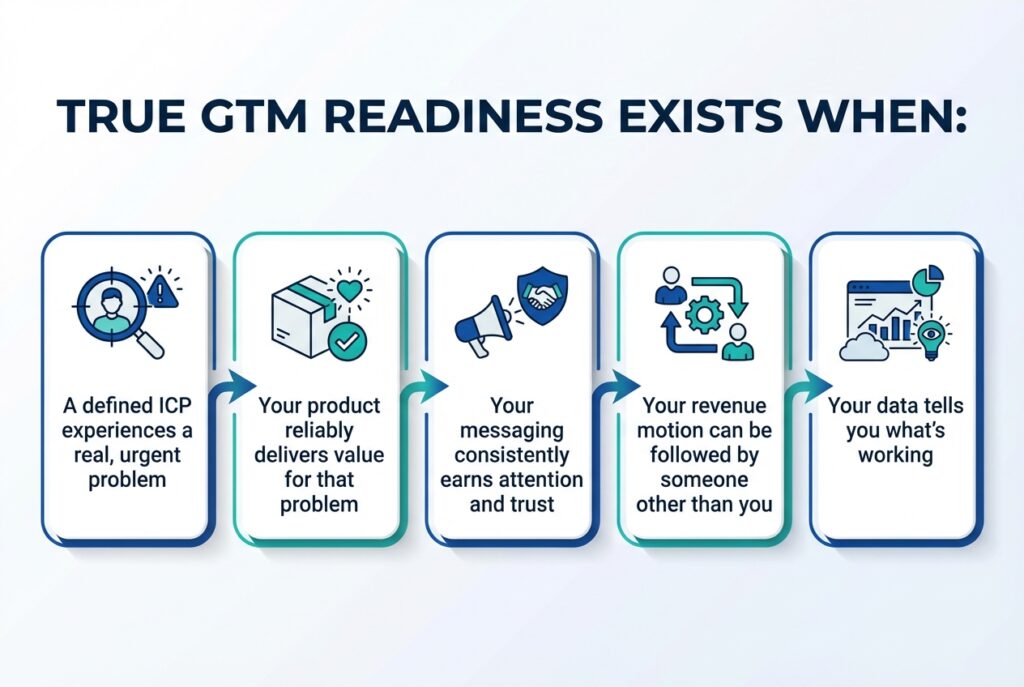
Market readiness and GTM readiness are related, but not identical:
- Market readiness is about timing and demand.
- GTM readiness is about execution.
Many startups get the first one right and collapse on the second. Think of GTM readiness as the starting line for scale. Not the finish.
The 6 Pillars of GTM Readiness
Together, these six pillars cover the full readiness surface area.
Individually, each one can quietly kill momentum if it’s weak.
- Market readiness
- ICP readiness
- Product readiness
- Messaging and positioning readiness
- Revenue motion readiness
- Operations and data readiness
You don’t need all six to be perfect, but you do need to know which ones are fragile before you accelerate.
Market Readiness: Can This Win Now?
A big market is not the same thing as a ready market.
Market readiness is about urgency, rather than size. It asks whether a meaningful group of buyers is actively trying to solve this problem today, with budget and consequences attached.
What Market Readiness Looks Like In Practice
Ready markets share a few traits:
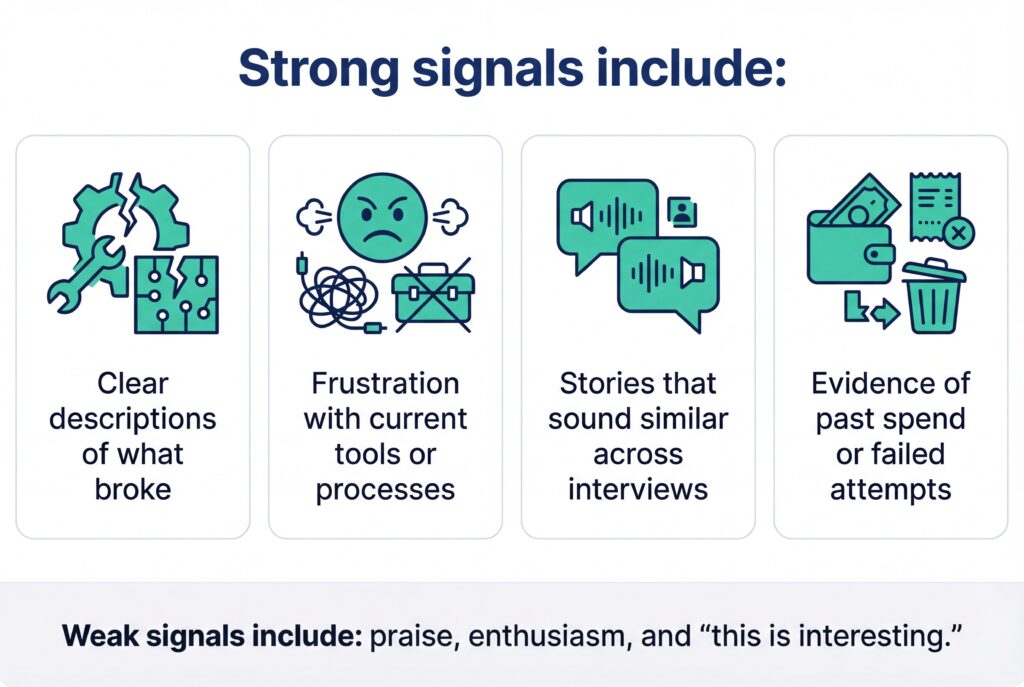
- The problem already costs money, time, risk, or reputation
- Buyers can name the pain without coaching
- There is an existing budget or workaround in place
- Something triggers action, not just interest
If conversations stay theoretical, the market is not ready. Curiosity is cheap. Urgency is rare.
How To Validate Market Readiness Quickly
Forget surveys. Talk to people who recently tried to solve the problem.
New Category vs Crowded Category
Both can work. They just demand different readiness.
- New categories require education, patience, and capital. Sales cycles are longer. Proof is harder. Positioning does more work.
- Crowded categories demand sharper differentiation. Buyers compare fast. Pricing pressure is real. Execution discipline matters more than vision.
Founders get into trouble when they assume one and operate like the other.
ICP Readiness: Do You Know Who This Is Really For?
Most GTM breakdowns start here.
An ICP that’s too broad feels safe. It also destroys learning. When everyone is a potential buyer, every loss has a different reason. Patterns never form.
What ICP Readiness Really Means
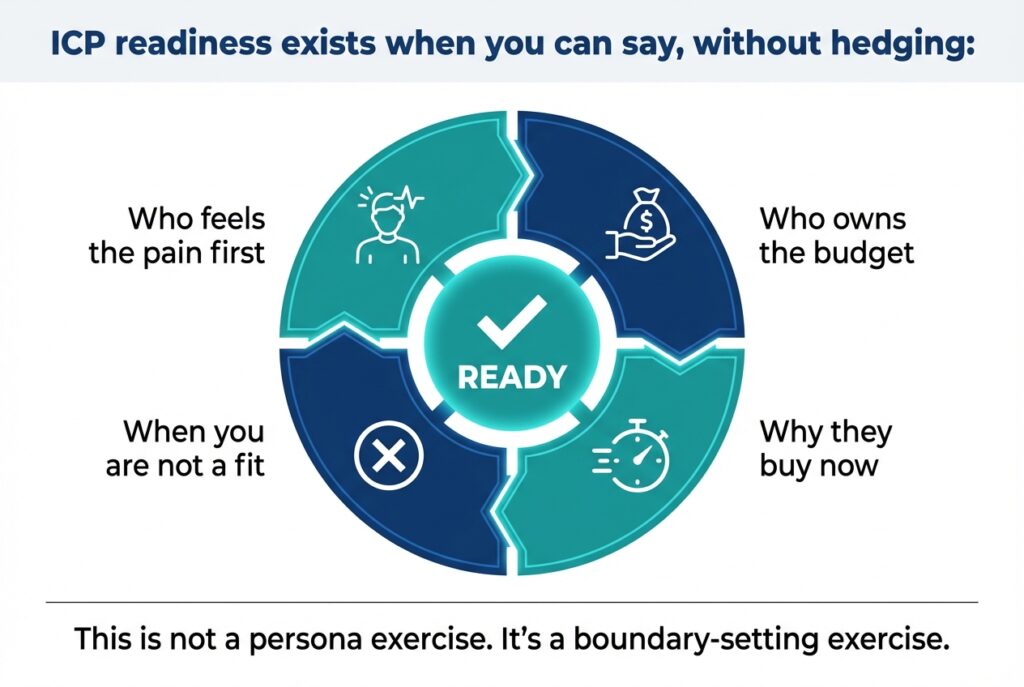
The Beachhead Principle
Early GTM needs a beachhead. One narrow segment where:
- The problem is acute
- The buying process is similar
- The value delivered is obvious
Expansion comes later. Precision comes first.
Red Flags That Signal Weak ICP Readiness
- “We sell to SMBs and enterprise” 🔴
- “Any company with sales” 🔴
- “Multiple verticals from day one” 🔴
- “We’re still figuring that out” 🔴
These aren’t neutral statements. They are warning signs.
Strong ICPs create focus.
Weak ones create noise.
Product Readiness: Can You Deliver Value Without Constant Intervention?
A product can be impressive and still not GTM-ready. Product readiness is not about feature count, but about reliable value delivery for a specific use case.
Minimum Product Readiness For GTM
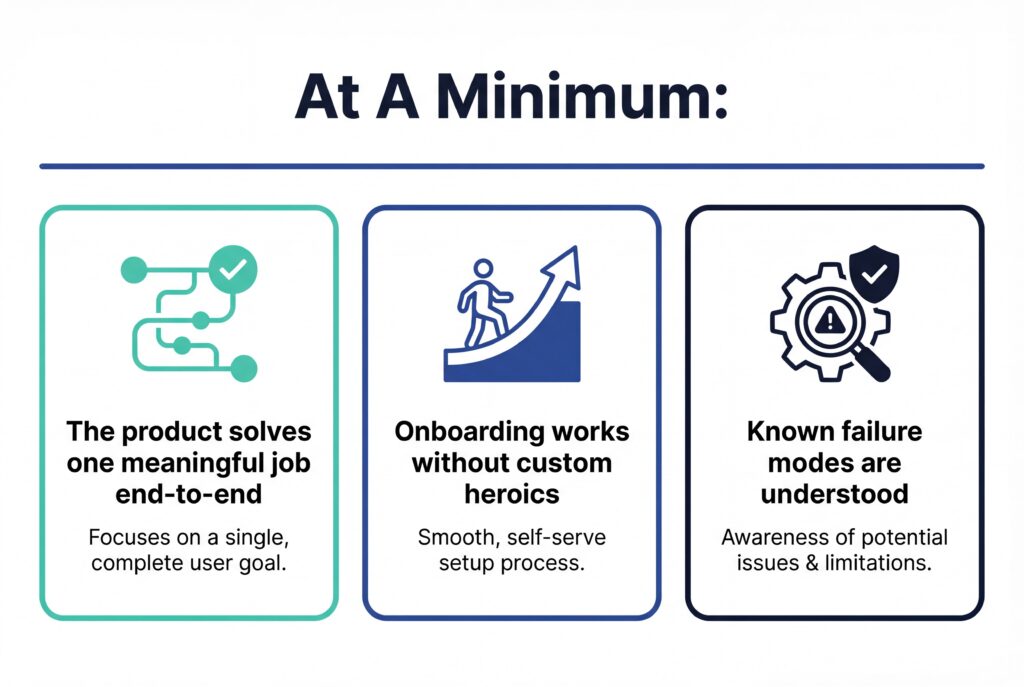
If every deal requires bespoke setup or deep founder involvement, GTM is premature.
Time-To-value Matters More Than Feature Depth
Early buyers are not looking for completeness. They are looking for relief.
If time-to-value is unclear, GTM stalls. Deals stretch. Churn spikes. Support gets overwhelmed.
Define time-to-value explicitly, then design backward from it.
What Happens When GTM Outruns Product Readiness
- Customers churn before value is realized
- Feedback becomes contradictory
- The roadmap turns reactive
- Reputation damage spreads quietly
The cost shows up later, but it compounds.
Messaging & Positioning Readiness: Does Your Story Hold Up Under Pressure?
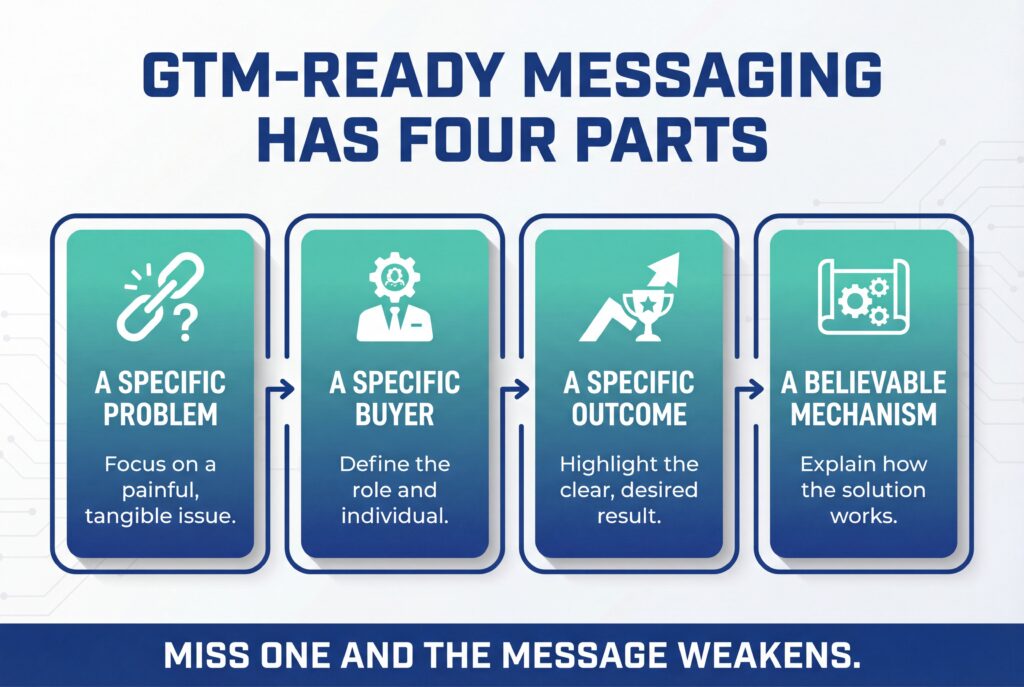
Messaging isn’t copy. It’s compression. It forces clarity about what you do, who it’s for, and why it matters right now.
Positioning Requires Tradeoffs
Positioning means choosing what you are not.
If your message tries to appeal to everyone, it resonates with no one. Buyers compare you to the alternatives they already know. If you don’t frame that comparison, they will.
How To Validate Messaging Readiness
Watch what happens in real conversations:
- Where prospects lean in
- Where they get confused
- Where objections cluster
Strong messaging reduces explanation.
Weak messaging increases it.
Revenue Motion Readiness: How Does Money Get Made?
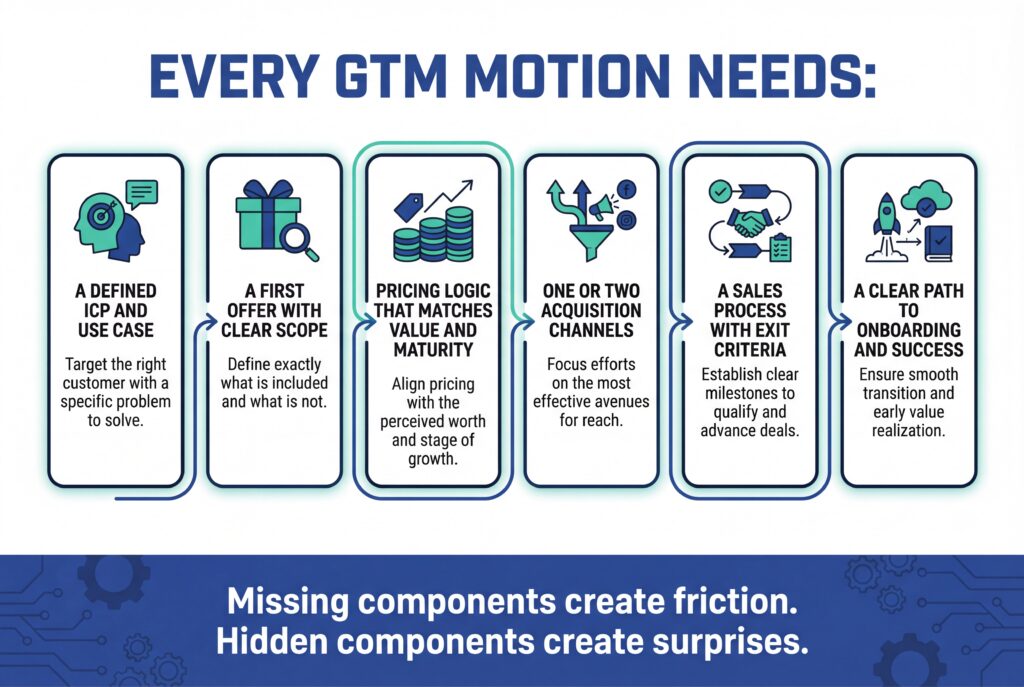
“Doing GTM” is not a strategy. Revenue motion readiness means your go to market strategy components are defined, intentional, and matched to your stage.
Choose One Primary Motion
- Founder-led sales
- Product-led motion
- Partner-led motion
Each requires different readiness. Trying to run multiple at once usually means none of them work well.
Core Go To Market Strategy Components
The Danger Of Skipping Process Definition
Without clear stages and standards:
- Forecasts become opinion
- Coaching becomes reactive
- Scale becomes chaotic
Process is not bureaucracy. It’s memory.
Operations & Data Readiness: Can You Learn Without Guessing?
GTM generates data whether you capture it or not. Ops and data readiness determine whether you learn from it or drown in it.
Minimum Instrumentation Before Scaling
You need to see:
- Funnel conversion by stage
- Time-to-value indicators
- Retention and churn reasons
Spreadsheets work early. Blind spots do not.
Operating Cadence Matters More Than Dashboards
Weekly GTM reviews should answer:
- Where deals stall
- Why they stall
- What changed since last week
Monthly reviews should adjust strategy, not rehash activity. Cadence turns data into decisions.
The GTM Readiness Checklist
This is the gating mechanism. If too many boxes are unchecked, do not scale. Fix first.
Market Readiness Checklist
- Buyers express urgency without prompting
- Budget ownership is clear
- Demand signals repeat
ICP Readiness Checklist
- Beachhead ICP defined
- Buying group mapped
- Clear non-fit criteria
Product Readiness Checklist
- Time-to-value defined
- Onboarding repeatable
- Known risks documented
Messaging Readiness Checklist
- Value proposition passes the one-minute test
- Differentiation is explicit
- Objections are anticipated
Revenue Motion Checklist
- One primary GTM motion chosen
- Sales stages and exit criteria defined
- First offer clearly scoped
Ops & Data Checklist
- Funnel tracking in place
- Weekly GTM cadence running
- Accountability is explicit
Common False Green Lights
Founders often scale on the wrong signals:
- A pipeline without qualification
- Logos without retention
- Interest without urgency
- Product praise without adoption
These feel like progress. They aren’t.
A 30-Day Fix Plan If You’re Not Ready
If gaps exist, focus beats speed.
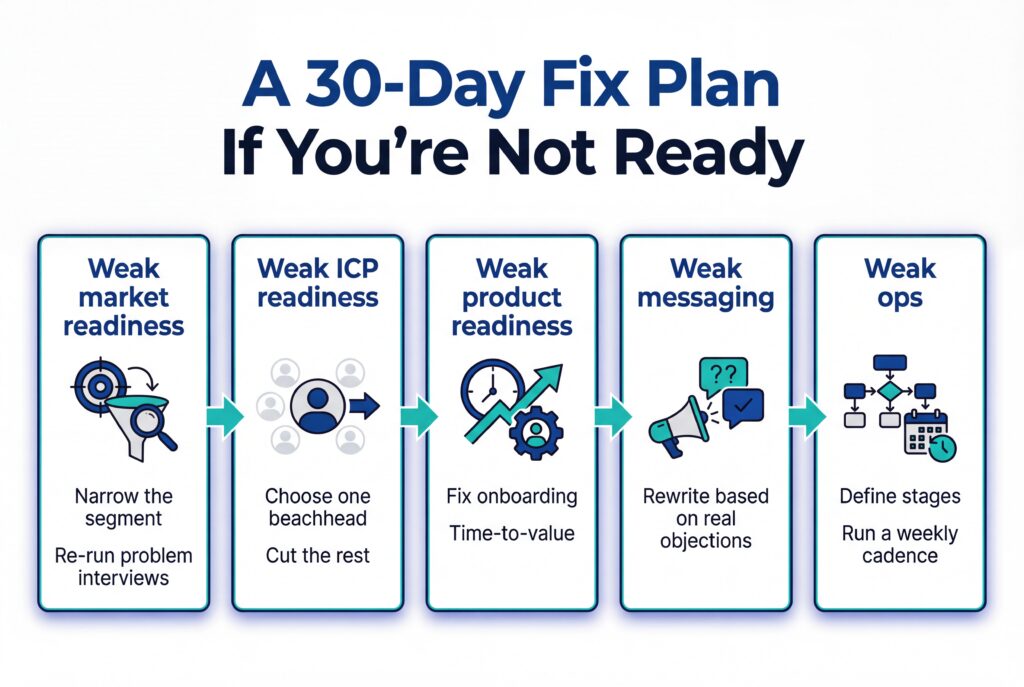
Progress comes from sequence, not hustle.
How EnableU Supports GTM Readiness That Holds
Most GTM failures are executional.
EnableU exists to close that gap. It turns strategy, playbooks, and deal data into real-time guidance so teams execute consistently.
For founders, that means:
- Playbooks that get followed
- Deal coaching that happens before the miss
- Signal-driven insight into what’s breaking
- Forecasts based on behavior, not hope
GTM readiness is not about doing more. It’s about making execution predictable.
Frequently Asked Questions
What’s the difference between GTM readiness and market readiness?
Market readiness asks whether buyers exist and care now. GTM readiness asks whether your company can consistently acquire, close, and retain those buyers without founder heroics. You can have one without the other. Only GTM readiness supports scale.
Is there a difference between a GTM checklist and a go to market strategy checklist?
Yes. A GTM checklist validates whether prerequisites are in place. A go to market strategy checklist evaluates how you plan to execute. One prevents premature launches. The other shapes how you move once readiness is confirmed.
How does a product go to market checklist differ for early-stage startups?
Early-stage product go to market checklists prioritize time-to-value, onboarding reliability, and narrow ICP fit. Advanced concerns like expansion plays or multi-channel orchestration come later. Readiness is about sequence, not completeness.
When should founders revisit GTM readiness after launch?
Any time the ICP, pricing, or revenue motion changes. GTM readiness is not a one-time milestone. It should be reassessed before hiring, entering new markets, or increasing spend across acquisition channels.
Conclusion
GTM readiness is not a launch decision. It’s an execution decision.
The difference between momentum and stall lives in the gaps between market demand, ICP clarity, product delivery, messaging discipline, revenue motion, and operational follow-through.
Miss one, and learning slows. Miss several, and scale turns into noise.
If you want to see how GTM readiness holds up in practice, start a free trial of EnableU’s Sales Excellence Framework and see how our eight pillars turn strategy and deal data into daily execution signals you can run on.
Leave a Reply