AI for GTM is showing up everywhere right now. Some of it is genuinely useful. A lot of it is just fast answers to slow problems.
The difference matters.
We’ll break down what AI does well in go-to-market, where it falls apart, and how teams are using it to bring more discipline into execution.
Key Notes
- AI for GTM creates leverage through signal detection, enforcement, and feedback loops (not content generation alone).
- Execution gains appear before strategy gains when AI is applied in-flow with clear standards.
- GTM performance compounds when AI runs as a closed loop across planning, selling, coaching, and measurement.
What “AI For GTM” Means In Practical Terms
In practical terms, it is using AI to turn GTM inputs (strategy, content, data, signals) into in-flow decisions, actions, and feedback loops.
That definition matters because it changes what you buy and how you deploy.
AI As A Capability, Not A Tool
Leaders get stuck because they think in vendors. Operators think in capabilities. Here are the core capabilities that show up across effective AI for GTM systems:
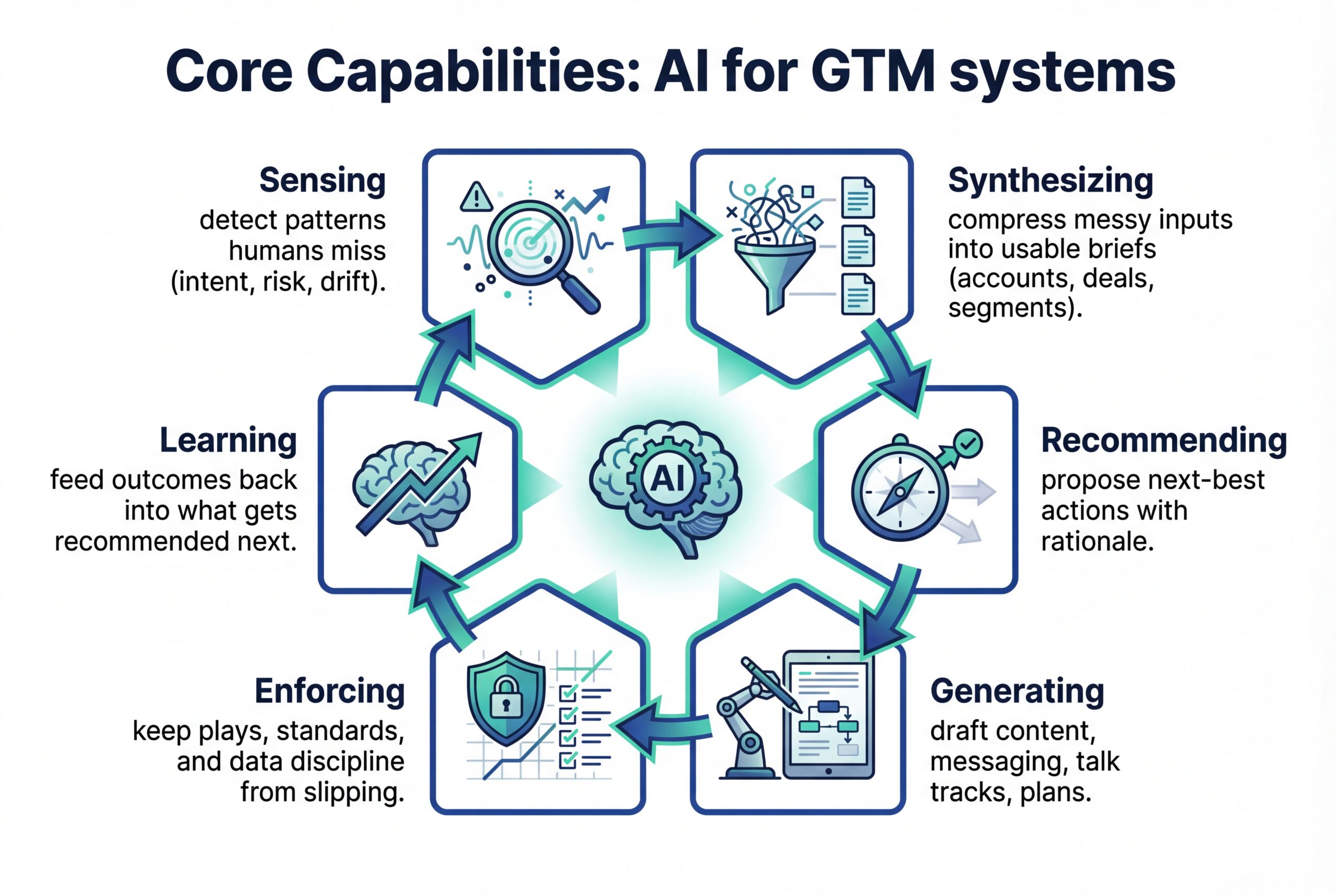
Most teams buy generation first.
It feels productive. But it also creates the fastest path to content spam and internal noise if you do not have the rest.
Strategy vs Execution
AI changes GTM in two different ways:
- Strategy: It tightens your diagnosis and options (better segmentation logic, better competitive patterning, better scenario planning).
- Execution: It reduces variance (better discovery, better follow-up, better coaching, better data).
Most organizations will see ROI in execution first. Strategy value follows once the execution loop produces trustworthy signals.
What AI Is Genuinely Good At Solving In GTM Right Now
Here is where AI earns its keep today, across real revenue teams.
1) Signal-driven prioritization
Human teams are bad at prioritization when everything looks urgent.
AI can help by:
- scoring account and opportunity readiness using multi-source signals
- flagging deal risk earlier based on behavioral patterns, not rep optimism
- identifying which segments are responding, and which are quietly decaying
2) Personalization at scale without losing message discipline
Personalization used to mean adding a first name and an industry sentence. Buyers are numb to that.
AI can help you create contextual relevance when it is grounded in:
- an explicit ICP definition
- a persona-level pain and proof library
- a stage-specific intent model
Done well, your reps stop writing from scratch. They still use judgment, but they start from a strong, compliant draft.
3) Rep and manager leverage
Two bottlenecks show up in every GTM org:
- reps spend too much time on non-selling work
- managers spend too much time preparing for coaching, instead of coaching
AI can help by generating first drafts of:
- account plans
- discovery question sets by persona and stage
- call summaries with decision points and risks
- follow-up emails with real next steps
- coaching notes tied to observed behavior
This is one of the few places where “save time” can mean “make more money,” because it gives selling time back.
4) Data hygiene and shared math
Most forecasts are wrong for boring reasons – stages are vague, fields are empty, next steps are not real, pipeline is padded.
AI can help by:
- spotting missing required behaviors per stage
- auto-populating and standardizing fields from call notes and emails
- flagging inconsistencies between activity, buyer signals, and stage claims
If you want AI to improve forecasting, your first investment is often not a forecasting tool. It is making the process measurable.
Where AI Gets Overhyped/Misapplied In GTM
The fastest way to kill AI adoption is to let it create embarrassment. Here are the common failure patterns:
1) Over-automation that harms trust
If AI writes your outbound and it reads like AI wrote it, you lose twice. You lose the buyer, and you also lose internal confidence in the whole program.
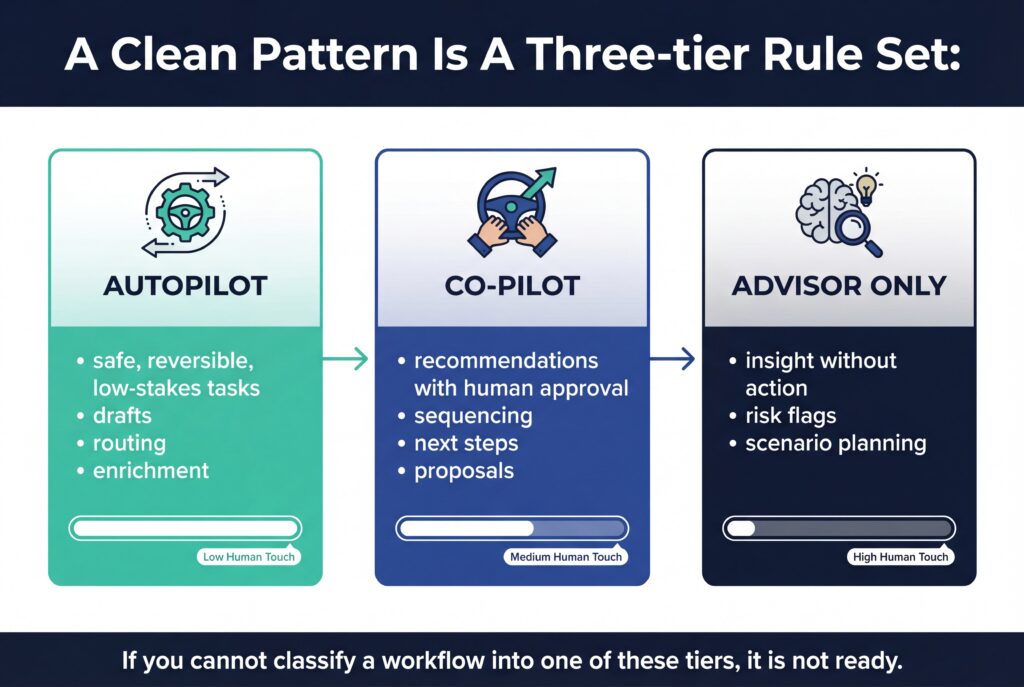
Rule of thumb: automate drafts and recommendations, not commitments.
2) Automating a broken process
AI does not fix your stage definitions.
AI does not fix unclear ICP.
AI does not fix the fact that your team does not follow the playbook.
It just makes the mess faster.
3) Garbage in, garbage out is real
The most common “AI disappointment” is a data disappointment.
- CRM fields mean different things to different managers
- Reps skip updates because it is admin
- Call notes are inconsistent
- Content libraries are bloated and outdated
You cannot model truth on top of opinion.
4) AI insights ignored due to HIPPO
If the model flags risk and the leader says “I have a good feeling,” the model will stop getting used.
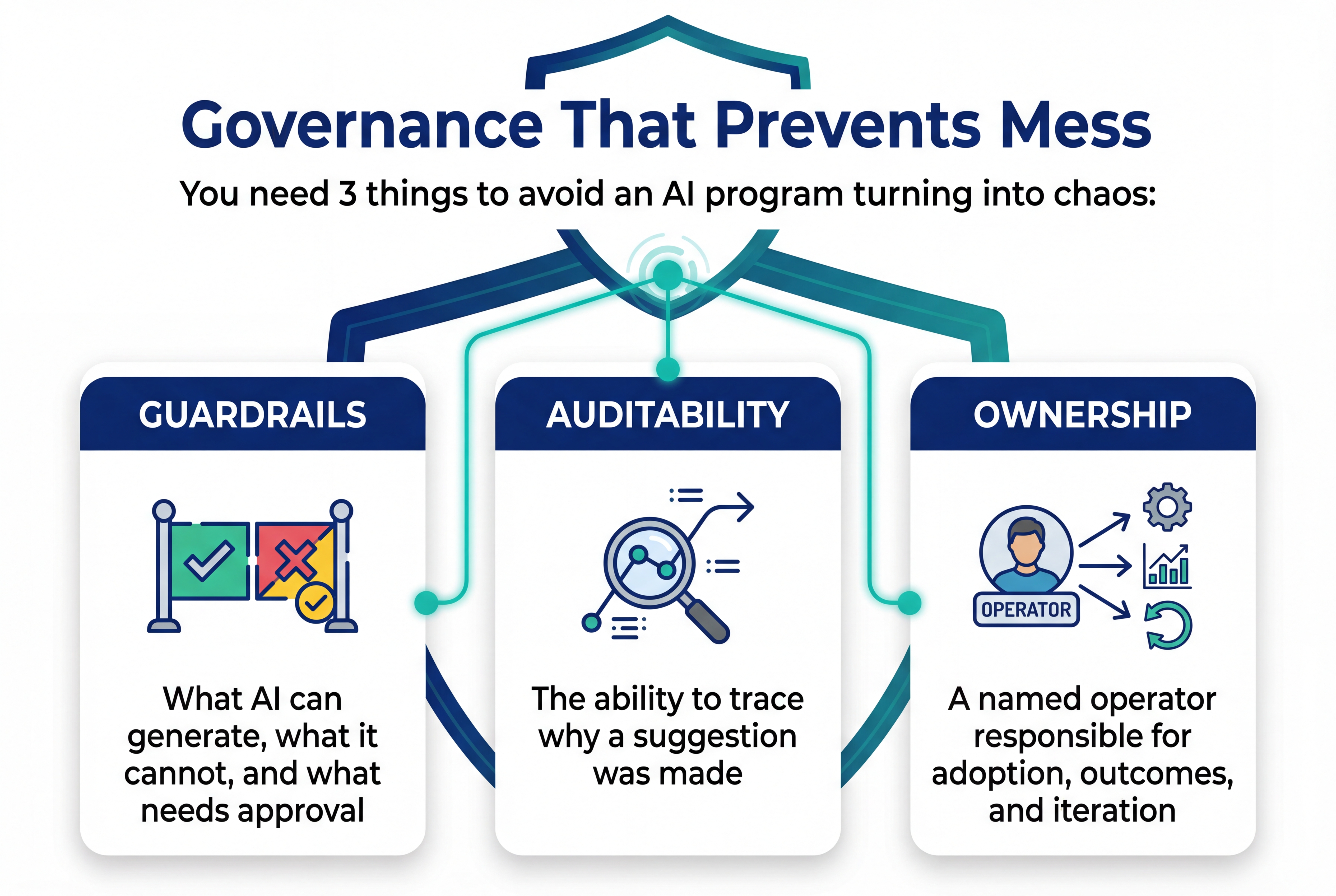
If you want AI to work, you need a governance rule:
- When AI flags a risk, it triggers a review.
- The review can override it.
- But the override needs a reason.
That one move turns AI from “advice” into an operating cadence.
What GTM Tasks Should Never Be Fully Automated?
This is where maturity shows. AI can run parts of the workflow. It should not run the business.
Keep these in a human-controlled lane:
- Commercial judgement: Pricing exceptions, non-standard terms, strategic give-gets
- Executive alignment: Handling conflict, politics, and internal tradeoffs inside the buyer
- Commit decisions: Forecast calls, resource allocation, deal desk approvals
- Customer commitments: Anything that changes what the buyer believes they will get
The Operating Model: Run AI For GTM As A System, Not A Stack
Here is the mistake: teams buy a bunch of tools and then they ask enablement to “drive adoption.”
That is backwards.
AI for GTM works when you run a loop:
- Upload: Strategy, plays, content, data
- Guide: In-flow prompts and recommendations
- Act: Reps and managers execute inside deals
- Learn: The system captures what worked and what did not
- Improve: Plays, messaging, and coaching update based on evidence
This is how you get compounding execution. Without the loop, AI becomes a pile of features.
Measurement: What To Track So AI Improves Revenue
If you track the wrong metrics, AI will optimize the wrong behaviors.
Leading indicators
These measure execution quality.
- Stage conversion rates by segment
- Time in stage
- Next-step adherence (next step with date, not “follow up”)
- Multi-threading coverage (number of buyer roles engaged per deal)
- Discovery quality markers (problem, impact, timeline, decision process captured)
Lagging outcomes
These are board-level.
- Win rate
- Cycle time
- ACV
- Retention and expansion
- Forecast variance
Efficiency unlock
This is where many teams miss the story. AI often pays back by freeing capacity.
Track:
- manager prep hours saved per week
- rep selling time regained
- proposal and follow-up turnaround time
If you do not measure this, the business will treat AI as a nice-to-have.
What Are The Best AI Tools For Sales GTM?
There’s no one ‘best stack’. There’s a best answer to your constraint.
If pipeline is bloated, you need truth and enforcement.
If outbound is noisy, you need messaging control.
If forecasting is vibes, you need observable behaviors and clean signals.
Your Practical Tool Selection Template
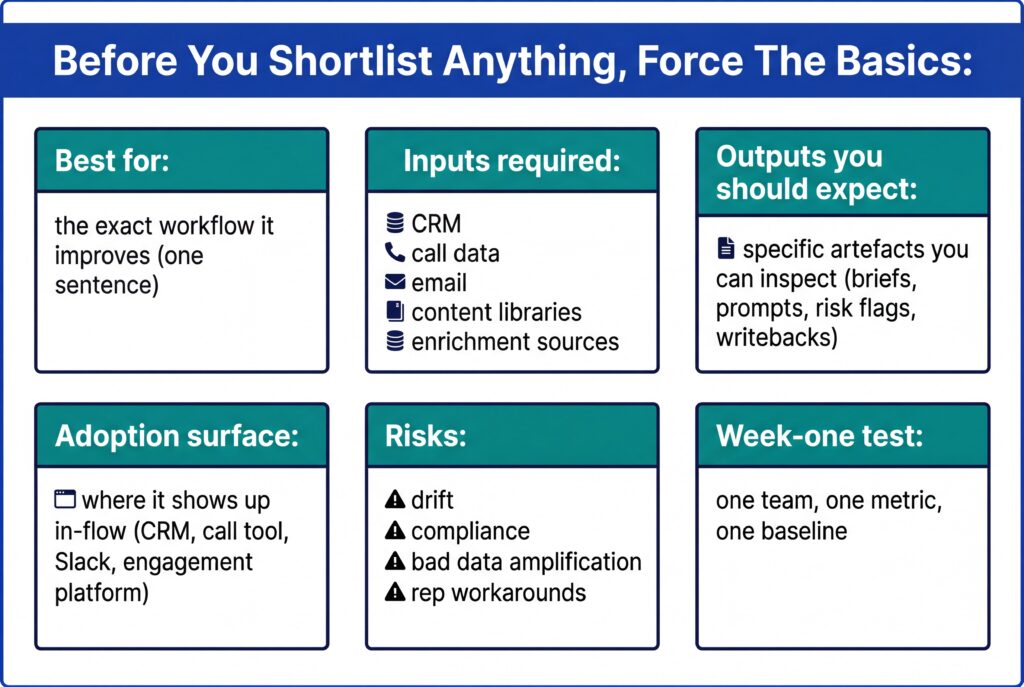
The Only AI for GTM Built for Sales Excellence
We might be biased, but EnableU is the best AI tool for sales GTM when the goal is predictable execution.
Most tools solve a slice: calls, intent, sequences, forecasting. Useful, but incomplete. GTM breaks in the gaps between tools, where process slips and coaching turns into post-mortems.
EnableU is built to close that gap with two connected surfaces:
- Sales Excellence Platform for leaders (standards, enforcement, measurement)
- Deal Pilot for sellers (in-flow buyer intelligence, account planning, messaging, coaching)
EnableU Sales Excellence Platform: The 8 Pillars Explained
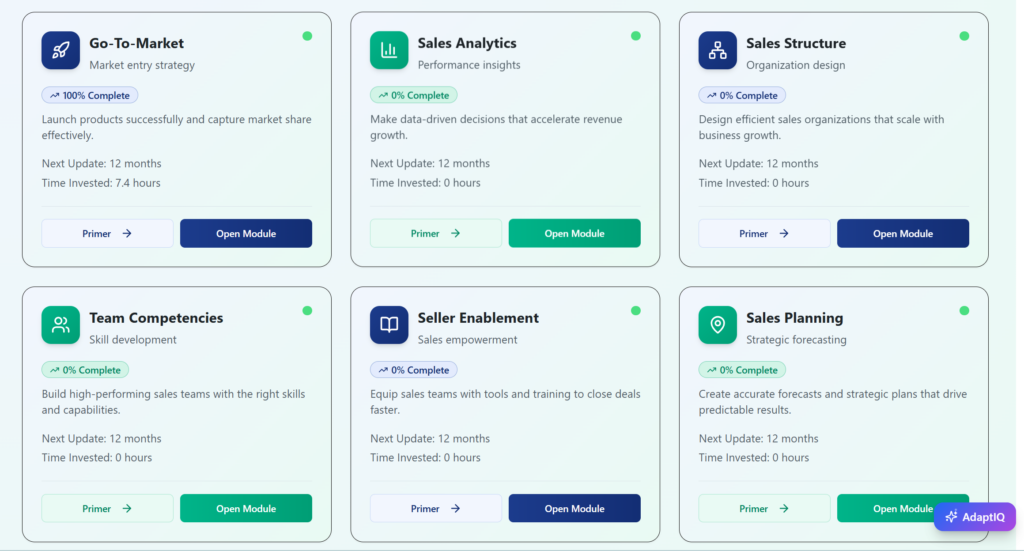
Think of these as the operating layers that decide whether GTM is repeatable or fragile.
- Go-to-Market Strategy. Tightens ICP, positioning, messaging, journey, and motion before you lock quotas.
- Sales Analytics & Insights. Turns leading indicators into usable signals: risk, drift, pattern changes by segment.
- Sales Structure. Territory coverage, span of control, role design. The stuff that quietly wrecks productivity if it’s off.
- Sales Competencies. Objective competency frameworks and skill gap visibility. Not “top rep energy.”
- Seller Enablement. The right content and talk tracks surfaced by persona, stage, and context.
- Sales Planning. Quotas, territories, resources, and targets tied together so changes don’t ripple blindly.
- Customer Success. Health signals, renewal risk, expansion triggers. GTM doesn’t stop at closed-won.
- Compensation. Models comp scenarios that drive the right behaviors while protecting margin.
Deal Pilot: What It Does In The Deal
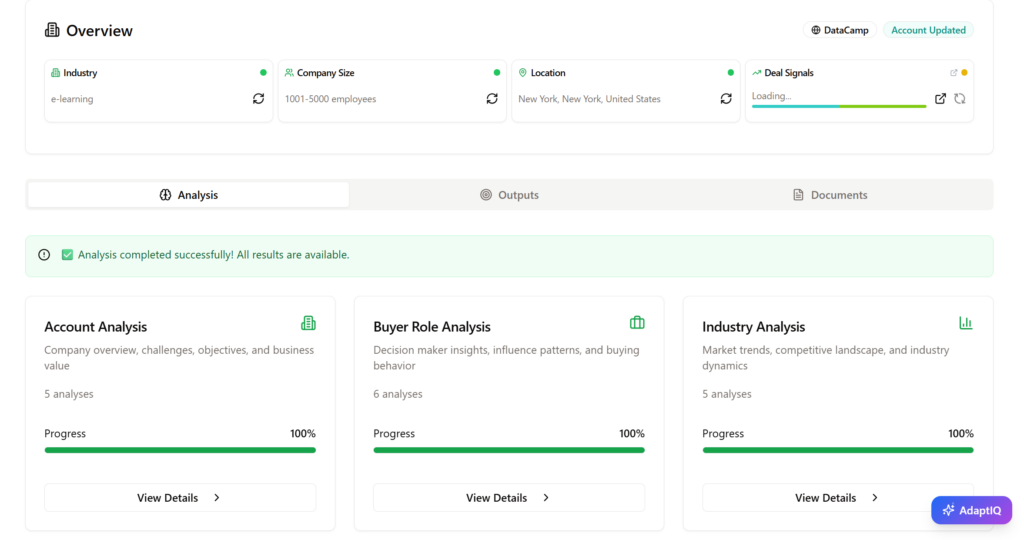
Deal Pilot is built for the work reps actually do, especially the parts that steal time and create inconsistency.
What it delivers, fast:
- Account planning in minutes: Company overview, industry context, buyer role analysis. First draft done.
- Buyer intelligence and signals: Who matters, what they care about, what’s changing, what indicates readiness.
- Discovery support: Questions tailored to persona and stage that get you to real qualification evidence.
- Contextual messaging: Sequences and collateral grounded in your approved story, not generic filler.
- In-call coaching: Prompts and next-best actions during live conversations, not after the deal slips.
The difference is simple: AI that makes outputs vs AI that makes execution predictable.
Implementation Roadmap: From Experiments To Predictable Execution
Phase 1: Foundation
- lock ICP and stage definitions
- clean up the source-of-truth content
- choose the workflows where AI can show value fast
Phase 2: In-flow Guidance
- embed prompts where reps work
- build manager cadence around evidence
- require reasons for overrides
Phase 3: Compounding Loop
- feed outcomes back into plays
- refine messaging based on what wins
- scale across teams or portfolio companies
If you skip Phase 1, Phase 2 becomes a churn machine.
Frequently Asked Questions
How is AI for GTM different from traditional sales enablement software?
Traditional enablement delivers content. AI for GTM guides execution. It uses live signals, behavior, and context to influence what reps and managers do in real time, not after the fact.
What are the best AI tools for sales GTM in enterprise vs mid-market?
Enterprise teams benefit most from AI that enforces standards, forecasting discipline, and multi-stakeholder selling. Mid-market teams see faster ROI from AI that improves discovery, messaging consistency, and rep ramp time.
Can AI for GTM work without clean CRM data?
Only to a point. AI can help surface gaps and clean inputs, but it cannot replace clear stage definitions or observable behaviors. Teams see real impact once AI reinforces, not compensates for, process discipline.
How long does it take to see ROI from AI for GTM?
Execution-focused use cases show impact fastest. Many teams see measurable gains in ramp time, deal quality, or manager efficiency within the first 30–60 days when AI is deployed in-flow.
Conclusion
AI for GTM delivers value when it is treated as part of how work gets done. Teams that see results use AI to enforce standards, surface real signals early, and reduce execution variance across deals, reps, and segments.
The pattern is consistent: define what “good” looks like, apply AI in-flow where decisions happen, measure observable behaviors, and feed outcomes back into plays and coaching.
Over time, this creates compounding gains in forecast accuracy, rep productivity, and manager effectiveness.
If you want to see how this works in practice, start a free trial to see how Deal Pilot and the Sales Excellence Framework’s eight pillars turn AI for GTM into daily, measurable execution.
Leave a Reply