
Sales excellence is a system.
The companies that win consistently don’t rely on heroic reps or one good quarter.
They operationalize the way they sell. They turn strategy into execution. They coach in the workflow. They measure what matters. And they improve faster than everyone else.
We’ll break down what sales excellence is, how high‑performing companies build it, the frameworks they use, the metrics they watch, the behaviors they enforce, and the systems that make excellence repeatable.
If you’ve ever felt like you’re a few inches from predictable growth but something slips every time, this is the missing piece.
Key Notes
- Sales excellence is a system that connects strategy, behavior, coaching, and data into one operating model.
- The maturity of your sales motion depends on how well your team enforces buyer-aligned behaviors.
- Cross-functional alignment, coaching cadence, and signal-driven decisions are the real drivers of predictable, repeatable revenue.
What Is Sales Excellence?
Sales excellence is the ability to drive predictable revenue through consistent, measurable, high‑quality execution across every part of your sales motion.
Not just hitting numbers once.
Hitting them again and again because you have a system that makes it possible.
It’s the difference between success and repeatable success.
Success is an outcome. Excellence is the engine.
Why It Matters Right Now
Sales is harder than it has ever been. Buyers research anonymously. Deals go multi‑threaded. Margins tighten. Boards demand efficiency, not experimentation.
And the teams that are winning do so because they’ve built a way of working that scales.
The gap between high‑performing teams and everyone else comes down to:
- Consistency
- Coaching
- Plays that get followed
- Forecasts tied to real behaviors
- Content that lives where reps sell
Sales excellence is the operating system behind all of that.
The Sales Excellence Framework (8 Pillars)
Every high-performing company eventually lands on the same truth:
You can’t scale inconsistent behavior. You need a framework that standardizes how strategy turns into daily execution.
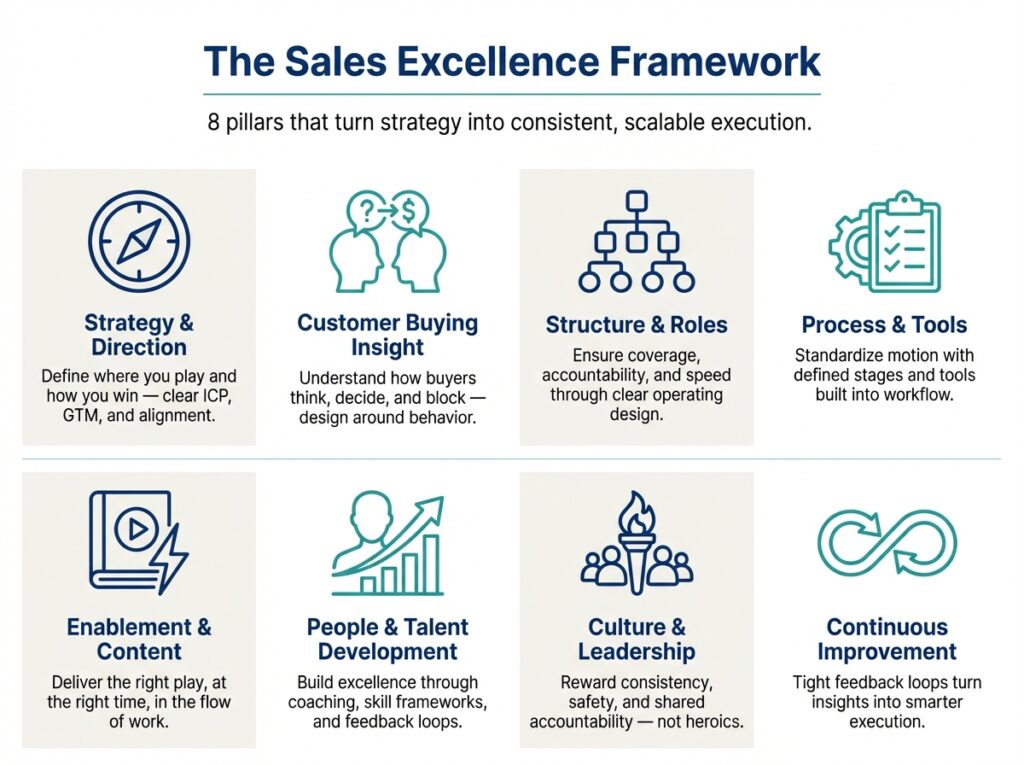
Here is the core Sales Excellence Model, broken into eight pillars that together cover everything a revenue organization needs:
1. Strategy & Direction
The choices that define where you play and how you win. Clear ICP, sharp value prop, segmentation, territory design, and a GTM strategy everyone understands.
Best practices:
- Define ICP and segment-specific plays
- Clarify what “good pipeline” means
- Align strategy with product, marketing, and CS
Failure patterns: Fuzzy messaging, random acts of GTM, misaligned expectations.
2. Customer Buying Insight
Deep understanding of how your buyers think, decide, block, escalate, and validate. Not personas. Buying behavior.
Best practices:
- Map the buying committee
- Track objections and competitor patterns
- Build plays that match how buyers buy
Failure patterns: One-size-fits-all messaging, shallow discovery, deals stalling late.
3. Structure & Roles
The operating design that ensures coverage, balance, accountability, and speed.
Best practices:
- Clear handoffs from SDR → AE → CS
- Territory design that prevents internal friction
- Span-of-control rules that keep managers managing
Failure patterns: Overlapping roles, manager overload, inconsistent expectations.
4. Process & Tools
Your methodology, stage definitions, exit criteria, and the systems that support them.
Best practices:
- One clean sales process
- Stage exit criteria tied to buyer behavior
- Tools embedded in the workflow
Failure patterns: CRM chaos, process avoidance, too many tools.
5. Enablement & Content
Enablement isn’t a library. It’s the distribution of the right play, at the right time, in the flow of work.
Best practices:
- In-flow playbooks
- Role-based training
- Real-time prompts
Failure patterns: Dusty assets, low adoption, training divorced from daily selling.
6. People & Talent Development
Excellence is a function of skills. Skills improve with coaching. Coaching happens through systems.
Best practices:
- Competency frameworks per role
- Skill-gap analysis
- Manager coaching cadences
Failure patterns: Hero rep dependency, unclear promotion paths, surface-level feedback.
7. Culture & Leadership
The values and behaviors you reward become the values and behaviors you scale.
Best practices:
- Inspect what you expect
- Celebrate consistent execution, not heroics
- Create psychological safety so reps share the real risks
Failure patterns: Fear-based culture, sandbagging, inconsistent standards.
8. Continuous Improvement
Sales excellence compounds when feedback loops are tight.
Best practices:
- Win/loss insights fed back into plays
- Forecast variance analysis
- Quarterly GTM refresh cycles
Failure patterns: Strategy drift, stale playbooks, reactive decision-making.
The Sales Excellence Model: Maturity Levels
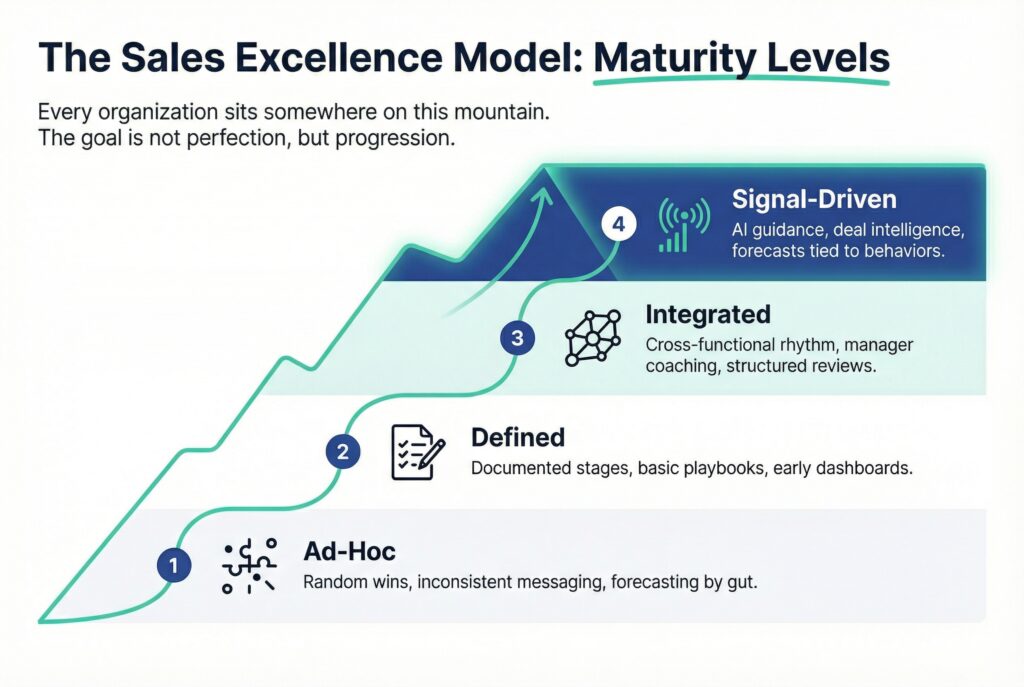
Stage 1: Ad-Hoc
Random wins. Inconsistent messaging. Process avoidance. Forecasting by gut.
Stage 2: Defined
Documented stages, basic playbooks, early dashboards, some repeatability.
Stage 3: Integrated
Cross-functional rhythm, content in-flow, manager coaching, structured reviews.
Stage 4: Signal-Driven
AI guidance, real-time deal intelligence, forecasts tied to behaviors, continuous improvement loop.
A simple maturity scorecard:
| Pillar | 1 (Ad-Hoc) | 2 (Defined) | 3 (Integrated) | 4 (Signal-Driven) |
| Strategy | No alignment | Set but unclear | Clear + adopted | Data-driven GTM |
| Process | Inconsistent | Documented | Followed | Enforced by signals |
| Enablement | Static | Updated quarterly | In-flow | Personalized + AI-guided |
| Coaching | Rare | Monthly | Weekly | In-the-moment |
| Metrics | Lagging | Basic dashboards | Leading indicators | Predictive |
The Roles That Make Sales Excellence Real
Sales excellence isn’t the responsibility of one hire or one function. It only works when every role in the revenue engine contributes to the same operating system.
When even one part slips, execution slips with it.
The Sales Excellence Manager
The operator who keeps the system running.
They own the revenue cadence, maintain playbooks, enforce adoption, partner with RevOps on data integrity, support managers with coaching frameworks, and surface early risk signals so nothing slips through the cracks.
Leadership
They set the standard and reinforce it. When leaders inspect behaviors consistently and hold the line, the entire system stabilizes. When they don’t, process becomes optional.
RevOps
They make execution measurable.
Clean data, clear stages, automation, and a reliable forecast rhythm give managers and reps the structure they need to follow the process with confidence.
Enablement
They bring the strategy into the workflow.
Training, content, and plays only matter if they show up where reps sell. Enablement ensures guidance is practical, contextual, and actually used.
Sales Managers
The hinge point of the entire system. Execution breaks or holds here. Managers coach the inputs, reinforce the process, and create the consistency reps need to improve deal by deal.
Sales Reps
They carry the motion. Reps deliver excellence when expectations are clear, steps are visible, and guidance appears at the exact moment they need it.
The Metrics That Prove Sales Excellence
You can’t claim excellence if you can’t measure it.
The best sales organizations measure these three things that predict revenue: performance, productivity, and proficiency.
Performance Metrics: Are We Winning the Right Deals?
Performance shows the outcomes your system creates.
You should be going deeper than “did we hit quota?”. Look for patterns that reveal whether the way they sell is working:
- Revenue and attainment to confirm overall consistency
- Win rate by segment to find repeatable motions
- Expansion and retention to see if value continues after the first sale
Performance tells you what happened.
Productivity and proficiency explain why.
Productivity Metrics: How Efficient Is Our Sales Engine?
Two teams can sell the same product with very different results.
Productivity metrics highlight whether reps are spending time on high-value work and whether the process is making selling easier or harder.
Signals that matter:
- Selling time % shows where rep hours really go
- Pipeline coverage exposes early-quarter strength or late-quarter panic
- Cycle length reveals friction in your process
- Content-in-use rate shows which plays move deals forward
Productivity answers a simple question:
Is our system making sales faster or slowing us down?
Proficiency Metrics: Are Reps Becoming More Skilled Over Time?
This is the foundation of long-term excellence. Skills compound. Treat proficiency as seriously as revenue.
Indicators to rely on:
- Ramp time for onboarding effectiveness
- Time-to-first-deal for early confidence and execution
- Skill or certification scores to validate capability
- Call coaching improvements to measure real development, not theory
When proficiency rises, everything else gets easier.
Here’s A Balanced Scorecard:
| Category | Example Metric | Healthy Range |
| Performance | Win rate | 25–50% lift |
| Productivity | Cycle length | 10–20% reduction |
| Proficiency | Ramp time | 30–50% faster |
A good scorecard blends all three categories so you can see the health of the whole system.
Process & Playbook Excellence
Most teams already have a process. And a playbook. And a training deck.
And a few PDFs that were great when they were created but haven’t been opened since.
The problem is none of it shows up when reps need it.
Companies that execute well make their process unavoidable (in a good way). Guidance lives inside the workflow. Steps are practical. Managers know exactly what to coach. Reps know what “good” looks like without digging around for it.
Here’s how to do it:
1. Define the critical behaviors first
Start by identifying the handful of actions that drive deal quality: real discovery, stakeholder mapping, clear next steps, and documented risk.
Those behaviors become the foundation of the process. Everything else supports them.
2. Embed the process where work happens
No one goes searching for a playbook, so put the guidance directly in front of reps:
- Exit criteria inside the CRM
- Stage-specific prompts during deal updates
- Discovery patterns that surface automatically
- Coaching notes attached to opportunities
When the process appears at the moment of action, adoption stops being a problem.
3. Managers to reinforce through a consistent cadence
Weekly pipeline reviews focus on behaviors. 1:1s use the same framework across the team. Deal movement is inspected the same way every time.
This consistency removes ambiguity and keeps everyone aligned on how deals should be run.
4. Tune the playbook quarterly
Markets shift. Competitors change their motion.
Review your process every quarter using call data and win/loss insights. Update objections, tighten messaging, remove friction, and add what’s working now.
5. Make stage progression objective, not interpretive
Clear exit criteria remove guesswork:
| Stage | Exit Criteria |
| Discovery | Pain validated + buying committee mapped |
| Evaluation | Mutual action plan confirmed |
| Decision | Business case agreed + procurement path understood |
If these aren’t met, the stage doesn’t move. This single rule stabilizes pipeline quality fast.
Why Does This Matter For Revenue Leaders?
A usable, visible, consistently reinforced process gives you control over execution.
- Cleaner forecasts
- Fewer surprises
- Higher win rates
- Faster onboarding
- Managers who coach instead of firefight
Cross-Functional Alignment
No sales organization becomes excellent in isolation. The teams that scale consistently do so because the rest of the business moves with them.
Sales, Marketing, Product, Finance, and Customer Success share one operating rhythm and one view of the truth.
That alignment tightens execution and removes the friction that slows deals down.
How Alignment Drives Sales Excellence
Marketing sharpens the front end of the motion.
They provide ICP clarity, real buyer language, and signal patterns from the market.
This ensures discovery, messaging, and early-stage qualification aren’t guesses but reflections of what buyers care about.
Customer Success closes the loop.
Renewal patterns, churn risks, expansion triggers, and reasons deals succeed or fail become inputs back into the sales process.
When CS insights influence the playbook, win rates rise and deals become cleaner.
Finance builds the guardrails that make execution realistic.
Comp plans, quotas, and budget decisions shape rep behavior.
When Finance and Sales plan together, you avoid the classic misalignment where targets don’t match territory realities or compensation incentivizes the wrong motion.
Product keeps messaging honest and relevant.
Product usage patterns, customer proof points, and upcoming releases inform how reps position value.
When product and sales are in sync, messaging lands stronger and competitive gaps shrink.
Culture, Coaching, and Incentives
You can install a great process and run clean pipeline reviews, but if the underlying culture rewards shortcuts or tolerates inconsistency, sales excellence never sticks.
Culture: The Environment That Sets The Standard
Build a culture where the right behaviors are normal and the wrong ones are impossible to hide.
That looks like:
- Consistency valued over heroics. A deal won the right way is worth more than a deal saved at the buzzer.
- Coaching expected, not optional. Managers aren’t pipeline auditors. They’re skill builders.
- Learning cycles built in. Teams review what worked, update plays, try again.
- Early risk flagging encouraged. Leaders want truth early, not surprises late.
Strong cultures reduce friction because everyone knows what “good” looks like and why it matters.
Coaching: Where Excellence Becomes Repeatable
Coach the inputs, not the outcomes. Focus on the behaviors that lead to predictable deals. And they do it inside a rhythm that never changes:
- Weekly pipeline review focused on deal quality
- Weekly 1:1 to align on skills and priorities
- Monthly call coaching to develop reps on real conversations
- Quarterly development plans that tie progress to opportunity
This cadence creates consistency across managers and across teams. Reps improve faster. Deals move cleaner. The entire operating system becomes calmer and more predictable.
Incentives: The Quiet Force Behind Behavior
Compensation design is one of the biggest levers in sales excellence.
Reps follow the money, so when incentives encourage solid pipeline creation, multi-threading, accurate deal hygiene, and disciplined execution, the entire motion improves.
Meaningful comp plans:
- Reward quality pipeline, not just volume
- Encourage multi-threaded deals
- Reduce reliance on end-of-quarter discounting (which destroys margin and forecast integrity)
When incentives reinforce the process, excellence compounds.
When they contradict it, the process collapses.
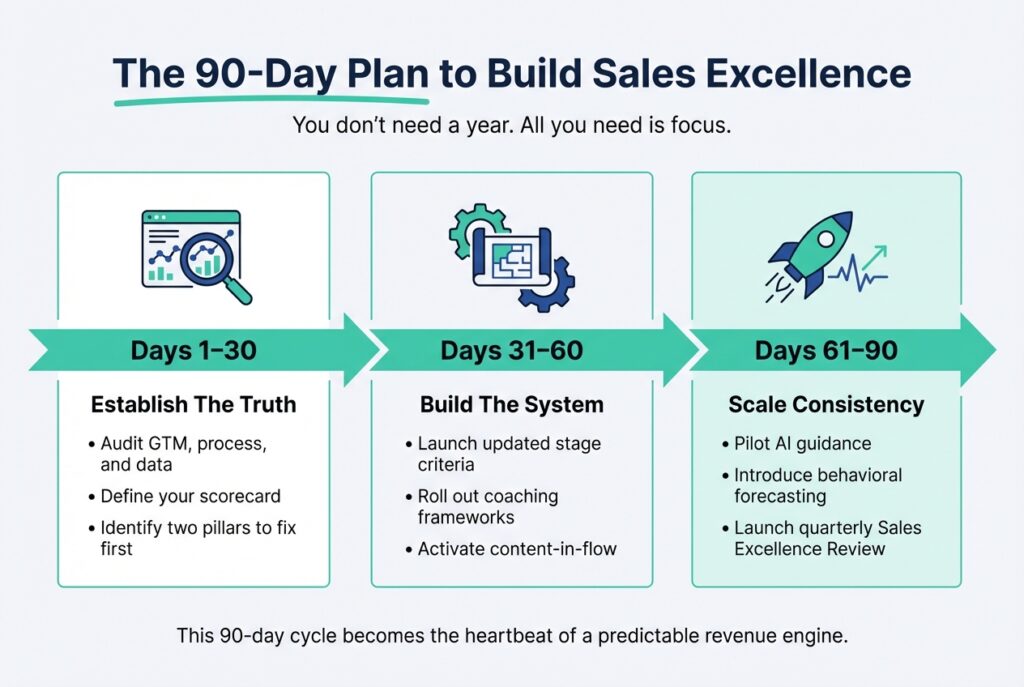
The 90‑Day Plan to Build Sales Excellence
You don’t need a year. All you need is focus.
How To Operationalize Sales Excellence with EnableU
Most teams know what good looks like. The gap is execution – processes drift, coaching gets inconsistent, plays don’t show up when they’re needed.
That’s the gap EnableU closes.
Our platform acts as the Sales Excellence System that operationalizes your strategy and makes great execution the default – not the exception.
What This Looks Like In Practice:
- Playbooks that live in the workflow. Reps get the right prompts, questions, and exit criteria at the exact moment they need them.
- Deal coaching in the moment. Managers don’t wait for reviews. They coach with live context, and reps adjust while deals are still winnable.
- Buyer and account intelligence surfaced in minutes. No more hours of prep. Every conversation starts informed, focused, and relevant.
- Forecasts tied to observed behaviors, not gut feel. Stage progression is grounded in real signals: engagement, risk, next steps, stakeholder coverage.
- A feedback loop that compounds. Every call, every deal, every play updates the system which makes the next motion sharper.
The Net Effect:
Execution tightens.
Coaching becomes predictable.
Reps perform with confidence.
Leaders finally get transparency they can plan around.
👉 If you want this level of execution across your team, start a free trial to see how the Sales Excellence System works in practice.
Frequently Asked Questions
What is a sales excellence framework?
A sales excellence framework is the structured system that defines how your team sells, coaches, and measures execution. It aligns strategy, process, enablement, and talent development so performance becomes consistent and predictable.
What are sales best practices in a high-performing revenue team?
Top teams anchor to buyer behavior, enforce stage exit criteria, run a tight coaching cadence, and review leading indicators weekly. Best practices aren’t tips. They’re the repeatable motions inside a sales excellence model.
What does a Sales Excellence Manager do?
They operationalize the system. That includes maintaining playbooks, running the operating cadence, monitoring adoption, surfacing risks early, and supporting managers with data-led coaching. They’re the engine behind excellence at scale.
How does a sales excellence model help companies grow faster?
It removes randomness. A strong model builds consistency across discovery, messaging, forecasting, and coaching. That consistency compounds into shorter cycles, higher win rates, and revenue you can plan around.
Conclusion
Sales excellence starts with a clear definition of how your team sells, then turns those expectations into daily behaviors through process, coaching, and a rhythm the whole company can follow.
The teams that achieve predictable revenue do it by tightening execution, keeping plays current, reinforcing the right habits, and using data to guide decisions instead of gut feel.
That’s what sales excellence is and how high-performing companies achieve it.
If you want to see how this level of execution becomes real, start a free trial. It’s the fastest way to understand whether this system fits your team and goals.