Sales team structure sets the ceiling on growth. It shapes how quickly new hires ramp, how managers coach, and how consistently revenue shows up quarter to quarter.
Early choices around roles, hierarchy, and coverage tend to stick longer than planned, especially once hiring picks up.
We’ll look at sales team structure as an operating system – covering how to build a sales team, design hierarchy and territories, and share examples that scale in real teams.
Key Notes
- Sales team structure combines roles, hierarchy, coverage, and operations into one execution system.
- Hiring sequence and role specialization determine whether growth creates leverage or drag.
- Territory and segment design drive coverage balance, capacity realism, and forecast stability.
What “Sales Team Structure” Means
A complete sales team structure has five elements. If one is missing, you are not designing a structure. You are improvising.
- Roles: Who does what, and what they do not do.
- Handoffs: Where work moves between roles, and what “done” means at each handoff.
- Hierarchy: Who manages who, and how coaching and accountability actually happen.
- Coverage model: How accounts are owned, segmented, and worked. This is where territories live.
- Operating backbone: Sales operations, RevOps, enablement, and the systems that keep the machine running.
When leaders say “we need to restructure,” it is usually because one of these elements drifted. Or they never existed in the first place.
How To Build A Sales Team From Zero
The fastest way to waste money in B2B SaaS is to hire around a motion you do not have. Early hiring should be about proving repeatability, not adding headcount for the sake of it.
Stage 0: Founder-Led Selling
In the earliest stage, the founder is the first salesperson. Nearly always.
This is not ego. It is information flow.
The founder-led phase is where you learn:
- What actually triggers a buyer to engage
- What the buying committee looks like in the real world
- Which objections are signal vs noise
- What proof the buyer needs to move
If you skip this, you will hire someone to “figure it out.” They will not. They will create activity. It will look like motion, but it won’t be repeatable.
Stage 1: First Hires That Create Repeatability
When you hit early traction (often around $1M ARR in many B2B SaaS models), your first non-founder hires should be execution sellers.
Not a senior VP.
A common playbook is to hire 1 to 2 AEs first, get them to quota, then hire the leader to scale it.
Why? Because an early VP hire often forces you to pretend you have a process. If you do not, they will either:
- Create process theater, or
- Take over deals and become the bottleneck, or
- Miss, then churn, and you reset again
Those first AEs should be versatile utility players. They can prospect and close. They are comfortable doing their own work.
Stage 2: Specialize As Soon As Volume Supports It
Generalists are useful early because there is no choice. Then generalists become the problem.
Once you have volume, specialization wins because the work is fundamentally different:
- Opening is different from closing.
- New business is different from expansion.
- Inbound response is different from outbound creation.
The signal to specialize is not a magical ARR number. It is operational:
- Prospecting starts slipping because closers are busy
- Follow-up gets inconsistent
- Deals stall because the rep is context switching all day
- The same rep is both running discovery and putting out customer fires
Specialize as soon as the work can support it. Waiting too long feels “lean.” It is usually just slow.
Stage 3: Add Leadership Without Creating Hierarchy Bloat
Leadership is not a title. It is a throughput constraint.
You need a real sales leader when:
- You have at least two reps proving the motion
- You need consistent coaching, hiring, and pipeline management
- The founder is still required to be in every deal
A common mistake is hiring the leader, then asking them to also be the top rep, the ops person, and the enablement function.
A leader can be hands-on early, but if they are the only person who can close, you built a dependency rather than a team.
Sales Team Hierarchy: Reporting Lines That Do Not Break
Hierarchy is a touchy topic because it sounds like management fluff. In practice, hierarchy is how you control coaching capacity.
A Practical Default Hierarchy for B2B SaaS
Most teams converge on some version of this as they scale:
- CRO / VP Sales
- Sales Managers / Directors
- AEs
- SDRs (with SDR leadership once volume supports it)
- CS / AM (if your model requires retention and expansion ownership)
- Sales Ops / RevOps (support and system ownership)
The key is clarity on what each layer owns.
Span of Control Rules
Span of control is one of those “boring” topics that decides whether your coaching works. Too many direct reports and coaching becomes triage. Too few and you create layers that add overhead, approvals, and slow decisions.
A good operator test:
- Can a manager do deal reviews, call coaching, and pipeline inspection for every rep, weekly?
- Or are they mainly forwarding Slack messages and asking for updates?
If it is the second one, your span is too wide, or your operating system is missing.
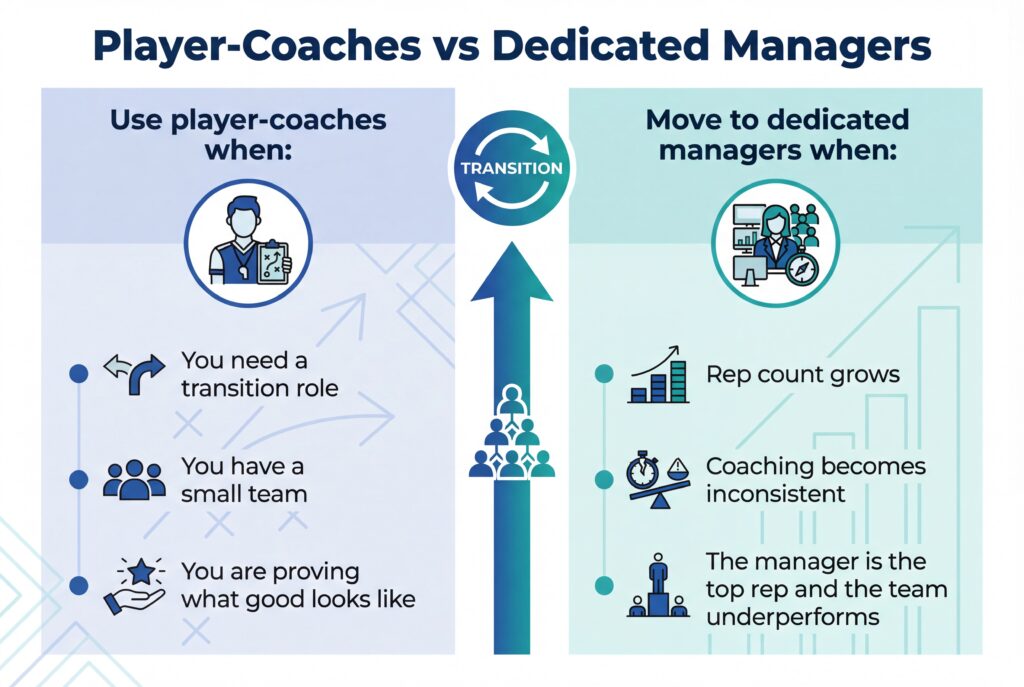
Player-Coaches vs Dedicated Managers
Player-coach roles can work in short windows.
They often fail long-term because the incentives collide. If you are carrying a number, you will prioritize your deals. You should.
Where SDRs Report
SDRs reporting to Sales tends to work better for outbound and pipeline creation.
SDRs reporting to Marketing can work for inbound and response speed.
What matters is less the reporting line and more the operating agreement:
- What qualifies as a real opportunity
- How feedback from AEs loops back into targeting and messaging
- How you prevent “lead quality wars”
Structuring by GTM Motion: PLG vs Sales-Led vs Hybrid
If you copy another company’s structure without matching their motion, you get fragile execution.
Motion shapes roles. It shapes handoffs. It shapes where “signals” come from.
PLG Structure (sales assist)
Pure PLG with no sales can exist for a while. Then deal size grows. Expansion becomes real. Security and procurement show up.
PLG sales teams typically add:
- PQL conversion roles (moving product intent to a sales conversation)
- Expansion ownership (AM or CSM-led expansion, depending on model)
- Enterprise assist (specialists who help when complexity shows up)
The structural risk in PLG is unclear ownership.
A product account can be “self-serve” right up until it is not. If you do not define the conversion rules, you create internal conflict and a bad buyer experience.
Sales-Led Structure (classic outbound + segmentation)
Sales-led teams usually need outbound creation earlier.
Common pattern:
- SDRs create meetings
- AEs run discovery, close
- CS/AM runs retention and expansion
Segmentation becomes critical sooner because:
- SMB deals behave differently than enterprise deals
- Sales cycles and stakeholders differ
- Messaging and proof differ
Hybrid Structure (most modern SaaS)
Hybrid is where many teams get stuck.
They have product signals, outbound motion, inbound motion, and partnerships. Then they wonder why they have overlap.
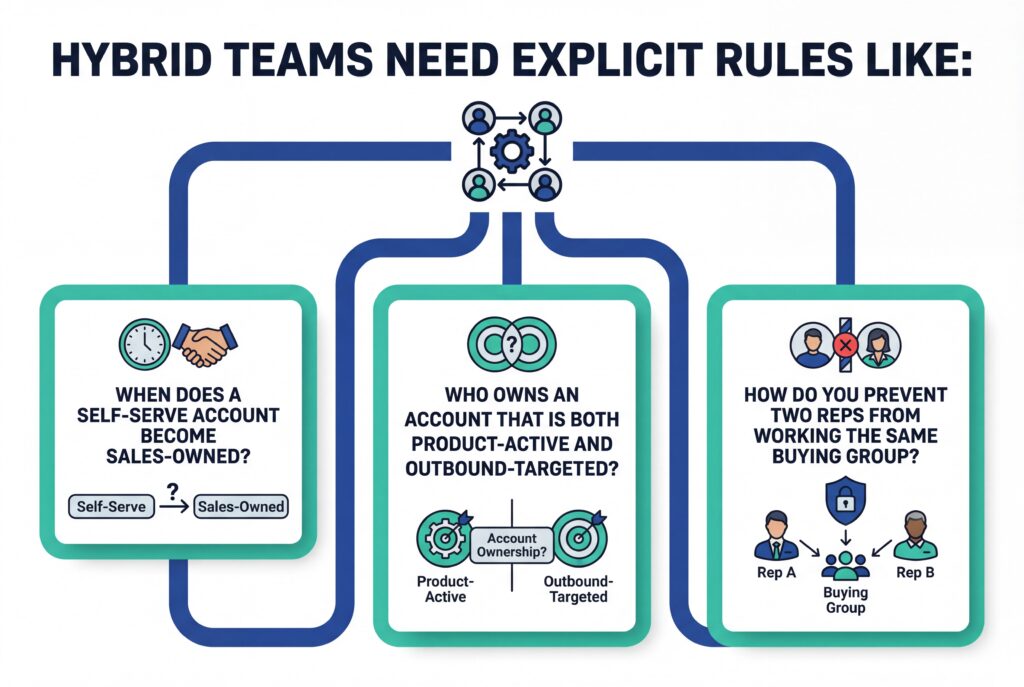
If you do not define it, reps will define it for you. In the worst way.
Coverage Models: Territories vs Segments
This is where structure gets real. Coverage design decides whether your team spends time selling or time fighting over accounts.
Territory-Based Coverage
Territory models make sense when geography is a real driver:
- Regional buying behavior differs
- Field coverage matters
- Relationship density matters
The risk is overlap and whitespace. Overlap creates duplicate outreach and internal tension. Whitespace creates invisible lost pipeline.
Segment-Based Coverage
Segment models usually win in SaaS:
- SMB vs mid-market vs enterprise
- Vertical specialization
- Named accounts
The risk is over-segmentation. You create complexity that your ops team cannot support. You also risk fragmented buyer experience if rules are unclear.
Hybrid Coverage
Most teams land here.
Common patterns:
- SMB and mid-market by territory
- Enterprise by named accounts or vertical pods
- Strategic accounts with overlays
Hybrid can work well, but only if account ownership rules are explicit.
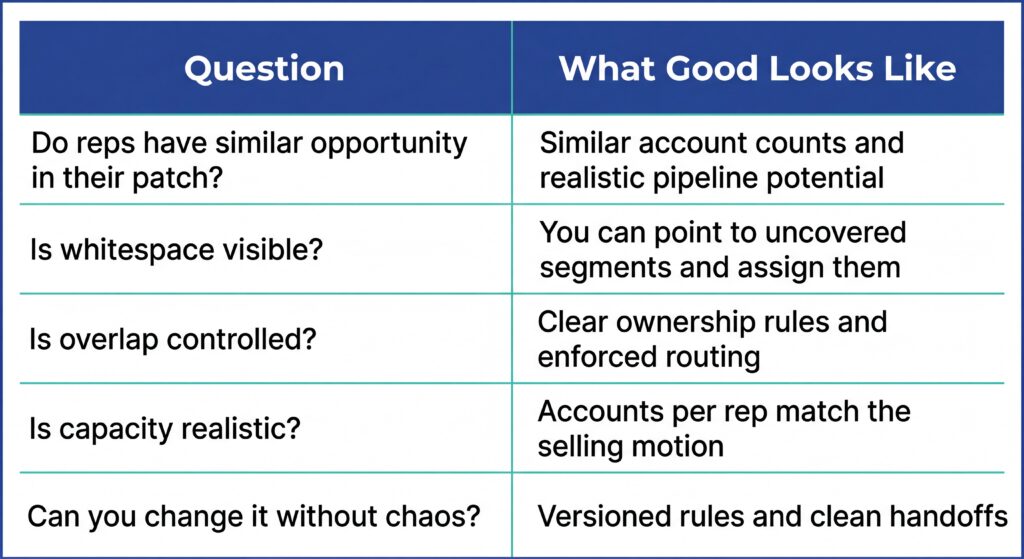
What Good Territory Design Optimizes For
Good territory design is not “fair.” It is balanced and workable.
It optimizes for:
- Balanced opportunity distribution
- Maximum coverage with minimal overlap
- Clear account ownership
- Capacity that matches reality
Here is a simple territory design checklist to use:
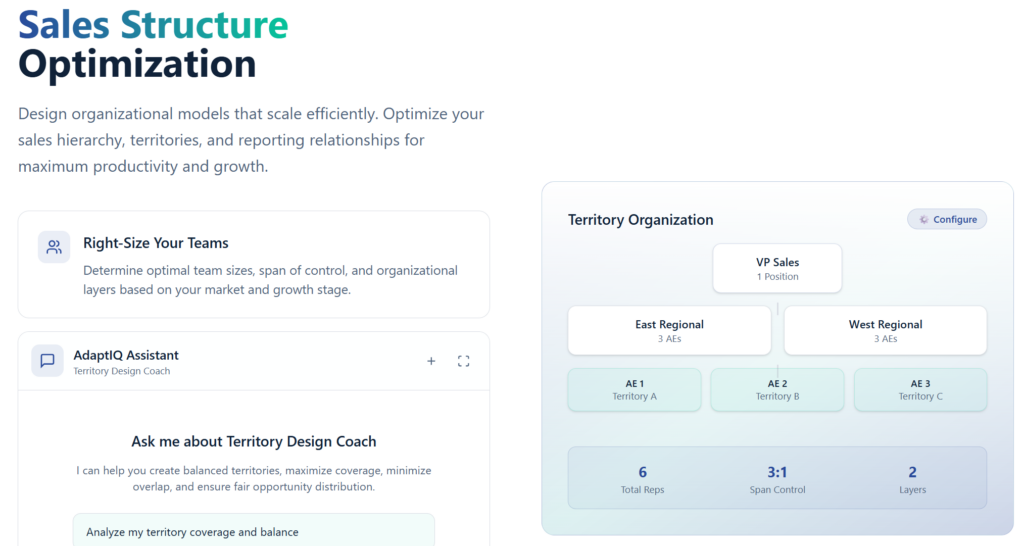
Where EnableU Fits: Territory Design Coach
Most territory projects fail because they become spreadsheet debates. The problem is not the math, but the lack of a shared operating system.
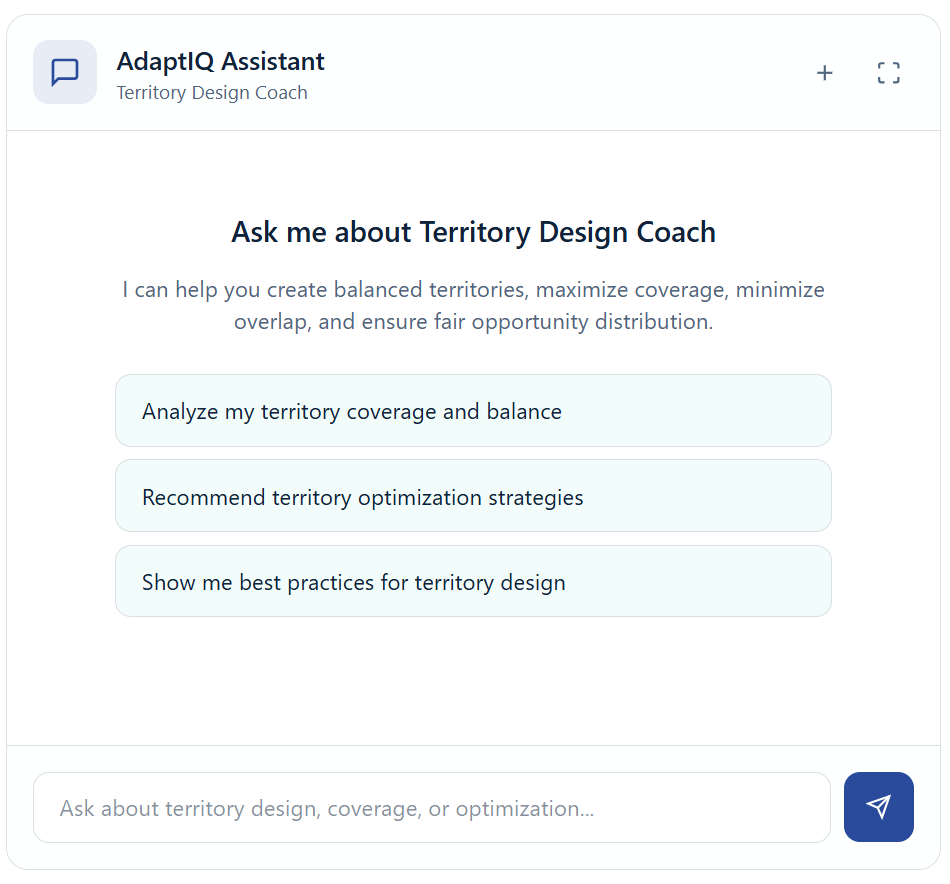
EnableU’s Territory Design Coach, inside the AdaptIQ Assistant, is built for the moments teams usually dread:
- Analyzing territory coverage and balance
- Flagging overlap and whitespace early
- Recommending optimization strategies based on capacity and performance signals
- Showing best practices for territory design, in context
The goal is simple – balanced territories, maximized coverage, minimal overlap, and fair opportunity distribution.
👉 Start a free trial to analyze territory coverage, flag imbalance, and pressure-test your structure in minutes.
B2B SaaS Sales Operations Team Structure
Most teams wait too long to build ops. Then they wonder why CRM hygiene is bad, forecasting is unreliable, and managers spend hours prepping for reviews.
That is not a people problem. That is missing structure.
What Sales Ops Owns vs Sales Leadership
Sales Ops should not own revenue. They should own the system that makes revenue execution measurable.
Sales leadership owns:
- Hiring, coaching, performance
- Deal decisions
- Targets and execution priorities
Sales Ops / RevOps owns:
- Process design and enforcement mechanics
- Systems and integrations
- Data quality and reporting
- Forecasting mechanics and inspection
- Territory and quota operations support
If your ops team is running training because no one else can, that is a smell. If your ops team is chasing forecast commits, that is a smell too.
Where Sales Ops Sits
A simple principle: Sales Ops has to be close to revenue leadership, but not captured by a single silo.
Many teams place Sales Ops under the CRO. Some place RevOps under the COO or CEO to align Sales, Marketing, and CS ops. Both can work.
What fails is burying ops so deeply that they cannot enforce process or drive cross-functional alignment.
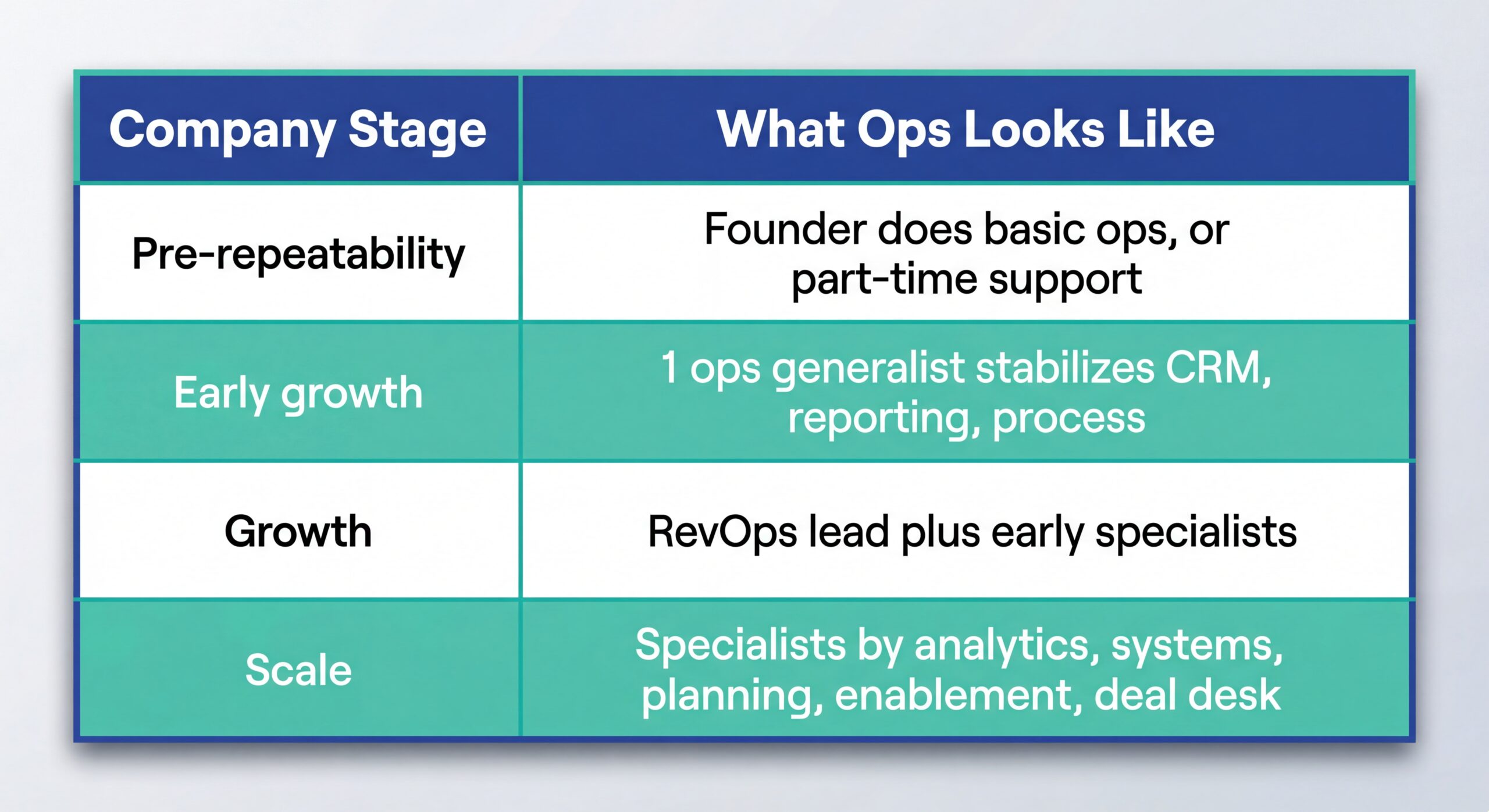
When To Introduce Sales Ops
Triggers are operational:
- Forecast variance keeps surprising you
- Reps waste time on admin and manual reporting
- Data quality makes reporting untrusted
- Territory and routing debates take weeks
- Onboarding depends on tribal knowledge
A rough stage-based view:
Roles That Can Be Merged Early, Then Split
Early on, you will merge.
That is fine.
Common combos:
- Sales Ops + Enablement
- Sales Ops + Marketing Ops
- Sales Ops + Deal Desk
Split them when:
- Your ops person is always behind
- Enablement becomes reactive
- You cannot ship clean changes without breaking something
What Not To Dump Into Sales Ops
Sales Ops is not the catch-all for “anything that feels operational.”
Do not put these under ops:
- Quota-carrying roles
- Customer ownership
- Product decision making
Ops should inform. Not own.
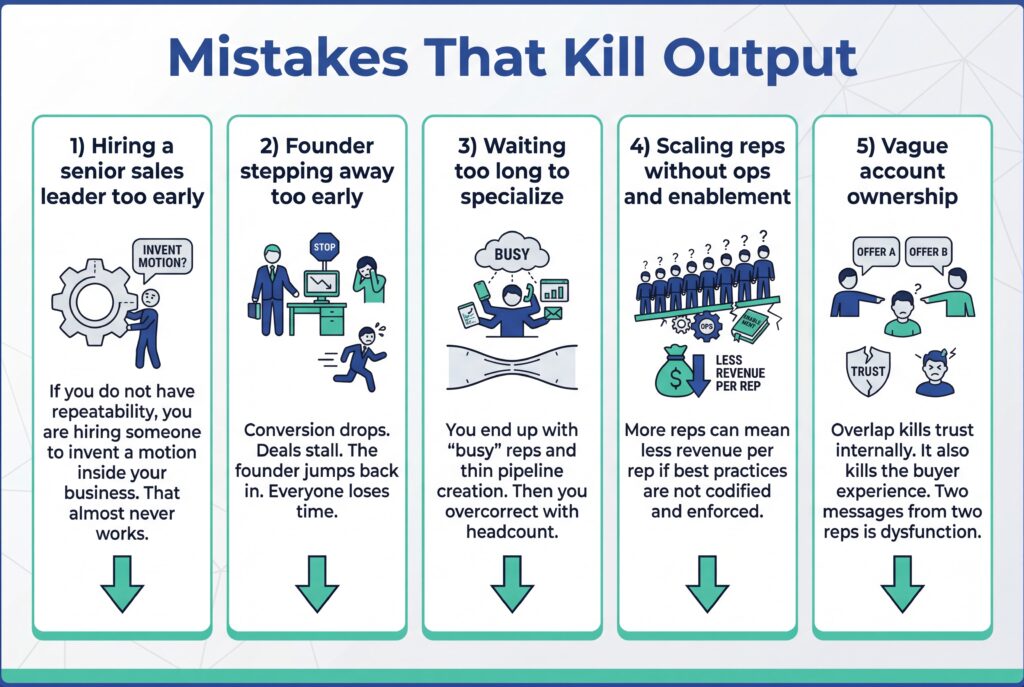
Mistakes That Kill Output
Sales Team Structure Examples You Can Copy
Examples matter because they show what changes, not just what exists.
PLG To Enterprise Assist
A common evolution:
- Early: product does the work, no formal sales
- Next: PQL conversion team and expansion ownership
- Later: enterprise assist roles for security, procurement, complex buying committees
The key structural rule is defining when an account becomes sales-owned. If you do not, you create internal conflict and a messy buyer experience.
Sales-Led SaaS Evolution (stage snapshots)
- Early traction: Founder + 1 to 2 AEs
- Early growth: SDRs added to create consistent top-of-funnel. Sales leader begins formal coaching.
- Growth: Split inbound vs outbound. Split opening vs closing if volume supports it. Add Sales Ops generalist.
- Scale: Add managers, formal enablement, and RevOps specialists. Segment teams by SMB, mid-market, enterprise.
Notice the theme – roles split when the work becomes too different to do well in one seat.
Enterprise SaaS Structure
Enterprise deals usually require:
- Smaller spans of control for managers
- Tighter deal inspection
- Presales support (SEs) when technical depth is required
- Named account coverage and clearer routing rules
The consequence of ignoring this is long-cycle deals stalling because the org cannot support the complexity.
The Practical Test for “Good Structure”
A good sales team structure makes execution boring in the best way.
Use this checklist to pressure test your structure:
- Roles map cleanly to your motion and funnel.
- Account ownership is unambiguous.
- Managers have the capacity to coach, weekly.
- Sales Ops improves data truth and reduces admin, instead of adding friction.
- Coverage design minimizes overlap and exposes whitespace.
If you cannot say “yes” to most of these, your forecast and your hiring plan are already at risk.
👉 EnableU’s Sales Excellence Framework is built for this exact gap between strategy and execution. Start a free trial to see how we can help right-size teams, set workable spans of control, and design coverage.
Frequently Asked Questions
How do you structure a sales team for B2B SaaS specifically?
B2B SaaS sales team structure depends on deal size, sales cycle length, and motion. Most teams evolve from generalist AEs to segmented roles, supported by dedicated Sales Ops to keep execution predictable as complexity grows.
What is the ideal sales operations team structure?
There is no fixed model. Early-stage teams need one strong generalist. At scale, Sales Ops usually splits into RevOps leadership, analytics, systems, and planning roles to support forecasting, territories, and quota design.
How many reps should a sales manager manage?
Most high-performing teams cap span of control at 6–8 reps. Beyond that, coaching quality drops, pipeline inspection becomes reactive, and managers shift from developing reps to chasing updates.
What is the difference between sales team hierarchy and sales team structure?
Sales team hierarchy defines reporting lines. Sales team structure includes hierarchy plus roles, handoffs, coverage models, and operating support. Teams often fix hierarchy first, but performance improves only when the full structure is addressed.
Conclusion
Sales team structure shapes how work gets done. It determines who owns the buyer, how managers spend their time, and whether growth creates leverage or friction.
The teams that scale well treat sales team structure as a system – roles are sequenced to prove repeatability, specialization appears when volume supports it, hierarchy protects coaching time, coverage balances opportunity and capacity, and Sales Ops turns intent into execution as headcount grows.
When these pieces line up, productivity compounds instead of stalling.
If you want to see how this plays out using your own data, start a free trial of EnableU’s Sales Excellence Framework. It helps you model structure, territories, and capacity so the team you build today still works at the next stage.
Leave a Reply