Sales enablement and sales excellence shape how revenue teams operate, but the line between them is often blurry in practice.
That blur affects how teams are built, how managers coach, and how performance is measured.
We’ll break down sales excellence vs sales enablement, clarify what each one is responsible for, and show how they work together to drive consistent, explainable execution in real sales environments.
Key Notes
- Sales enablement equips teams, while sales excellence enforces execution through standards, proof, and cadence.
- Enablement owns inputs like training and content; excellence owns outcomes like forecast accuracy and win rates.
- Predictable performance comes from linking enablement outputs to enforced behaviors and measurable results.
Quick Definitions
Sales Enablement Meaning
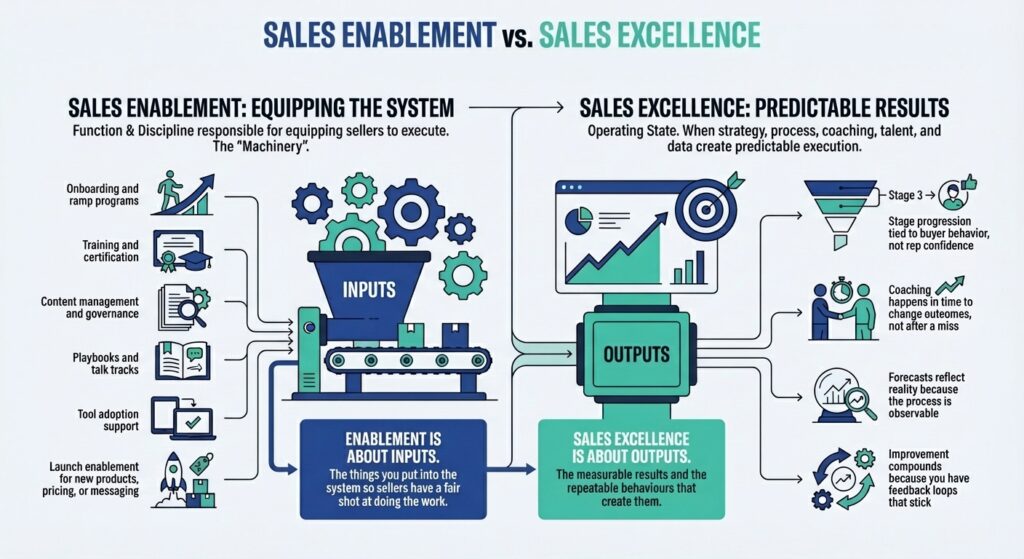
Sales enablement is the function and discipline responsible for equipping sellers to execute.
That sounds broad because it is. Enablement typically owns the machinery that helps reps do the job well.
- Onboarding and ramp programs
- Training and certification
- Content management and governance
- Playbooks and talk tracks
- Tool adoption support
- Launch enablement for new products, pricing, or messaging
Enablement is about inputs. The things you put into the system so sellers have a fair shot at doing the work.
Sales Excellence Definition
Sales excellence is not a department but can be thought of more as an operating state.
Sales excellence is what it looks like when strategy, process, coaching, talent, and data discipline create predictable execution. Not perfect. Predictable.
In an excellent org, performance is not a mystery.
- Stage progression is tied to buyer behavior, not rep confidence
- Coaching happens in time to change outcomes, not after a miss
- Forecasts reflect reality because the process is observable
- Improvement compounds because you have feedback loops that stick
Sales excellence is about outputs.
The measurable results and the repeatable behaviors that create them.
Function vs Outcome (& Where They Overlap)
A clean way to frame it:
Sales enablement is a function. It has a charter, a team, a backlog, and deliverables.
Sales excellence is an outcome and operating model. It is owned by leadership and sustained by cross-functional governance.
They overlap in a few places. Enablement influences rep readiness; excellence demands it. Enablement can design coaching tools; sales excellence makes coaching non-negotiable.
The mistake is treating enablement as the owner of excellence. That’s how you end up with enablement being blamed for forecasting misses.
Scope Boundaries: What Each Owns, Influences, Supports
What Enablement Owns vs Influences vs Supports
Enablement typically owns:
- Onboarding and role-based ramp
- Training curriculum and reinforcement
- Certification, assessment, and knowledge checks
- Content operations, tagging, governance, retirement
- Enablement tooling and adoption programs
- Launch enablement for product, pricing, messaging
Enablement typically influences:
- Messaging alignment with marketing and product
- Process consistency across teams
- The shape of deal reviews and call coaching rubrics
- Manager enablement programs
Enablement typically supports:
- Managers running coaching consistently
- Reps executing plays in real deals
- Leaders scaling a methodology across regions or segments
Here’s the operational truth:
Enablement can’t force a manager to coach.
It can’t enforce exit criteria in stage definitions. It can’t correct a rep’s pipeline hygiene mid-quarter if the org doesn’t make it matter.
What Sales Excellence Includes & Who Owns It
Sales excellence is owned by the CRO and sales leadership, with RevOps as the instrumentation layer.
It includes:
- Go-to-market clarity and tight messaging
- Process quality and stage integrity
- Coaching system and inspection cadence
- Talent system and competency model
- Forecasting discipline and pipeline truth
- Incentives and consequences that match the strategy
- Continuous improvement loops
Excellence is not a project. It’s a management system.
The Clean Boundary
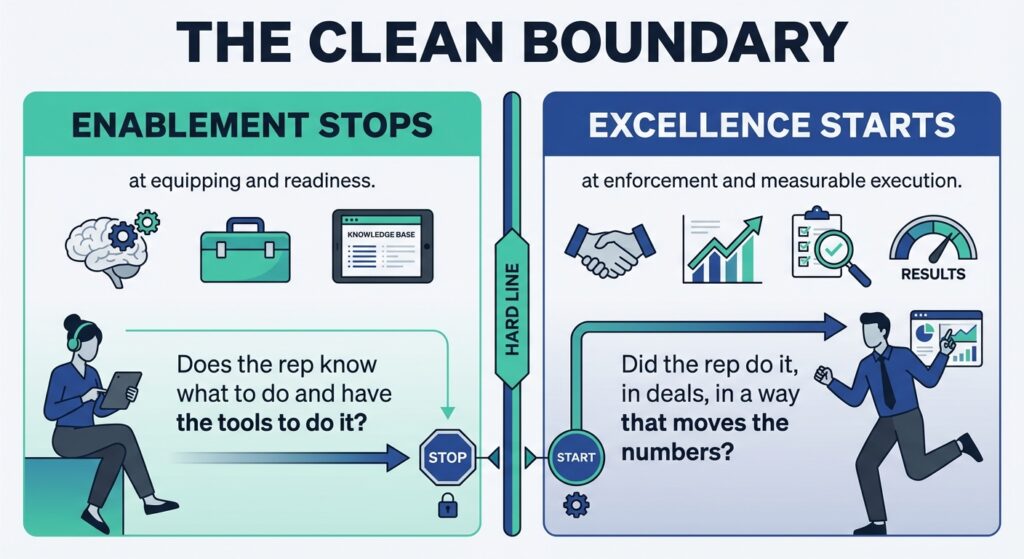
When teams blur this, they over-invest in training and under-invest in inspection.
Three Related Terms People Confuse With Enablement
If your leadership team uses these terms interchangeably, you’ll get mismatched hires, mismatched KPIs, and a lot of argument instead of progress.
Sales Enablement vs Sales Effectiveness
Sales effectiveness is the conversion engine. It’s how efficiently your sales motion turns inputs into outcomes.
So the relationship looks like this:
- Enablement supplies the inputs: training, content, plays, tools.
- Sales effectiveness describes execution quality: how well those inputs convert in real deals.
- Sales excellence is sustained outperformance: the system that makes effectiveness repeatable and scalable.
This is why sales enablement vs sales effectiveness debates often feel circular. They are describing different layers of the same system.
Sales Readiness vs Sales Enablement
Sales readiness is a rep-level state. Are they prepared to execute?
Readiness usually includes:
- Knowledge of the product and ICP
- Ability to run discovery
- Ability to handle common objections
- Ability to use the sales process and tools properly
- Confidence built through practice
Enablement builds readiness. Excellence prevents readiness from decaying.
That decay is real. You can have a great onboarding and still see drift by month three if there’s no reinforcement, no inspection, and no coaching cadence.
Why This Matters To CROs
These distinctions matter because they determine where you place accountability.
- If you measure enablement on outcomes it cannot control, you’ll churn enablement leaders and keep the underlying execution problem.
- If you measure effectiveness only on activity, you’ll build busy teams that don’t win.
- If you want excellence, you need to manage the system, not just the function.
What Great Looks Like In Practice
Strong enablement is visible.
- A new rep can find the right asset in under a minute
- Training is role-based and mapped to real deal moments
- Certification isn’t a formality; it’s tied to core behaviors
- Content is governed – there’s an owner, a lifecycle, and retirement rules
- Managers have tools that make coaching easier, not harder
The signal is not the volume of content.
The signal is whether the right assets show up in the right moments.
What Sales Excellence Looks Like
Excellence is also visible.
- Stage definitions are tied to buyer proof, not internal milestones
- Deal reviews focus on risk and next steps, not narration
- Managers show up prepared because the system gives them signal
- Forecast changes have reasons you can trace back to observable behaviors
Excellence feels boring in the best way (less drama, more consistency).
The Operating Models
Enablement As A Program Portfolio
Sales enablement is easiest to run when you treat it like a portfolio, not a grab bag.
A clean portfolio view:
- Onboarding and ramp (time-to-first-meeting, time-to-first-deal)
- Continuous learning (reinforcement, refreshers, recertification)
- Content operations (governance, tagging, retirement)
- Manager enablement (coaching rubrics, review templates)
- Launch enablement (product, pricing, messaging updates)
- Field feedback loops (what’s working, what’s not, and why)
If you can’t place an initiative in one of these buckets, it’s probably noise.
Excellence As A Revenue QC System
If enablement is the portfolio, sales excellence is the quality control system.
Revenue QC means your sales process has standards, proof, and inspection.
- Standards: what “good” looks like at each stage.
- Proof: buyer evidence required to move forward.
- Inspection: deal reviews and coaching cadence that actually checks the proof.
This is the missing piece for most teams. They have plays. They don’t have enforcement.
How Enablement Feeds Excellence Without Owning It
Here’s the clean handoff:
- Enablement builds the plays, training, and content
- Leadership and managers enforce usage through their cadence
- RevOps instruments the system so adherence and outcomes are measurable
If you skip the middle step, enablement becomes a content factory and managers become reactive.
Metrics: What To Measure & How To Avoid Vanity KPIs
The fastest way to ruin enablement is to measure it like a marketing team. The fastest way to ruin excellence is to measure it like a training team.
You need a metric stack.
Enablement KPIs (leading indicators)
Enablement should be measured on leading indicators it can influence.
Good enablement KPIs tend to answer:
- Are reps getting ready faster?
- Are they adopting the plays and content?
- Are they improving in observable skills?
Examples:
- Time-to-first-qualified meeting
- Time-to-first-deal
- Certification pass rates tied to key competencies
- Content usage by stage and persona
- Coaching asset usage by managers
Excellence KPIs (outcomes & system health)
Excellence KPIs are broader and more unforgiving.
- Win rate by segment
- Cycle time and late-stage slippage
- Stage conversion rates tied to buyer proof
- Forecast accuracy and forecast variance
- Pipeline health score (coverage plus quality)
- % reps at quota and distribution of performance
A useful tell:
Excellence metrics should let you predict problems early.
Scenarios (Sales Excellence vs Sales Enablement Examples)
This is where the difference becomes painfully clear.
Scenario A: Strong Enablement, Weak Excellence
This is common.
You’ll see:
- Training attendance is high
- Content library is huge
- Reps still wing discovery
- Stage progression is inconsistent
- Managers coach late
Root causes usually include:
- No enforced exit criteria
- Deal reviews that are storytelling sessions
- No consequence for ignoring the plays
- Tool data that can’t be trusted, so leaders stop using it
Enablement gets blamed because it’s visible. The real issue is enforcement.
Scenario B: Excellence Without Formal Enablement
You’ll see this in early-stage teams. A strong founder or CRO runs tight deal reviews. Coaching is constant. The process is simple. Execution is crisp.
Then the team grows.
What breaks:
- New reps ramp inconsistently
- Tribal knowledge stays tribal
- Messaging drifts by region
- Leaders lose the ability to “hear” every deal
Excellence without enablement can work at small scale. It rarely survives growth.
Scenario C: The Good-To-great Path
Good-to-great looks like:
- Pick one problem that matters
- Define buyer-proof standards for a single stage
- Build a play and training that matches those standards
- Enforce it in deal reviews for 90 days
- Instrument the metrics so you can see adherence and impact
- Iterate based on evidence
This is how improvement compounds
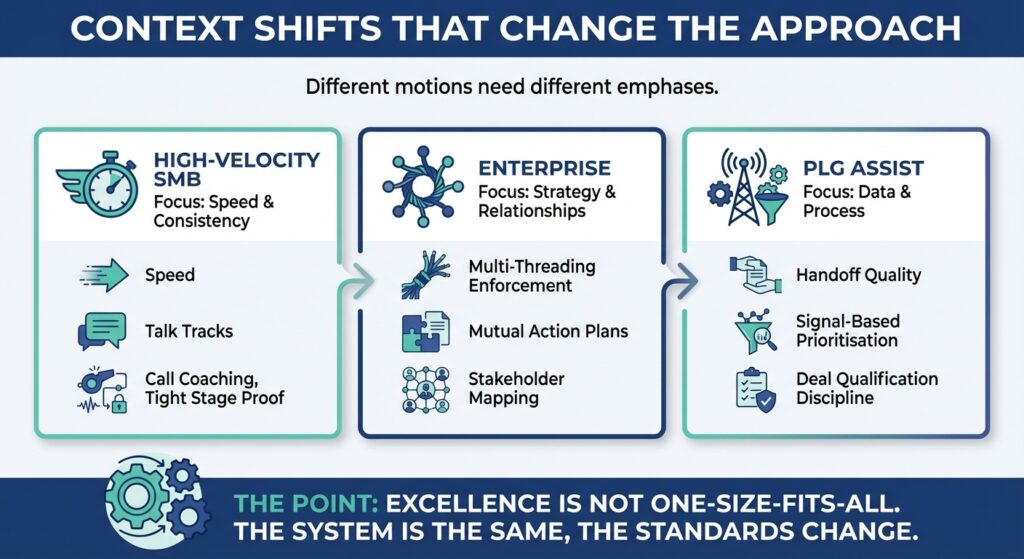
Context Shifts That Change The Approach
Governance & Accountability: Who Runs What Cadence
This is where most enablement vs excellence efforts die. Not because the ideas are wrong. Because nobody owns the cadence.
The Cadences That Make This Real
A practical cadence stack:
- Weekly: Deal inspection, stage proof checks, coaching on live risks
- Monthly: Enablement impact review, content retirement, readiness gaps
- Quarterly: Standards refresh, recertification, enablement roadmap reset
If you only do quarterly reviews, you are managing by surprise.
RevOps As The Instrumentation Layer
RevOps is the connective tissue. They should connect:
- Training completion and certification
- Content usage
- Call coaching insights
- CRM stage movement and conversion
- Forecast accuracy
If these data sources don’t talk, leaders revert to opinions. And opinions are expensive.
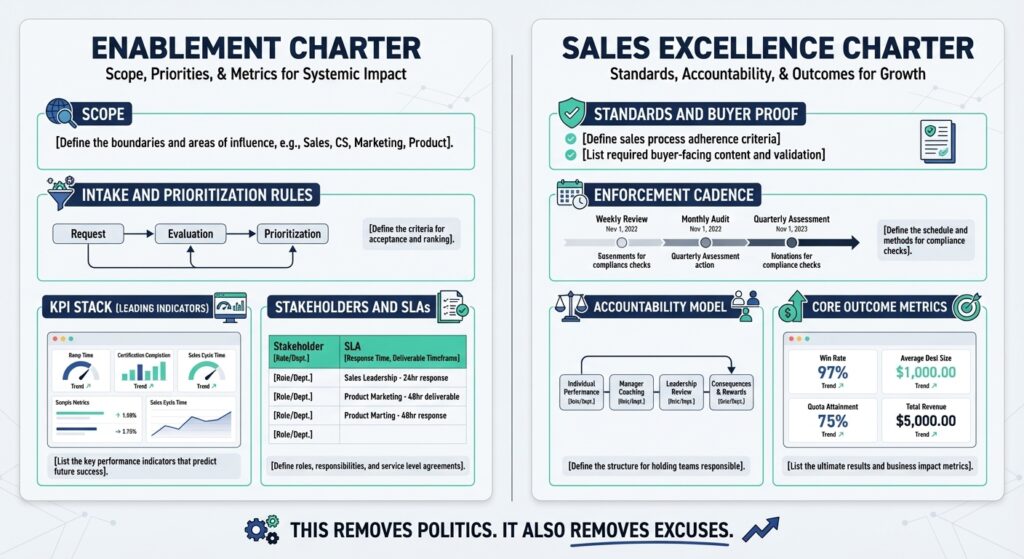
Two Charters You Should Write
If you’re serious, write two one-page charters.
Enablement charter should include:
- Scope
- Intake and prioritization rules
- KPI stack (leading indicators)
- Stakeholders and SLAs
Sales excellence charter should include:
- Standards and buyer proof
- Enforcement cadence
- Accountability model
- Core outcome metrics
It will look something like this:
Pitfalls & Anti-Patterns (+ How To Fix Them)
Enablement Theatre
Signs:
- Lots of launches
- Lots of assets
- Little adoption
- No KPI movement
Fix:
- Tie every enablement output to one stage, one behavior, one metric
- If it can’t be measured, don’t ship it
Content Factory Trap
Signs:
- Content grows forever
- Reps can’t find what they need
- Teams keep creating “new” versions of the same thing
Fix:
- Governance with retirement rules
- A single owner per asset
- Usage-based pruning quarterly
Launch-And-Forget
Signs:
- Training happens once
- People “agree” to use the play
- Behavior changes for two weeks
- Drift returns
Fix:
- Reinforcement loops
- Manager coaching prompts
- Recertification on the highest-leverage behaviors
Leadership Undercutting Adoption
If leaders don’t use the process in deal reviews, the team won’t either.
Fix:
- Make the standards visible
- Inspect weekly
- Align incentives with adherence
The 90-Day Playbook For CROs & Sales Leaders
If you try to “fix enablement” broadly, you’ll drown. Pick one problem. Then run a sprint.
Step 1: Choose One Business Problem
Good problems have consequences.
- Stage 2 conversion is weak
- Late-stage slippage is high
- Ramp time is too slow
- Forecast accuracy is unreliable
Step 2: Define The Behaviors & The Buyer Proof
For the chosen stage, define:
- What behavior must happen
- What buyer proof confirms it
- What “bad” looks like
This becomes the standard.
Step 3: Build The Enablement Package
This is not a giant course.
Ship:
- A stage playbook (one page)
- A manager coaching rubric
- Two to three talk tracks or questions that matter
- A simple readiness check
Step 4: Enforce for 90 days
Enforcement is mostly cadence.
- Use the rubric in deal reviews
- Coach on live deals
- Track adherence weekly
Step 5: Measure, Prune, Scale
At day 90, you should know:
- Did the behavior change?
- Did the leading indicator move?
- Did the lagging metric begin to shift?
If yes, scale. If no, kill it or rebuild it.
Where AI Fits in Sales Excellence & Enablement
At EnableU, AI has one job: turn sales strategy into daily execution you can measure.
That breaks into two motions:
How EnableU Enables Sales Reps (Deal Pilot)
Deal Pilot is built for the work reps do in real deals. Pre-call. In-call. Follow-up. Next step.
Its role is simple: Make the next best move obvious and fast.
That shows up as:
- Buyer intelligence in context when a rep is prepping or mid-conversation
- Persona- and stage-specific prompts, so messaging stays sharp and consistent
- Real-time deal guidance during calls when the outcome is still changeable
- Account planning and research in minutes, so reps spend time selling, not stitching tabs together
Deal Pilot doesn’t replace skill. It standardizes good judgment, so more reps show up like your best reps, more often.
How EnableU Achieves Sales Excellence (Sales Excellence Platform)
The Sales Excellence Platform is the system layer. It’s where leadership intent becomes a repeatable operating model.
This is where AI helps you build the standards and then enforce them across the org.
- Define and operationalize stage standards tied to buyer proof
- Surface execution risk early based on what’s missing or weak in the deal
- Coach in-flow using prompts aligned to your methodology and your plays
- Run forecasts on observable behavior, not opinions and anecdotes
- Prove methodology adherence so “we did discovery” isn’t a debate
This is how sales excellence becomes repeatable. You stop relying on hero reps and post-mortems. You run a system that holds up at scale.
The Distinction That Matters
Deal Pilot improves execution inside the deal.
The Sales Excellence Platform improves execution across the system.
Together, they connect enablement and excellence into one loop:
strategy → guidance → execution → insight → improvement.
Frequently Asked Questions
Is sales excellence the same as sales effectiveness?
No. Sales effectiveness measures how well execution converts inputs into outcomes. Sales excellence is the operating system that makes that effectiveness consistent and scalable across the entire revenue organisation.
How does sales readiness fit into sales enablement?
Sales readiness is an outcome of enablement, not a replacement for it. Enablement builds readiness through training and reinforcement, but readiness only sticks when it’s enforced through coaching and process discipline.
Can sales enablement exist without a sales excellence framework?
Yes, but it usually results in high activity and inconsistent results. Without a broader excellence system, enablement outputs struggle to translate into predictable revenue performance.
Conclusion
Sales enablement equips reps with guidance, content, and coaching in the moments that matter. Sales excellence is the operating system that turns those inputs into consistent behavior, measurable progression, and explainable results.
When standards are clear and execution is visible, coaching gets sharper, deals move with intent, and forecasts stop being debates.
If you want to see what this looks like inside a real platform, start a free trial to see how sales strategy becomes daily execution, deal risk surfaces early, and coaching stays tied to what wins.
Leave a Reply