Prospecting used to feel straightforward – pull a list, send a sequence, hope something sticks.
Now attention is scarce, buying groups are messy, and relevance decides whether you get 10 seconds or none at all.
The reps who win know which accounts matter, why now matters, and who holds power inside the deal.
We’ll break down how to identify sales prospects with precision and how to use AI to move faster without losing judgment.
Key Notes
- Prospect quality improves when Fit, Intent, and Coverage are scored together.
- Corroborated buying signals outperform isolated engagement activity.
- Stakeholder mapping early prevents single-threaded deals and late-stage stalls.
- AI accelerates research, prioritization, and discovery without sacrificing judgment.
What Sales Prospecting Means Now (& Why The Old Playbook Fails)
Sales prospecting in a modern B2B context is the deliberate process of identifying potential customers and opening a relevant conversation until there is a qualified opportunity worth real pipeline work.
In practice, prospecting includes:
- Targeting: who you go after
- Timing: why now
- Stakeholder selection: which people inside the account
- Channel strategy: how you reach them
Lead vs prospect vs qualified opportunity
Different orgs label these slightly differently, but the operational difference is consistent.
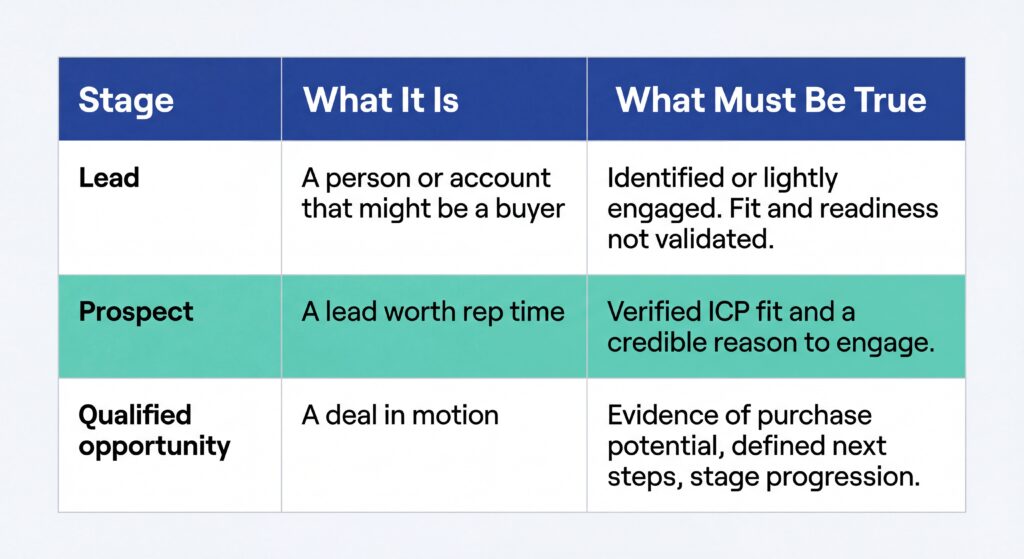
The takeaway is blunt: a prospect is not “anyone you can email.”
A prospect is someone where the math of your time makes sense.
What changed?
A few shifts have changed the physics of outbound.
- Buyers do more self-serve research. Many prefer a rep-free buying experience for a big chunk of the journey.
- Buyers punish irrelevant outreach. Not ignore. Avoid.
- Buying groups are bigger and more cross-functional. It is rarely one champion and a signature.
- Outbound volume is easier than ever to generate. Noise is the default.
- Deliverability is less forgiving. Bulk sending is getting stricter.
So the old playbook, which rewarded volume and light personalization, becomes expensive. Expensive in time. Expensive in domain reputation. Expensive in brand.
Step 1: Identify Prospects With High Fit
Fit is where most teams lie to themselves.
They call something “ICP” and it’s basically “companies we want to sell to.”
That is not an ICP.
A usable ICP is a probabilistic model grounded in conversion reality.
Build or refine your ICP in three loops
1) Win/loss loop
Look at what converts. Not what you wish converted.
- Meeting → qualified pipeline
- Qualified pipeline → win
If a segment creates meetings but not pipeline, it is not a “good segment.”
It is a distraction.
2) Negative ICP loop
You need disqualifiers that save you time.
Examples:
- Too small or too large to realize value
- Wrong compliance environment
- Wrong operating model
- Tech stack incompatibilities that kill implementation
- Maturity mismatch (too early or too late)
Bad targeting is not neutral. Buyers punish it.
3) Buying-group loop
Most ICPs describe “the user” and ignore how the account buys.
You want to know things like:
- Who gets veto power?
- Does procurement enter early or late?
- What does security review look like?
- What kind of change management do they require?
If you ignore this, you can win early interest and still lose the deal when the real evaluators show up.
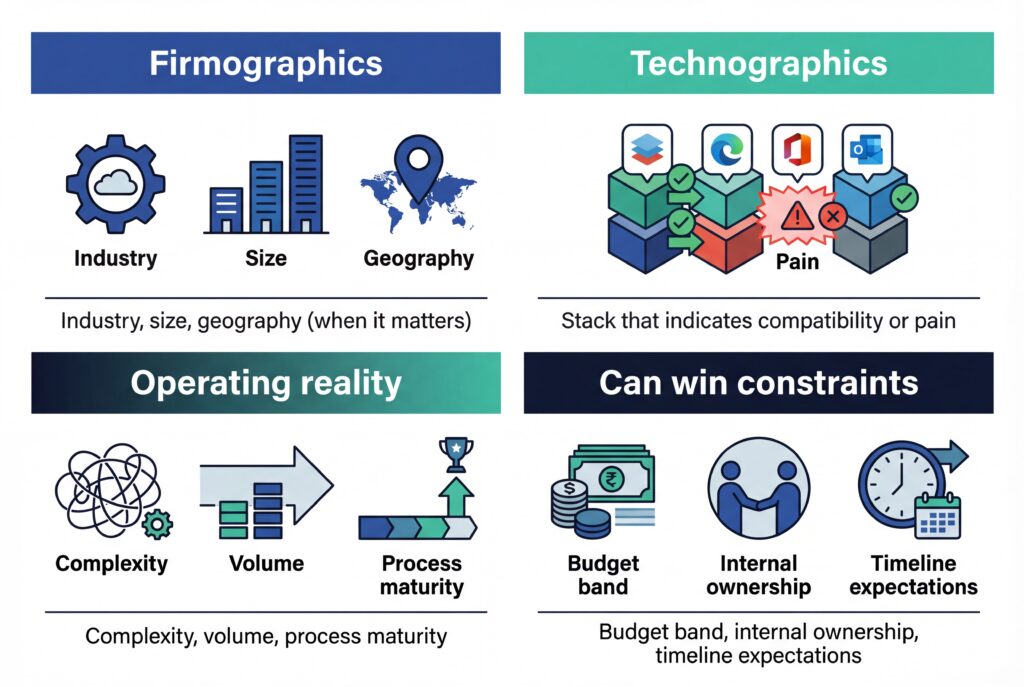
Fit signals that matter
You already know firmographics and technographics.
The mistake is treating them as enough.
A more useful fit filter includes:
Fit red flags
These are accounts that look good in a spreadsheet but usually waste rep time.
- “They are big.” That is not a reason.
- “They use a competitor.” Sometimes that is a reason. Often it means nothing.
- “They are hiring salespeople.” Hiring can be a trigger. It can also just be churn.
- “They engaged with one piece of content.” That is activity, not fit.
Fit is about conversion probability.
Step 2: Identify Prospects With Real Buying Intent
Most reps either ignore intent entirely or treat one signal like a green light.
Both fail.
Build a simple signal stack
Think in layers.
First-party signals (strong when present)
Examples:
- Pricing page visits
- Demo requests
- Trial usage patterns
- Repeated category content consumption
- Review site comparisons
These signals are closer to evaluation behavior, not casual browsing.
Third-party intent (useful, but noisy)
Topic consumption across publisher networks can be directionally helpful.
But by itself, it creates false positives.
Treat it like a smoke alarm, not a fire.
Trigger events (timing multipliers)
Triggers matter because they explain “why now.”
Common examples:
- Hiring for roles tied to the initiative
- Tech stack changes
- New leadership
- Funding or expansion
- Reorgs
Triggers are not proof of buying. They are proof of motion.
Signals that indicate they are unlikely to buy
There are two types:
- Fit failure: wrong segment, wrong constraints, wrong environment.
- Signal failure: activity that looks like interest but does not sustain into evaluation.
If you are getting lots of “we’re not looking right now,” you might be early.
Or you might be reading noise as intent.
How to separate intent from casual interest
Use the corroboration rule.
Ask:
- Is the account inside ICP?
- Is the activity repeated over time?
- Is there escalation behavior?
- Are multiple personas showing engagement?
If the answer is no, treat it as nurture, not activation.
This alone can save you a week a month.
Step 3: Map the Buying Group (Coverage Wins Deals)
Most deals die because the buying group never aligned.
Buying groups are larger and more cross-functional than most reps want to admit.
And healthy consensus is not guaranteed.
Why buying-group coverage is a prospecting problem
If you wait until late stage to multi-thread, you’re late.
Early outreach shapes:
- who hears the story first
- what concerns get framed as “risk”
- whether procurement and finance enter as blockers or partners
Coverage is how you avoid the “hidden buyer gap.”
A practical buying group map
You do not need perfect org charts.
You need a working model.
Common roles to map:
- Business owner: owns the KPI and pain
- User or functional lead: lives with the workflow
- Technical evaluator: cares about integration, security, architecture
- Finance or procurement: cares about cost, terms, risk
- Risk, legal, compliance: cares about exposure and governance
- Executive sponsor: unlocks priority and resolves conflict
The point is not titles. It is power and veto.
Stakeholder map template
Use this grid for one account and you will feel the difference immediately.
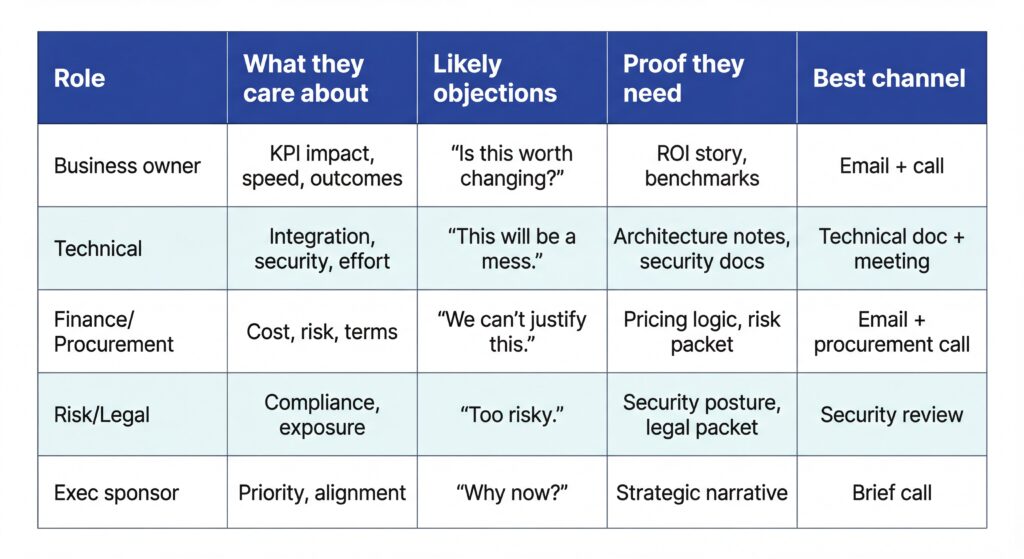
This is coverage.
How prospect identification changes by segment
The framework stays the same. The weighting changes.
- Enterprise: Coverage dominates. Account-first prospecting wins. Multi-threading is not optional.
- Mid-market: Hybrid motion. You still need prioritization by intent and triggers, but buying groups can be real.
- SMB: Speed matters. Your leverage is timing plus the right person. Data cleanliness becomes a huge advantage.
Step 4: How Do You Research a Sales Prospect Manually (Without Wasting Half Your Day)
Manual research is still necessary. The question is how to do it without turning it into performance theatre.
A useful standard workflow for most SDRs is 5 to 10 minutes per prospect.
Not because that’s “ideal.”
Because it’s real life.
The 5-minute research checklist
Start here.
- ICP fit confirmation (size, industry, basic constraints)
- Timing triggers (hiring, leadership changes, expansion, stack shifts)
- Current stack angle (what they run today and what pain that implies)
- Initiatives and language (what they claim to prioritize, in their words)
- Role relevance and plausible pain (why this person’s function would care)
If you do these five well, you will have enough to create relevance.
Best sources for prospect research (ranked by signal quality)
- Company-controlled sources: website, product pages, pricing, careers, press releases, filings
- Behavioral and intent sources: first-party engagement, review comparisons, category content
- People and buying group sources: org charts, role histories, functional ownership clues
- Data hygiene sources: validation and enrichment tools
A boring note, but important:
Stale records will punish you. Bounces and wrong-role emails compound quickly.
What is overvalued & rarely useful
The “creepy trivia” stuff.
Yes, you can mention a prospect’s pet or hobby.
No, it rarely increases conversion.
It often does the opposite. It feels like you’re trying to buy attention with a fun fact because you don’t have a business reason.
Relevance beats personalization.
How deep should research go before outreach?
Make it proportional.
- Standard outbound: 5 to 10 minutes per prospect is workable.
- ABM or enterprise: think “time per account per week,” because you’re mapping a buying group and building message architecture.
Step 5: Turn Research Into Outreach Buyers Don’t Ignore
Most outreach fails before the buyer even reads it.
Not because the copy is bad…
Because there is no credible reason to engage.
Use relevance, not surface-level personalization
Surface-level personalization is:
- “Congrats on the funding.”
- “Loved your post.”
- “Noticed you went to X school.”
Meaningful research is:
- “You’re hiring for X, which usually creates Y bottleneck.”
- “Teams that migrate to Z often hit A problem.”
- “Procurement tends to block this late. Here’s how to de-risk early.”
One is trivia.
The other is work.
A repeatable message map
Use this when you don’t know what to write:
- Observation: a specific initiative or signal
- Implication: the cost, risk, or bottleneck it creates
- Hypothesis: why you’re reaching out and how you help
- Next step: low-friction ask
Example skeleton:
- Observation: “Saw you’re hiring RevOps and rolling out a new sales motion.”
- Implication: “That’s when routing and CRM hygiene usually drift.”
- Hypothesis: “We help teams stabilize the system so pipeline stays clean.”
- Next step: “Worth 10 minutes to see if this is on your roadmap?”
Three outreach angle patterns that hold up
- Hiring wedge. Hiring signals an initiative. Tie it to a role-owned bottleneck.
- Tech stack wedge. Stack indicates reality. Don’t pitch replacement immediately. Start with the pain that shows up at their stage.
- Buying group de-risk wedge. Bring in procurement, finance, or risk early. Many deals stall because these stakeholders show up late.
These angles are scalable because they’re grounded in business reality, not clever writing.
AI Prospect Research (What It Means, What It’s Good For, What It Breaks)
AI can help a lot.
It can also help you fail faster.
The difference is whether you use it as a research and prioritization co-pilot or a spam cannon.
What people usually mean by “AI prospect research”
In the market, it usually bundles four activities:
- Summarization and synthesis of account context
- Signal detection and prioritization
- Drafting outreach and talk tracks
- Workflow automation (logging, routing, next steps)
If your AI tool only does #3, you are basically paying for “faster generic.”
Where AI genuinely outperforms humans
- Cross-account synthesis: AI can scan many accounts and surface themes that a rep would miss.
- Predictive prioritization: Once you have outcome data, scoring can move from rules to probability.
- Administrative compression: AI can cut the time sink that steals your selling hours.
The win is not “AI writes emails.”
The win is that AI reduces time-to-relevance.
Where AI still falls short
Two gaps matter:
- Truthfulness and grounding. Generative AI can confidently produce wrong content. Confabulation is real. Treat outputs as hypotheses until validated.
- Contextual judgment. AI can prepare context, but you still own the decision – prioritization tradeoffs, what angle is credible, what to avoid.
If you hand that away, you deserve the generic replies you get.
Non-negotiable guardrails
- Require sources for claims.
- Separate fact vs inference.
- Validate initiatives and job roles.
- Use second-source checks for high-stakes claims.
AI is powerful, but it is not a truth machine.
How To Use AI For Prospect Research (A Daily Workflow)
Here’s a workflow designed for real SDR and AE constraints. It assumes throughput matters, but brand damage is not acceptable.
Step A: Define the primitives
Before tooling.
- ICP and negative ICP
- “Why we win” narratives
- Shared definitions for data vs signal vs intent
If these are fuzzy, AI will automate the fuzz.
Step B: Build a minimum viable data spine
- CRM fields that matter
- Validation and enrichment feeds to fight contact decay
- Deliverability compliance basics if you scale
You cannot score your way out of broken data.
Step C: Build your signal stack and scoring model
Start with the FIC rubric. If you have enough outcomes data, move toward predictive scoring.
Either way, create one queue.
One.
Not five dashboards.
Step D: Generate an AI research brief (with evidence)
The brief should include:
- account snapshot
- initiative hypothesis
- key stakeholders and hidden buyers
- two to three messaging angles
- disqualifiers
- sources for any claim
This solves a real problem: research time.
Step E: Draft human-grade outreach
Constrain the output.
- One initiative
- One hypothesis
- One low-friction next step
- Ban fluff and congratulations
AI should draft, not decide.
Step F: Push outputs into your systems and close the loop
Write back:
- Fit score, Intent score, Coverage score
- next-best action
- the brief
- outcomes (reply, meeting, disqualify reason)
Then improve the model.
Prompts that produce useful work
Use prompts that force decision usefulness.
Prompt 1: Fit and initiative brief
- Output: fit verdict, top initiatives with evidence, owners, disqualifiers, two angles
- Requirements: cite sources, label inference vs fact, list unknowns
Prompt 2: Signal vs intent separation
- Output: what signals exist, whether intent is verified, contact now vs wait vs nurture
Prompt 3: Six-sentence opener
- Requirements: business reason, hypothesis, low-effort next step
- Ban: compliments, congratulations, irrelevant facts
The structure is the point.
AI Prospecting That Reduces Research Time Without Killing Relevance
AI prospecting only matters if it does two things:
- Reduces research time
- Improves relevance
If it only does one, it creates noise.
Here’s where Deal Pilot changes the equation for SDRs and AEs.
Where Deal Pilot Changes the Equation
- Compresses account research into minutes. Generates a structured account snapshot with company context, industry dynamics, and likely business priorities so you are not stitching this together manually.
- Clarifies buyer roles beyond titles. Surfaces decision influence, functional priorities, and likely objections so messaging aligns to power, not just job title.
- Unifies buying signals into one view. Pulls intent data, behavioral indicators, and competitive context into a single place so prioritization is not guesswork.
- Builds a usable account brief automatically. Creates a working hypothesis, stakeholder map, and messaging angles so you start with direction instead of a blank page.
- Generates stage-aware messaging. Drafts outreach aligned to persona, role, and deal stage rather than generic personalization.
- Supports live discovery and deal progression. Provides contextual prompts and next-best-action guidance during conversations instead of relying on memory from training.
Frequently Asked Questions
How do you research a sales prospect if you have no prior engagement data?
Start with ICP fit and industry context, not contact-level activity. Analyze company initiatives, hiring trends, tech stack, and business model to form a hypothesis before you look for engagement signals. Relevance starts with fit, not clicks.
What is sales prospecting in a sales-led vs product-led company?
In sales-led models, prospecting focuses on initiating demand through outbound and account targeting. In product-led models, it often centers on identifying high-usage accounts and converting product signals into sales conversations. The motion changes, but Fit × Intent × Coverage still applies.
Is AI prospect research accurate enough to trust on its own?
No. AI prospect research accelerates synthesis, not judgment. It should surface patterns, signals, and hypotheses – but reps still need to validate sources and apply context before acting.
How do you scale sales prospecting without hurting deliverability?
Prioritize targeting quality over message volume. Use verified data, smaller high-fit lists, signal-based prioritization, and strong domain hygiene to avoid damaging sender reputation while increasing engagement rates.
Conclusion
Prospecting is no longer a volume game. It is a judgment game.
If you take one thing from this guide, let it be this: how to identify sales prospects comes down to disciplined fit, verified intent, and real coverage. Tight ICPs save you from chasing noise. Corroborated signals protect your time. Buying group mapping protects your deals. AI helps when it compresses research and sharpens prioritization, not when it writes smoother spam.
Attention is scarce. Earn it with relevance.
If you want to see what compressed, signal-driven prospecting looks like in practice, start a free trial of Deal Pilot and build your first account brief in minutes.
Leave a Reply