Your prospect reads your first line and decides in five seconds whether you’re worth the reply.
That’s the game.
Personalized outreach used to mean adding a custom sentence and hoping it landed.
Now the bar is higher. Relevance has to be real. Timely. Grounded in what the buyer cares about.
So where does AI fit into that equation? We’ll break down how AI can support personalized sales outreach without turning it into noise.
Key Notes
- Personalization requires verified triggers, persona alignment, and disciplined message architecture.
- AI compresses research, surfaces buying signals, and supports trigger-driven messaging.
- Guardrails, data governance, and human review prevent generic or risky outreach.
AI outreach explained
AI outreach is using AI to reduce manual work and improve decision quality across outbound, from targeting to messaging to follow-up.
Not “AI sends spam faster.”
You will see AI sales outreach tools marketed as magic. Ignore that framing.
AI is good at a very specific set of jobs.
The five jobs AI can do across outbound
- Sense: spot patterns and signals across accounts and activity
- Synthesize: compress research into something you can use
- Generate: draft variants by persona and channel
- Orchestrate: recommend next-best actions and timing
- Learn: analyze outcomes and push improvements back into the system
If you keep these jobs separate in your head, you will buy and use tools better.
You will also stop asking AI to do the parts it is bad at.
Where reps win most
For SDRs and AEs, the biggest upside is not “better prose.”
It is:
- Research compression: turning 45 minutes of tabs into a 90-second brief
- Angle scaffolding: turning a trigger into a clear message direction
- Priority guidance: focusing on accounts with real momentum
- Consistency: using the best plays more often, not only when a top rep feels inspired
AI makes the work repeatable. You still make the calls.
Get the strategy right before you touch an outreach AI tool
Here is the uncomfortable truth:
If your ICP is fuzzy, your outbound is already broken.
AI will just help you ship more broken messages.
Before you pick an outreach AI tool, lock down four prerequisites:
1) Operational ICP clarity
Not aspirational. Operational.
Operational ICP answers:
- Who buys from us when it is working?
- Who never buys, even when we win the meeting?
- What are the common triggers that make this category urgent?
- What is the minimum proof we need to be credible?
If you cannot answer those, do not “personalize.” You are guessing.
2) Message architecture
Personalization is not improvisation.
It is controlled variation.
You need a simple messaging matrix that maps:
- persona
- business problem
- trigger
- proof
- ask
Then AI can generate within the boundaries.
Without this, AI outputs become fluent sameness.
3) Data discipline
The quality of outreach is capped by the quality of the inputs.
If your CRM is a graveyard, AI will hallucinate relevance.
Even if the writing looks good.
4) Human-in-the-loop boundaries
Decide where AI is allowed to operate, and where a human must decide.
A clean rule for outbound:
- AI can draft.
- AI can suggest.
- AI cannot invent.
If a claim cannot be verified quickly, it does not go into the message.
The 3 assets AI must reference
To make AI useful and safe, give it three inputs that do not change every day:
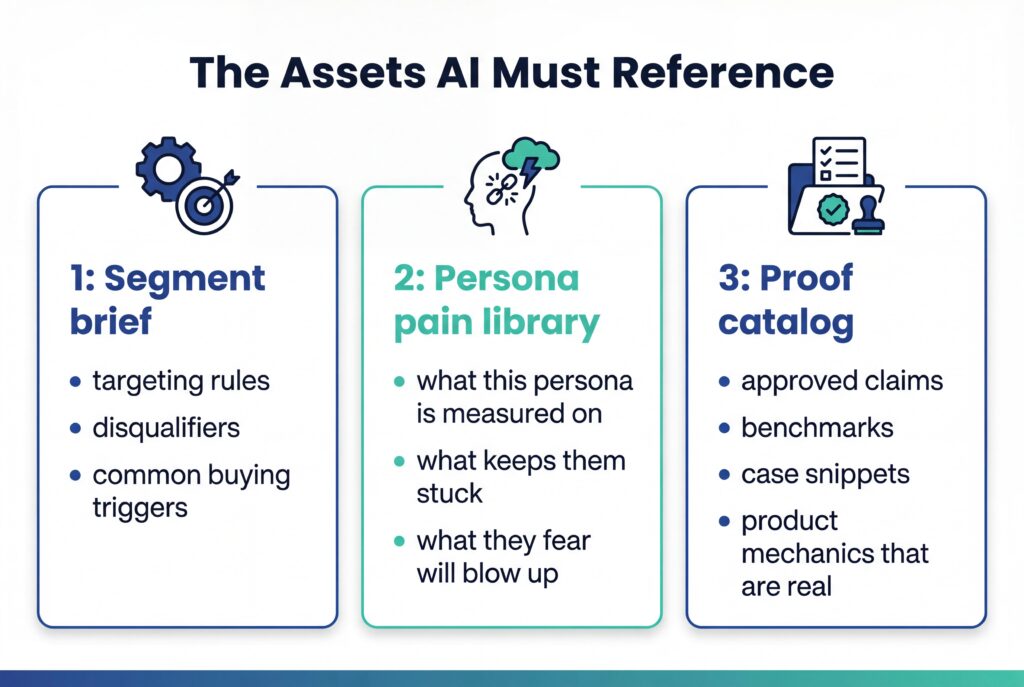
Now you can scale personalization without turning it into fiction.
The data that powers personalization & the data that should not
Not all data creates relevance.
Some data creates creep.
Think in two buckets: Ground truth vs decorative context
Ground truth is information you can act on and claim safely.
- verified firmographics
- clear triggers (job posts, product launches, leadership changes)
- signals inside your own systems (site activity, content engagement, prior conversations)
- known pain patterns by segment
Decorative context is trivia. It makes a message feel personal without making it relevant.
- random social posts
- school and hobby mentions
- vague “congrats” notes
The fastest way to lose trust is to open with decorative context. Buyers have seen it too many times.
A practical outreach data taxonomy
For reps, it helps to classify inputs the same way every time.
- First-party structured: CRM fields, stages, product usage, past opportunities
- First-party unstructured: call notes, transcripts, emails (where permitted)
- Engagement signals: opens, clicks, site visits, event attendance
- Firmographic and technographic: industry, size, stack
- Triggers and intent: hiring, funding, product shifts, market moves
AI is strongest when it can pull from first-party truth and layer in external context carefully.
The grounding rule
If AI gives you a “fact,” treat it like a lead, not like truth.
Your job is to ask:
- Where did that come from?
- Can I verify it in 30 seconds?
- Is it relevant to the problem I solve?
If the answer is no, cut it. Clean messages beat clever ones.
AI for prospect research & account intelligence
This is the highest ROI use case for most outbound teams.
Not because it is glamorous.
Because it saves time and increases accuracy.
The SDR & AE Workflow: AI research in 7 steps
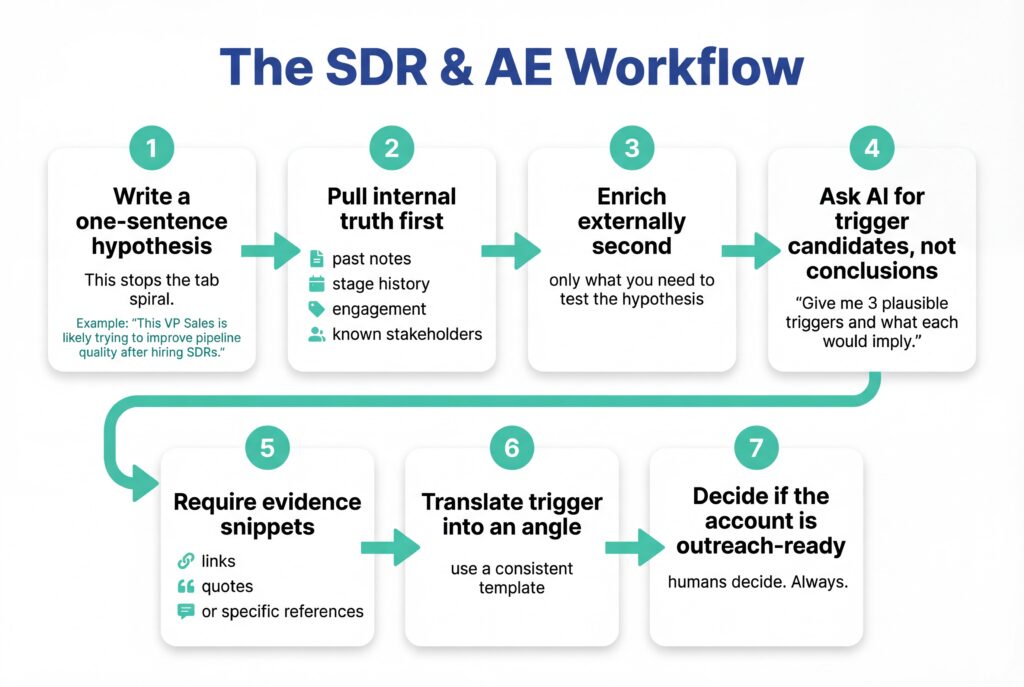
The trigger-to-angle template
Use this to avoid vague messaging.
- Because [trigger], teams like yours often run into [consequence].
- Usually that shows up as [symptom you can name].
- Worth a quick look at [specific thing you can do next]?
AI can draft this. You keep it honest.
Where community outreach tools fit
Teams often forget that some of the best signals are not in classic databases.
Communities create intent signals.
- what topics people are asking about
- what tools are being discussed
- what pain patterns keep showing up
Used correctly, community outreach tools help you identify themes and triggers.
They are not an excuse to spray DMs into a Slack group.
The mindset is: listen for patterns, then run a targeted play.
Personalization at scale across channels without getting weird
Personalization is not a binary. It has levels.
If you try to jump straight to “deep personalization” without a system, you end up with creepy messages or burned-out reps.
The personalization depth ladder
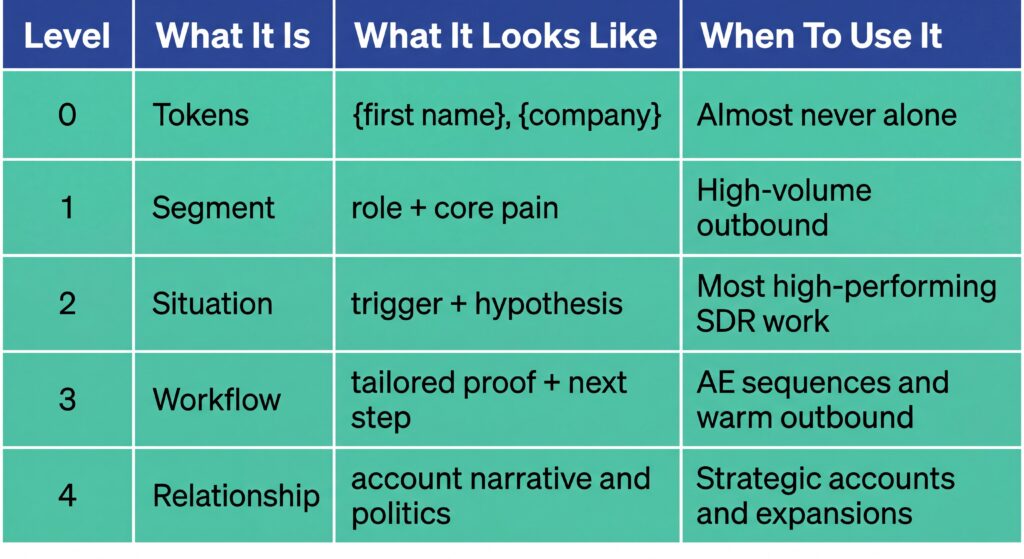
AI is strong at Levels 1 to 3.
Humans own Level 4.
Cross-channel adaptation that stays coherent
Most teams lose deals because their story changes between touches.
AI can help you keep one narrative, adapted to each channel.
- Email: concise, proof-driven
- LinkedIn: lighter, more conversational, less detail
- Call: direct opener tied to the trigger
The content changes.
The logic stays.
Messaging workflows that produce replies
Here is a simple rule:
If you cannot explain the relevance in one sentence, you do not have relevance.
AI can help you draft, but the structure has to do the work.
A “human” outbound structure that works
- Relevance (one sentence)
- Value hypothesis (one sentence)
- Proof (optional, one sentence)
- Ask (one sentence)
Not four paragraphs. Not a novel.
Prompt constraints that remove generic output
If you want AI to support personalization, you must constrain it.
Good constraints:
- “Use only the facts below. Do not add new claims.”
- “Give me 3 openers, each tied to a different trigger.”
- “Write for a VP Sales who cares about forecast accuracy and rep productivity.”
- “Max 75 words. One question at the end.”
Bad constraints:
- “Make it sound personal.”
- “Make it compelling.”
Those produce fluff.
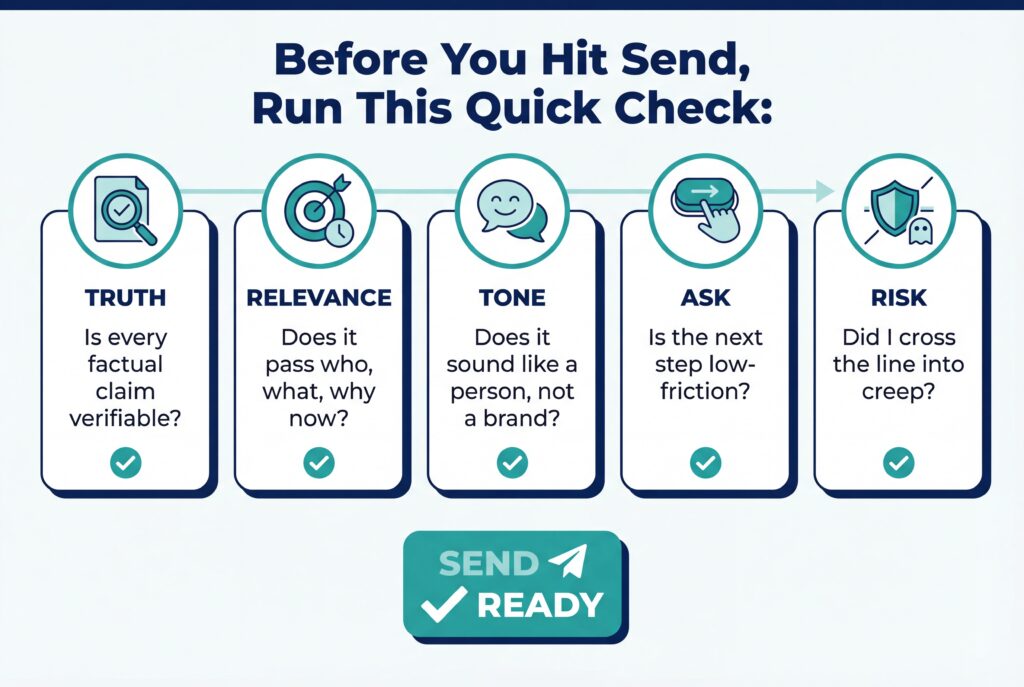
The rep editing checklist
How to evaluate an outreach AI tool
Most teams buy tools for features. Then reps ignore them.
Evaluate tools based on workflow impact.
A strong outreach ai tool should reduce effort and increase decision quality without forcing reps to change how they sell.
The five-layer capability model
- Data layer (can it access the right sources? can it show lineage and recency?)
- Signal layer (can it identify triggers that map to your ICP? can it separate noise from intent?)
- Generation layer (can it generate within guardrails? can it reuse approved proof and messaging?)
- Orchestration layer (can it recommend next-best actions? can it support sequencing without spamming?)
- Governance layer (can you audit outputs? can you control permissions and data exposure?)
Embedded vs standalone tools
Embedded AI (inside your CRM and workflow) is often better for grounding.
It has first-party truth.
Standalone tools can be great for experimentation and enrichment.
But they often create another silo.
A practical decision rule:
- If your “truth” lives in Salesforce or HubSpot, prioritize embedded or tightly integrated approaches.
- If your biggest bottleneck is enrichment and research speed, standalone tools can help. But only with guardrails.
Measurement & optimization
If you cannot measure it, AI will optimize the wrong thing.
Most systems drift toward volume because volume is easy to count.
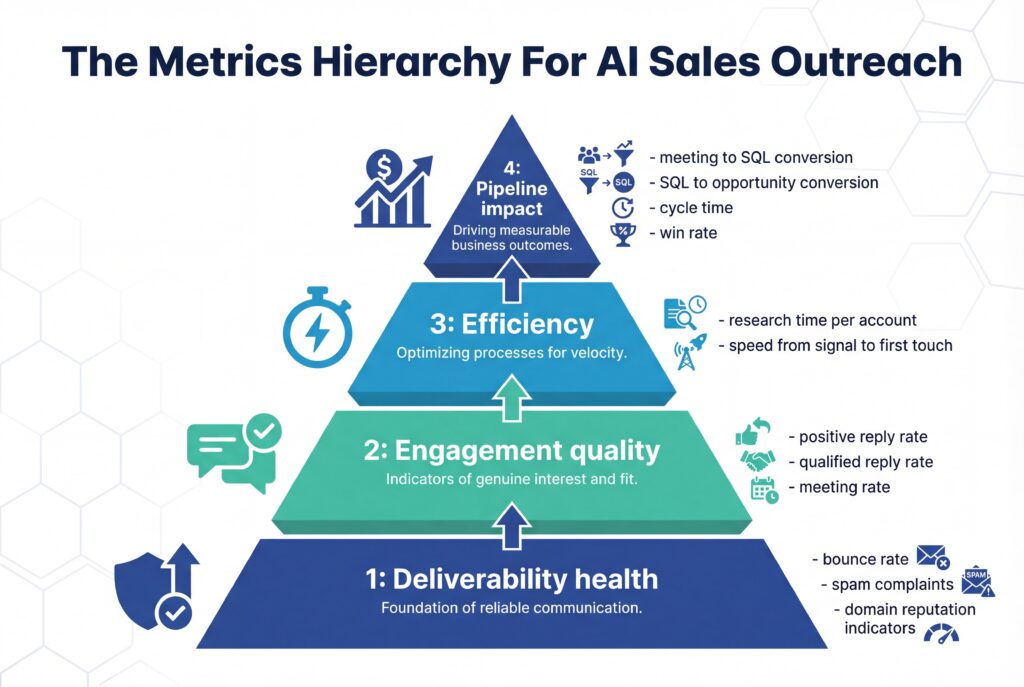
You need a metrics hierarchy that rewards quality.
The metrics hierarchy for AI sales outreach
Measure by segment, not averages
Averages hide truth.
Break down by:
- persona
- industry
- trigger type
- channel
The whole point of personalization is that segments behave differently.
Your reporting should reflect that.
What “working” looks like
You are not looking for more activity.
You are looking for:
- higher positive replies without opt-out spikes
- faster signal-to-touch
- more consistent proof usage
- less rep time burned on research
And yes, a healthier pipeline.
Risk, compliance & trust
AI can scale mistakes as easily as it scales good work.
Treat this section like part of the outbound system, not legal overhead.
The four risk buckets
- Accuracy and integrity (hallucinated facts, false claims)
- Privacy and compliance (using data without permission, mishandling opt-outs)
- Security (exposing sensitive internal data in prompts)
- Trust (creeping buyers out, )damaging brand reputation
The 3 override points
A human must decide when:
- a message includes a factual claim about the prospect
- a message includes any sensitive data reference
- the next step changes deal strategy
If a tool cannot support these checkpoints, it is not ready for scale.
A rollout plan that does not blow up your outbound
- Phase 1: AI for research and drafting
- Phase 2: AI for controlled personalization using approved proof
- Phase 3: AI for next-best-action suggestions with human approval
This sequencing matters.
Teams that skip phases usually pay for it with deliverability and trust.
How EnableU Makes Personalized Outreach Work
Most AI outreach tools generate text.
Deal Pilot enforces relevance.
Instead of asking reps to “personalize better,” it removes the friction that makes personalization inconsistent in the first place.
1. Research Without the Tab Spiral
Reps spend hours stitching together company context, persona insight, and industry trends.
Deal Pilot compresses that into a structured account brief in minutes:
- Company reality
- Buyer motivations
- Industry pressure
- Relevant signals
Not trivia. Usable context.
2. Trigger-Driven Messaging
Personalized outreach fails when it ignores timing.
Deal Pilot surfaces buying signals and aligns messaging to role and deal stage so reps aren’t guessing at the “why now.”
That means fewer generic touches and more situational relevance.
3. In-the-Moment Coaching
Training fades. Execution drifts.
Deal Pilot provides real-time guidance during calls, suggesting next best actions and contextual messaging based on live conversation flow.
Personalization doesn’t stop at the first email. It carries through discovery and objection handling.
What This Changes for AEs and SDRs
- Less manual research
- Faster account planning
- Cleaner, role-specific messaging
- Stronger discovery conversations
- Fewer stalled deals
The point isn’t automation.
It’s making relevance repeatable.
Frequently Asked Questions
What’s the difference between AI outreach and traditional automation?
Traditional automation follows fixed rules and sequences. AI outreach adapts messaging based on persona, signals, and outcomes – improving relevance over time instead of just increasing volume.
Are AI sales outreach tools safe to use for LinkedIn and community channels?
It depends on how they’re used. Many AI sales outreach tools can support drafting and research, but direct automation inside platforms may violate policies. Use AI for intelligence and angle-building, not mass DM automation.
How do community outreach tools fit into personalized sales outreach?
Community outreach tools help surface intent signals from forums, Slack groups, and niche communities. The value isn’t blasting messages – it’s identifying patterns and engaging thoughtfully when timing and relevance align.
How do you choose the right outreach AI tool for your team?
Start with workflow fit. The right outreach ai tool should reduce research time, ground messaging in verified data, and integrate with your CRM – without adding another disconnected system reps ignore.
Conclusion
Most teams asking how can AI support personalized sales outreach? are really asking how to scale relevance without scaling chaos.
The answer isn’t better writing. It’s tighter ICPs, verified signals, disciplined messaging architecture, and feedback loops that improve performance.
AI works when it compresses research, sharpens angles, and keeps execution aligned to role and timing. It fails when it’s used to spray fluent nonsense faster.
If relevance scales faster than volume, pipeline quality improves.
If it doesn’t, everything drifts.
If you want to see what trigger-driven research, persona-grounded messaging, and in-call guidance look like in practice, start a free trial of Deal Pilot and test it on a real account today.
Leave a Reply