![EnableU blog cover showing robot high-fiving marketer with “AI for Product Marketing [Ultimate Guide]” headline and Read More button.](https://blog.bestbootcamps.com/wp-content/uploads/2026/02/Blog-Covers-12.png)
The smartest product marketing teams are not using AI to write faster.
They are using it to decide faster. And to get those decisions to show up in the revenue number.
That distinction matters because most “AI for product marketing” content is stuck in the speed layer. Draft this. Summarize that. Generate a launch plan.
It sounds useful.
It rarely changes outcomes.
Here’s your deep dive.
Key Notes
- AI advantage lives in decision and execution layers, not content speed.
- Revenue impact requires signal ingestion, constrained transformation, and measurable feedback loops.
- Segmentation, positioning, enablement, and pricing benefit most from AI when grounded in evidence.
The 2026 Definition of AI for Product Marketing
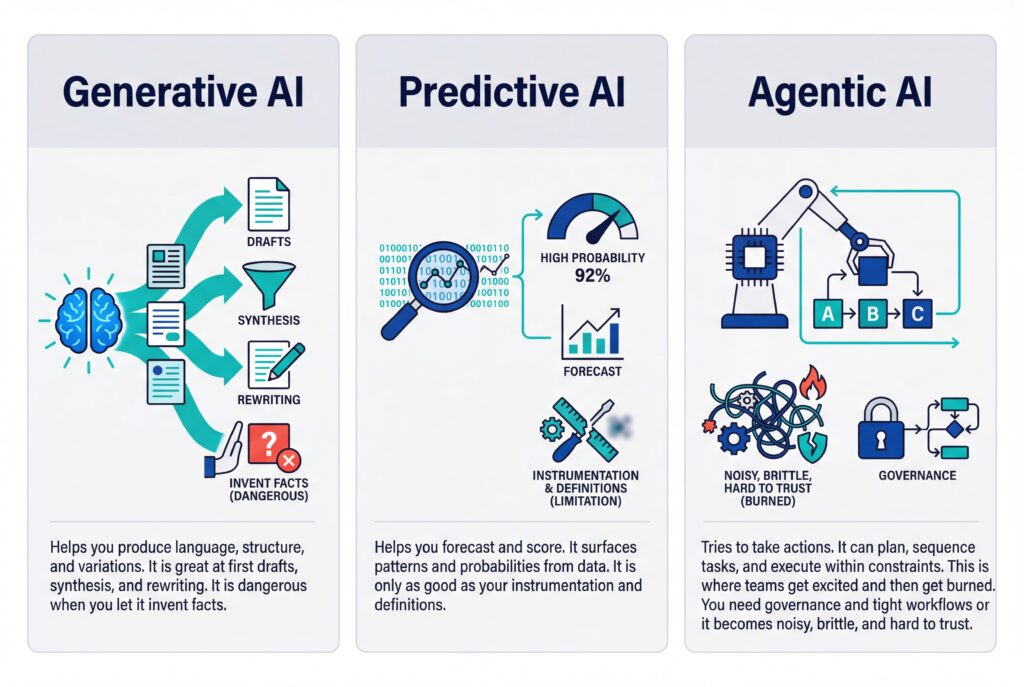
“AI” is a bucket term.
In product marketing, the type of AI you use changes the risk, the value, and the operating model.
What “AI” Means In This Guide
The practical definition
In 2026, AI product marketing should mean:
- Ingest signals (customer, product usage, pipeline, market)
- Improve decisions (segmentation, positioning, packaging, launch bets)
- Operationalize execution (enablement, messaging, lifecycle, competitive response)
- Close the loop with measurement (what changed, why, and what to do next)
If you only do step 3, you are doing content automation. Not product marketing.
What changed recently & why it matters
Three shifts are forcing the issue:
- The cost of iteration collapsed. PMM can now test variants, adapt narratives, and update enablement without a two week queue.
- The next generation of workflows is moving from “create” to “orchestrate.” Your team’s advantage will come from how well you design repeatable loops, not how clever your prompts are.
- Discovery and distribution are changing. Buyers increasingly get “answers” from AI systems and community recaps. Product marketing needs evidence, clarity, and defensible claims, not broad category slogans.
The Executive Lens: Where AI Creates Durable Advantage
There are two ways AI gets sold internally:
- “We will create more assets.”
- “We will create better outcomes.”
Only the second one survives scrutiny.
Speed layer vs decision layer vs execution layer
- Speed layer: Drafting, summarizing, rewriting, repurposing. Useful. Easy to start. Also easy to commoditize.
- Decision layer: Segmentation, positioning, packaging, pricing hypotheses, launch priorities. Harder. This is where compounding advantage lives.
- Execution layer: Enablement in deals, lifecycle messaging in-product and in-email, competitive response in real time. This is where decisions either show up or die quietly.
If you want the CRO and CMO aligned, focus on the decision layer and prove it in the execution layer.
The AI theatre trap
Most teams stall for predictable reasons:
- They run pilots with no success definition.
- They adopt tools without workflow integration.
- They can’t trace impact to win rate, cycle time, activation, retention, or expansion.
- They let AI outputs float around Slack with no ownership.
AI becomes a set of demos rather than a system as it should be.
The C-level mental model
Treat AI as a production system.
- Inputs: signals and truth sources
- Transformation: decisions and assets constrained by your messaging rules
- Feedback: instrumentation and review cadence
- Accountability: owners, gates, and escalation paths
If you cannot draw it as a loop, you cannot run it as an operating system.
The Product Marketing AI System: End-to-End Operating Model
Product marketing sits in the middle of the revenue engine. That is why AI in PMM is not a “marketing productivity” project, but a revenue execution project.
Here’s the system:
1) Inputs: what AI should be grounded in
AI is only helpful when it is anchored in the stuff that is true.
First party signals
- CRM: stage movement, conversion rates, deal slippage reasons
- Call transcripts: objections, competitor mentions, buying committee gaps
- Win loss notes: why deals were won or lost, not just outcomes
- Product usage: activation behaviors, feature adoption, retention indicators
- Support and success: ticket themes, renewal risk, expansion triggers
Market signals
- Competitor messaging changes, pricing shifts, release cadence
- Review sentiment and recurring complaints
- Category narratives changing in communities and analyst channels
If the AI cannot cite where an insight came from, it should not be used for decisions.
2) Transformation: what PMM should produce with AI
PMM should not “produce content.”
PMM should produce clarity and behavior change.
- Decisions: ICP, segmentation, positioning, packaging, launch priorities
- Evidence: proof points, case snippets, quantified outcomes, claim rules
- Enablement: talk tracks, objection handling, discovery prompts, deal guidance
- Asset systems: pages, decks, sequences that stay current
3) Feedback loops: how the system learns
The loop closes when the team can answer:
- What shifted in the market or buyer behavior?
- What did we change in messaging or enablement?
- Did it show up in pipeline conversion, cycle time, or expansion?
A healthy system makes iteration normal. Not heroic.
AI Across the Product Marketing Lifecycle
This is where most product marketing AI guides become a checklist that repeats itself. We are not doing that.
Each section below is a distinct job with distinct outputs.
1) Segmentation & ICP development
AI can accelerate segmentation work, but it cannot own segment truth. Segment truth is a strategic decision. It changes how you build, sell, price, and support.
Where AI helps:
- Theme clustering across messy qualitative inputs (calls, tickets, open text survey responses)
- Pattern surfacing around pains, constraints, and language used by different buyer roles
- Segment scoring drafts based on signals you define (LTV potential, adoption readiness, sales complexity)
Where humans must own it:
- Which segment is worth building for
- Which segment is “not us”
- The tradeoffs you are accepting
Deliverables worth producing:
- ICP hypothesis doc with explicit disqualifiers
- Segment scorecard that forces decisions
- Message constraints per segment: what we lead with, what we never claim
Every segment should have a “failure mode” section. How do we lose here, even with a good product?
2) Research ops acceleration
AI can remove the mechanical friction in research. That frees PMM to do the thing that matters: interpretation.
Where AI helps:
- Drafting interview guides and follow ups
- First pass coding of transcripts into themes
- Building a “voice of customer library” with searchable snippets
- Converting call themes into hypotheses for testing
Where it fails:
- It compresses nuance.
- It over generalizes.
- It misses the “why now” or “why not” in buyer hesitation.
Use this simple template to keep research outputs useful:
- Theme
- Evidence (quote, ticket excerpt, call moment)
- Consequence (what happens if we ignore it)
- Implication (what changes in messaging or product)
- Test (how we validate)
3) Trend sensing & early signal detection
Trend sensing is not “read the internet and summarize it.”
That is how you end up chasing noise.
Build a signal taxonomy:
- What counts as a competitor move?
- What counts as a buying behavior shift?
- What counts as pricing pressure?
- What counts as a narrative shift?
Then let AI monitor within those lanes.
Every trend summary should include three tags:
- Observed: direct evidence
- Inferred: reasonable interpretation
- Action: what we will do in the next 14 days
If the AI cannot separate observed from inferred, you will end up making confident decisions on weak ground.
4) Positioning & messaging iteration
This is one of the highest leverage uses of AI in product marketing, if you treat it as a hypothesis engine.
What AI should do:
- Generate positioning options under strict constraints
- Pressure test claims for ambiguity, sameness, and easy counters
- Draft persona specific messaging variants using your proof library
What AI should not do:
- Invent differentiation
- Write claims you cannot defend
- Summarize competitors without evidence
A practical approach that works:
- Start with a crisp positioning spine – for X, who need Y, we do Z because proof.
- Load AI with customer language and proof points.
- Generate variants.
- Run a “hostile reviewer” pass (How would a competitor attack this? What would a skeptical CFO question?)
- Turn the surviving options into enablement.
The win here is not better copy.
The win is fewer mismatched deals and cleaner sales cycles.
5) Launch strategy & orchestration
Launch is where PMM gets exposed. Not because the plan is bad. Because execution drifts.
AI can help, but only if you use it to tighten the operating model.
Use AI for:
- Pre mortems: what will go wrong and why
- Risk register drafts: what could break adoption, what could break credibility
- Channel plan variants: what changes if sales cycle is longer than assumed
What you still need:
- Clear prioritization: what is the one thing we want the market to remember
- A sales narrative that holds up in real conversations
- A launch checklist that ties into the sales workflow
A launch without enablement is not a launch. It is marketing activity.
6) Enablement & sales alignment
This is the loop that makes AI worth it.
Most enablement fails for one reason: it is not current and it is not used in deals.
AI can fix that, but only if you build a closed loop.
Closed loop enablement:
- Mine calls for objections, competitor mentions, and deal risk patterns
- Translate them into updated talk tracks and prompts
- Push guidance in flow, in the tools sellers use
- Track adoption and outcomes
7) Lifecycle growth & personalization
Personalization is easy to fake and hard to do well.
AI makes it easier to personalize at scale, but the real job is to personalize based on a real driver, not a demographic.
Good personalization is driven by:
- Stage and intent
- Adoption behavior
- Role specific stakes
- Expansion signals
Bad personalization is:
- “We saw you are in fintech.”
- “Congrats on your funding.”
Use AI to map lifecycle plays:
- Activation nudges tied to usage dropoffs
- Education tied to feature thresholds
- Expansion messaging tied to outcomes achieved
Then measure in the only language that matters: retention and expansion.
AI for Content & Asset Creation Without Killing Trust
Yes, AI can help you create assets.
But the operator move is to create an asset system.
Where AI content helps most
High volume, structured formats are ideal:
- Sales decks and talk tracks with persona variants
- Product pages and comparison pages
- Email sequences aligned to objections and stages
- Release notes and changelog narratives
- Demo scripts and discovery question sets
That is where AI tools for product marketing tend to pay off quickly.
Technical to marketing translation
This is a classic failure point.
Product says: “We shipped X.”
Marketing says: “This changes outcomes in Y context.”
AI can help bridge that gap, but only with truth sources.
Use a proof gate:
- What is the exact capability?
- What is the boundary condition?
- What does it not do?
- What evidence do we have?
The fastest way to lose trust is a clean sentence that is not true.
Build a single source of truth for messaging
If you want AI output that does not sound generic, you need constraints.
Create a messaging repository:
- Positioning spine
- Persona pains and stakes
- Proof points and quantified outcomes
- Claim rules and forbidden claims
- Competitive deltas with evidence
- Approved language and terms
Then constrain generation to that.
This is how you avoid the “every tool sounds the same” problem.
AI for Analytics, Decisions & Pricing
Attribution Reality Check
AI does not magically fix attribution.
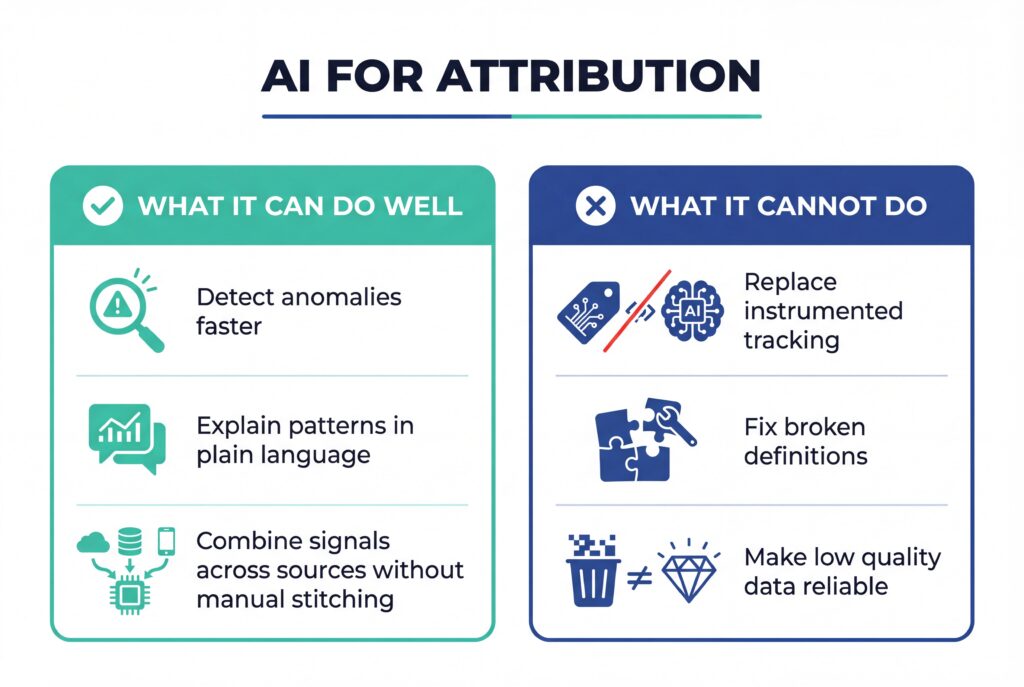
If your pipeline stages are inconsistent, the AI will just produce confident nonsense faster.
Product usage insights that change PMM cadence
The practical change is this: PMM can ask better questions more often.
Questions worth operationalizing:
- What behaviors predict activation within 7 days?
- Where does trial friction show up?
- Which feature usage correlates with retention?
- What signals predict expansion readiness?
Turn those into a monthly cadence, not a quarterly deck.
KPIs AI can optimize when grounded
AI shines in high frequency optimization:
- Message variant performance
- Segment based conversion differences
- Early warning on pipeline dropoffs tied to objections
- Next best action recommendations in lifecycle plays
But you still need a human to decide which lever matters.
Pricing & packaging in the AI era
Pricing is shifting. You already feel it.
As AI features become table stakes, the value moves to:
- Outcomes achieved
- Consumption usage
- Expansion pathways
- Trust and risk reduction
Packaging in 2026 needs clarity on the unit of value.
Seat based is simple. It is also increasingly misaligned with how value is delivered.
Hybrid models are harder to sell.
They can be better, if PMM gives sales a clean narrative and guardrails.
AI-Driven Competitive Intelligence That You Can Trust
Competitive intelligence is a minefield because AI will hallucinate competitor facts with a straight face.
Your system needs evidence tagging.
What “always on” should mean
- Monitor competitor web and pricing changes
- Track product releases and messaging shifts
- Summarize review sentiment and recurring complaints
But keep it structured.
Pair external monitoring with internal call intelligence
The fastest competitor signal is not a blog post.
It is a buyer saying: “We are also looking at X.”
Mine call transcripts for:
- Competitor mentions
- Comparison questions
- Objections tied to competitor claims
Then update talk tracks and proof points.
A simple evidence tagged CI schema
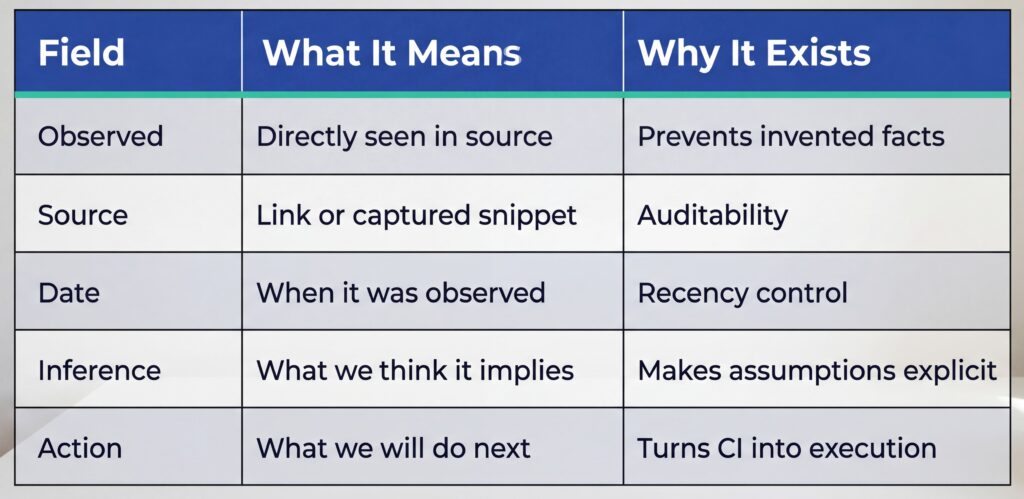
If CI does not change enablement, pricing, or positioning, it is trivia.
AI for Strategy: Designing the System Before You Scale It
Most AI conversations in product marketing focus on execution. Draft faster. Personalize more. React quicker.
Strategy is different.
Strategy is where you decide who you serve, how you win, and what behaviors you reward. If that layer is wrong, AI just helps you scale confusion.
Used properly, AI helps leaders:
- Map competitive landscape shifts before committing quota
- Pressure-test ICP assumptions against real pipeline and usage signals
- Model go-to-market paths before expanding headcount
- Simulate territory, quota, and comp scenarios before locking plans
- Identify structural bottlenecks in span of control, coverage, and role design
- Surface skill gaps tied to revenue performance, not opinion
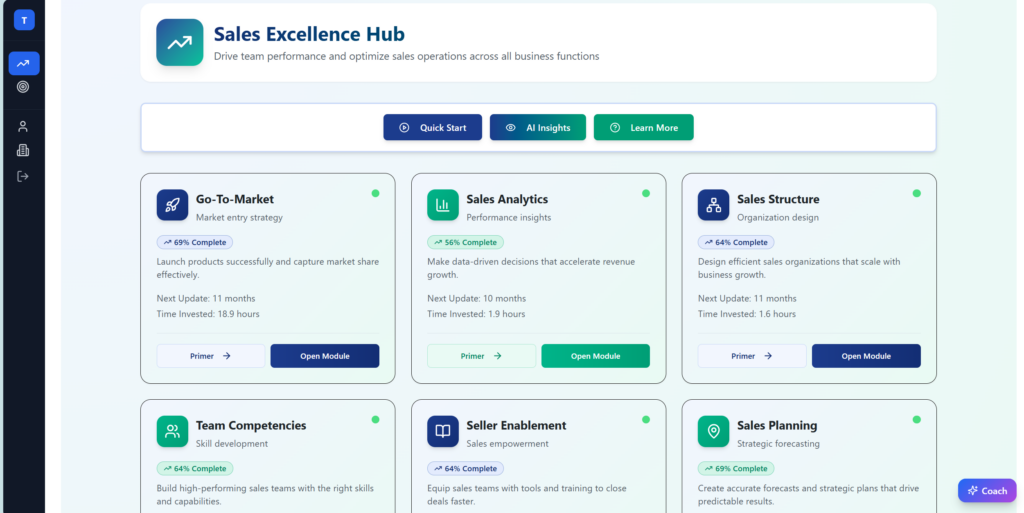
This is where EnableU’s Sales Excellence Framework operates.
The platform does not “write content.” It guides leaders through the eight strategic standards that determine whether execution will compound or collapse.
👉 Start a free trial and turn your sales strategy into a measurable, guided system.
Stack, Implementation, Operating Cadence
The modern product marketing AI stack, by layer
- Signal layer: CRM, product analytics, calls, support, community
- Knowledge layer: tagged repository of truth sources and approved claims
- Orchestration layer: workflows that push guidance into daily execution
- Governance layer: permissions, review gates, privacy rules, audit trails
When teams say “we need a tool,” they usually mean “we need orchestration.”
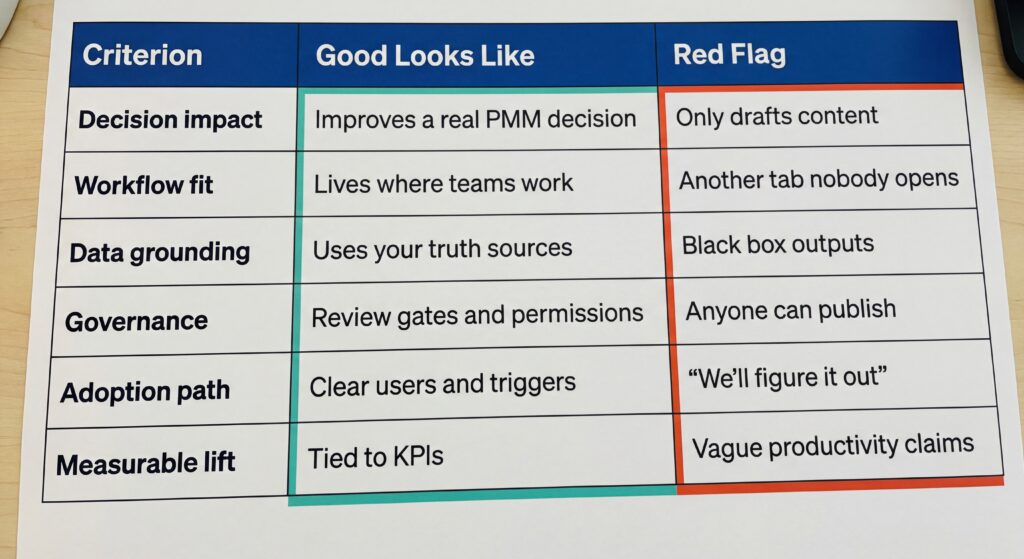
A decision rubric for AI tools for product marketing
Use this rubric before you buy anything:
A rollout pattern that works
Start with one loop.
The highest leverage loop for most companies is enablement freshness. It touches win rate and cycle time quickly.
Rollout steps:
- Pick one loop
- Define baseline metrics
- Build the messaging source of truth
- Constrain generation
- Push guidance in flow
- Measure adoption and outcomes
- Scale to the next loop
Do not scale chaos.
Governance, Risk & Trust
CROs and CMOs do not reject AI because they hate innovation.
They reject it because the failure modes are expensive.
Risk categories that matter in PMM
- Confabulation and invented facts
- Privacy leakage and data exposure
- Bias and homogenization of messaging
- IP and compliance risk
- Trust degradation with buyers
Guardrails for customer facing outputs
Run simple gates:
- Proof required for claims
- Competitive claims must be evidence tagged
- Human review for anything public
- Clear policy for what data can be used
- Logging of what was generated and why
This is not bureaucracy. It’s how you avoid reputation debt.
Where AI is inappropriate
- Unreviewed competitor claims
- Fabricated quotes
- Capability claims that are not verified
- Sensitive targeting without governance
If you want a strong brand, you protect trust.
A Practical 90-Day Plan
You can do this without a massive replatform.
Days 0 to 15: Pick the loop and set baselines
- Choose one mission critical loop
- Define success metrics
- Identify truth sources
- Set governance and review gates
Recommended first loop: enablement freshness tied to call intelligence.
Days 16 to 45: Build the source of truth & constrained generation
- Messaging repository
- Proof library
- Claim rules
- Standard templates for talk tracks and objection handling
Days 46 to 90: Integrate in flow, measure, scale
- Push guidance into seller workflow
- Track usage
- Track outcomes
- Expand to CI monitoring and segmentation iteration
The point is not to “implement AI.”
The point is to make execution predictable.
Frequently Asked Questions
What are the best AI tools for product marketing teams?
The best AI tools for product marketing are those that improve real decisions, not just content speed. Look for tools that connect CRM data, product usage, and call intelligence to messaging and enablement workflows. If it cannot tie into revenue metrics, it is just another content generator.
How is AI product marketing different from traditional product marketing?
AI product marketing uses structured data and signal loops to continuously refine segmentation, positioning, and enablement. Traditional PMM often runs in quarterly cycles. AI compresses insight latency and pushes updates into daily execution.
Can product marketing AI replace human product marketers?
No. Product marketing AI can analyze patterns, generate variants, and surface insights. It cannot own segment truth, strategic trade-offs, or market judgment. The strongest teams use AI to accelerate thinking, not outsource it.
Is product marketing AI only useful for large enterprises?
Not at all. Smaller teams often see faster impact because they can redesign workflows quickly. The key is starting with one high-leverage loop, such as enablement freshness or competitive response, rather than trying to automate everything at once.
Conclusion
When grounded in real signals, tied to segmentation, positioning, pricing, and enablement loops, AI for product marketing compresses the time between “we think” and “we know.”
The teams seeing real gains are not automating drafts. They are instrumenting strategy. They are tagging objections, tracking message shifts, updating enablement in days instead of quarters, and measuring what changes in win rate, cycle time, and retention.
AI becomes useful the moment it makes your strategic assumptions testable and your execution consistent.
If you want to see how AI for product marketing connects directly to revenue performance, start a free trial of EnableU’s Sales Excellence Framework and pressure-test your GTM, structure, and planning against real signals.
Leave a Reply