Sales strategy is easy to talk about and harder to operationalize.
Choices around who to sell to, how to win, and how work gets done compound quickly once deals, headcount, and expectations increase. Small gaps turn into execution drag.
We’ll share the secrets on how to create a sales strategy built for that reality – covering ICP focus, value definition, sales motions, prospecting, process, and the systems that keep execution consistent as the business scales.
Key Notes
- Sales strategy scales through explicit choices across ICP, value, motion, and execution standards.
- Process and methodology function as revenue quality control through buyer-state stages and evidence gates.
- Scalable prospecting prioritizes account selection, buying signals, and persona-specific messaging over volume.
Foundations: Strategy, Plan, Targets
Many teams blur these together and wonder why execution breaks.
A sales strategy is the set of hard choices that define how you win.
It answers four questions:
- Who we serve first (and who we don’t)
- The value we deliver to those segments
- The motion and model that fit those buyers
- The behaviors required to win the same way, every time
A sales plan is the resource map built after those choices. Headcount. Quotas. Territories. Activities. Timelines.
Targets are simply the numerical expression of that plan.
Why Does The Distinction Matter?
If you skip straight to planning or targets without a strategy beneath them, your team fills the vacuum.
- Reps chase anything that moves
- Managers coach from personal style, not a shared system
- CAC spikes because the motion is inconsistent
- Pipeline becomes noise instead of signal
CEOs feel this as chaos.
CROs feel it as inconsistency they can’t fix with more meetings.
👉 The real fix isn’t “better execution” – it’s a sales strategy that’s explicit enough to dictate how reps sell, how managers coach, and how leaders make decisions.
The Sales Strategy Framework: The 10 Components That Create Scale
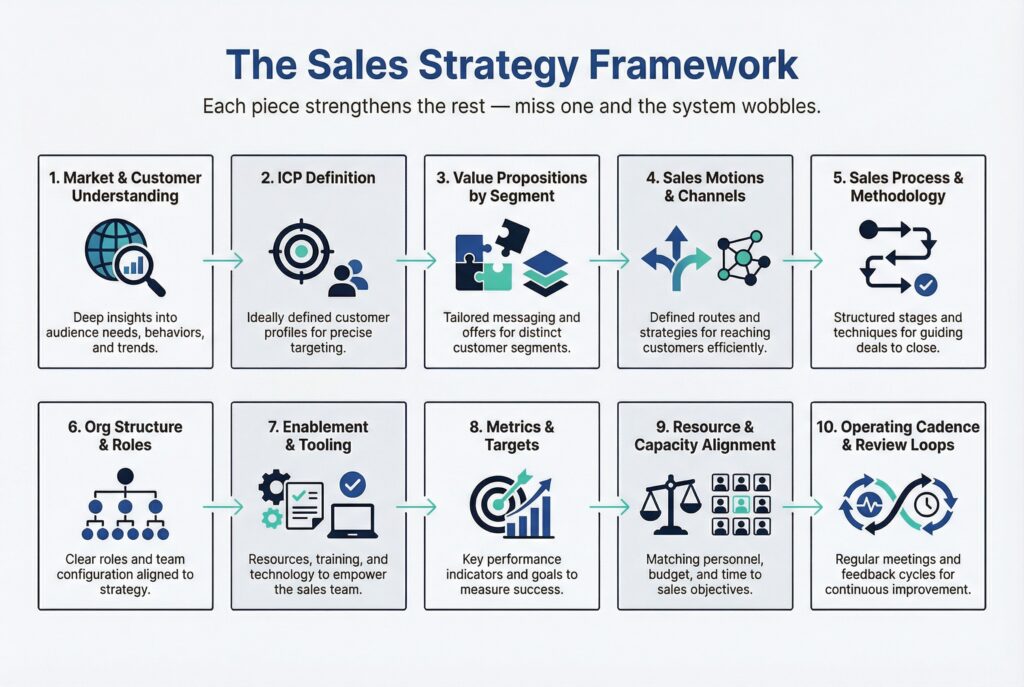
A scalable sales strategy is built like an operating model. Each piece strengthens the rest. Miss one and the system wobbles.
The 10 components:
- Market and customer understanding
- ICP definition
- Value propositions by segment
- Sales motions and channels
- Sales process and methodology
- Org structure and roles
- Enablement and tooling
- Metrics and targets
- Resource and capacity alignment
- Operating cadence and review loops
You don’t need to perfect every pillar overnight. It’s enough to bring clarity to each, then connect them into one rhythm that the team can follow.
Target Market and ICP: Where You Win First
If this piece is wrong, everything downstream breaks. Pipeline bloats with junk. Win rates collapse. Deals drag.
ICP isn’t a persona sheet. It’s a performance filter.
Define it using:
- Historical wins – who closes fast, renews, expands
- Trigger events – funding, regulatory pressure, internal change
- Problem intensity – the cost of inaction
- Access to power – can your reps reach decision-makers
Usually, the hardest part isn’t identifying the ICP. The hardest part is protecting it when pipeline pressure rises. But a tight ICP is the first unlock for scalable execution.
Signals That Your ICP Is Off:
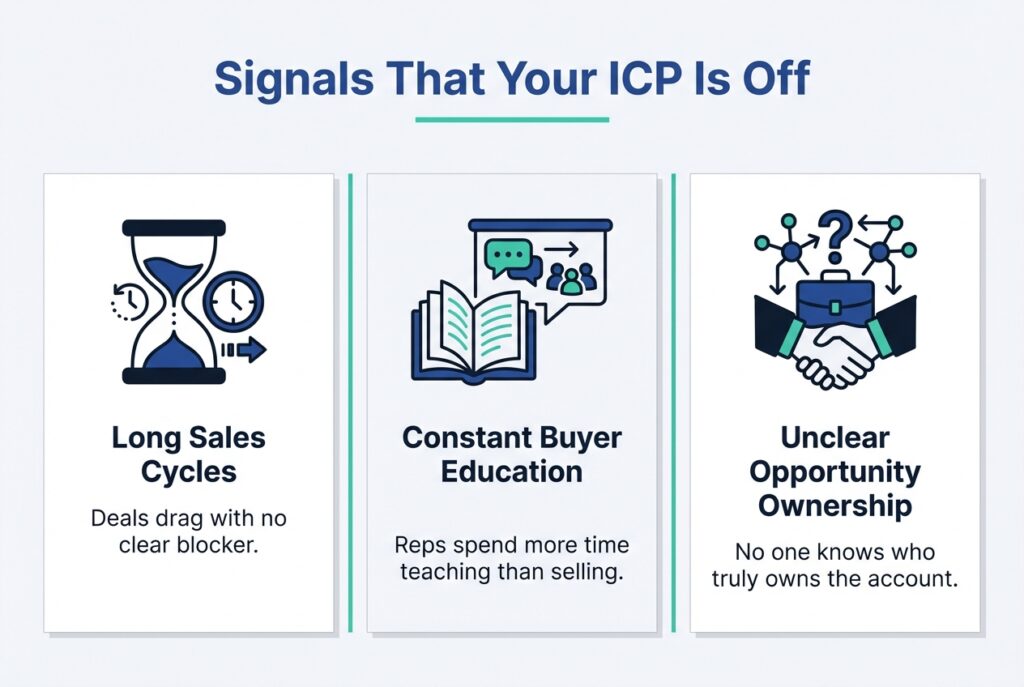
Tighten the ICP before you add headcount. Otherwise you scale inefficiency.
Segment Value Propositions: Why You Win (In Their Words)
Great value propositions describe the change your buyer wants and the constraint blocking it.
The job is to translate:
- Their pain → your outcome
- Their risk → your proof
- Their constraints → your differentiators
Each segment gets its own version. A PE-backed COO cares about EBITDA lift and forecast discipline. A startup CEO cares about repeatability and fast rep ramp.
A Strong Value Prop Does Three Things:
- Names the business problem
- Quantifies the cost
- Shows how your solution reduces that cost
Everything inside your sales motion becomes easier when this work is sharp (messaging stops being generic, discovery gets real, deals move faster).
Choose Your Sales Model and Motions
Your strategy dictates your motion, not the other way around.
Common motions:
- Transactional: High-velocity inbound or outbound.
- Inside sales: Tight ICP, structured discovery.
- Enterprise: Long cycles, committee buying, solution mapping.
- Channel: Partner-led, co-sell models.
- Product-led with sales assist: Usage → qualification → expansion.
Pick the motion that matches:
- Deal complexity
- ACV
- Buyer sophistication
- Required education
Then define the prospecting strategy for that motion. The part most teams skip.
A Scalable Sales Prospecting Strategy Includes:
- Clear account selection rules
- Trigger-based prioritization
- Persona-focused messaging
- Research templates
- Capacity math (touches per rep, conversions per stage)
Without this, reps “spray and pray” which poisons your funnel and burns your market.
Sales Process and Methodology: Your Revenue QC System
The Job of Revenue QC
Revenue QC exists for one reason: reduce variance without slowing velocity.
It does that by answering two questions, in a way the whole org can inspect:
- What is true at each stage of a deal?
- How do we prove it?
If those answers are vague, you don’t have a process. You have labels.
Process Defines Deal State
A scalable sales process is a set of state changes in the buyer journey. Each stage should represent a buyer reality you can point to.
Examples of buyer-state shifts (not your exact stage names):
- The buyer has confirmed a problem worth solving now
- The buying group and decision path are known
- Success criteria are documented and agreed
- Commercial terms are directionally aligned
- A mutual plan exists with dates and owners
Evidence Gates
QC only works if you put gates in the line.
That means exit criteria that require evidence.
A good evidence gate has:
- A required artifact (notes, stakeholder map, success criteria, mutual plan, business case, security checklist, etc.)
- A minimum standard (not “captured” but “captured with these fields completed”)
- A no-pass rule (if the artifact is missing or thin, the deal does not progress)
This is the most important shift: Deals move forward when evidence is complete, not when a rep feels confident.
QC Controls for the Big Three Failure Modes
Most pipeline defects come from three places. Treat these like quality faults you design controls around.
1) No Power
The deal advances with a friendly contact, not the real decision path.
QC control: Stakeholder map required by mid-stage. Multi-threading becomes a stage requirement, not advice.
2) No Compelling Event
The buyer likes the idea. Nothing forces a timeline.
QC control: Documented compelling event or quantified cost of delay before late-stage progression.
3) No Shared Definition of Success
The rep sells features. The buyer measures outcomes. Misalignment shows up at procurement or renewal.
QC control: Success criteria must be explicit, confirmed, and tied to measurable outcomes.
Methodology Defines Behavior Inside the Process
Process is what must be true.
Methodology is how reps get there.
Think of methodology as the standard work that makes evidence reliable:
- What questions must be asked to validate pain (discovery standard)
- How a rep proves economic impact (business case standard)
- How power is mapped (stakeholder standard)
- How risk is handled (objection and consensus standard)
This is why “we trained MEDDIC once” doesn’t matter. Methodology only exists if it changes behavior in live deals and shows up in evidence gates.
Enforcement Is the Difference Between Theory and QC
QC fails when enforcement is optional.
Enforcement does not mean policing. It means the system makes quality visible and non-negotiable.
Practical enforcement mechanisms:
- Stage progression tied to evidence completion (no artifact, no move)
- Manager coaching prompts tied to the methodology (coaching becomes diagnosis, not advice)
- Deal reviews structured around defects (power, urgency, success criteria), not slide decks
- Loss reviews that map back to missing gates (so the system improves)
When this is in place, forecast accuracy improves for a boring reason: You’re no longer forecasting opinions. You’re forecasting verified deal states.
What “Good” Looks Like
A revenue QC system is working when:
- Two managers reviewing the same deal reach similar conclusions.
- A stage means the same thing across segments, reps, and regions.
- Slippage is explainable, not surprising.
- Forecast calls feel like inspection, not negotiation.
That’s the point.
Consistency that scales.
Org Design, Roles & Capacity Planning
Many companies scale headcount before they scale clarity.
That’s how you end up with misaligned quotas, broken territories, and managers drowning in direct reports.
A scalable structure answers three questions:
- Who owns which part of the funnel?
- Do we have the right spans of control?
- Can the current team hit target with today’s ICP?
Core elements:
- SDR vs AE vs AM split
- Territory and segment design
- Manager-to-rep ratios
- Clear role expectations and competencies
Then capacity planning:
Quota, ramp curves, attainment assumptions, and coverage math. If this math is wrong, targets become fiction and strategy collapses.
Enablement & Tooling: Content That Gets Used
Enablement fails when it delivers knowledge instead of behaviors. Reps don’t need more content. They need the right guidance at the right moment.
Scalable enablement systems:
- Surface the exact play, script, or template based on stage.
- Embed coaching into daily work.
- Track whether content is used in real deals.
- Keep training tied to the methodology.
Tooling is part of this. CRM, engagement platforms, conversation intelligence, forecasting. But tools only create value when they reinforce the strategy.
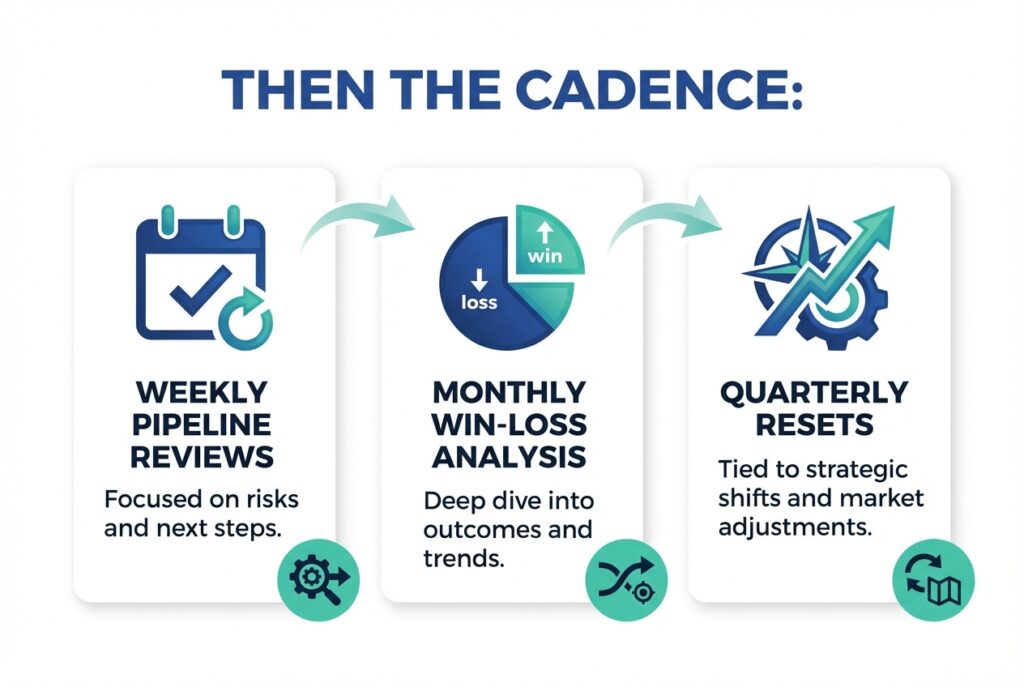
Metrics, Targets, Operating Cadence
A strategy scales when decisions aren’t made from memory or intuition. Your metric stack should include:
- Leading indicators: pipeline hygiene, stage conversion, activity that actually correlates.
- Lagging indicators: revenue, win rate, ACV, cycle length.
- Quality indicators: multithreading, deal risks cleared, champion strength.
Set targets only after you understand your true conversion math. Anything else creates sandcastles.
Prospecting Strategy: Scale Quality, Not Volume
Prospecting breaks when the team optimizes for quantity. Volume looks good in dashboards and terrible in revenue.
A scalable prospecting engine does three things:
- Helps reps focus energy where momentum already exists.
- Sparks conversations that sound human, not automated.
- Reduces time to insight so reps spend more time selling.
The ingredients:
- Account selection rules
- Buying signals (funding, leadership change, hiring acceleration, strategic announcements)
- Persona-specific angles
- Discovery questions tuned to each role
- Multi-touch sequences with clear purpose
A prospecting strategy becomes scalable when the quality of first conversations improves quarter over quarter.
Pricing, Packaging & Deal Strategy
This is the quiet lever behind predictable growth.
You need:
- Packaging aligned to segment maturity
- Clear discounting rules
- Deal qualification frameworks
- Risk flags the team watches for
- Stakeholder maps
- Mutual action plans
Large deals collapse when there’s no structure around power mapping or validation. Small deals stall when reps over-educate or oversell.
Your pricing and deal strategy isn’t about squeezing more ACV.
It’s about increasing the probability of closing the right deals, at the right size, with the right expectations.
Growth Strategies After Initial Fit
Once you’ve proven repeatability inside one segment, you have choices:
- Expand within the segment
- Move upmarket
- Enter adjacent segments
- Add new product lines
The wrong move here can erase a year of progress.
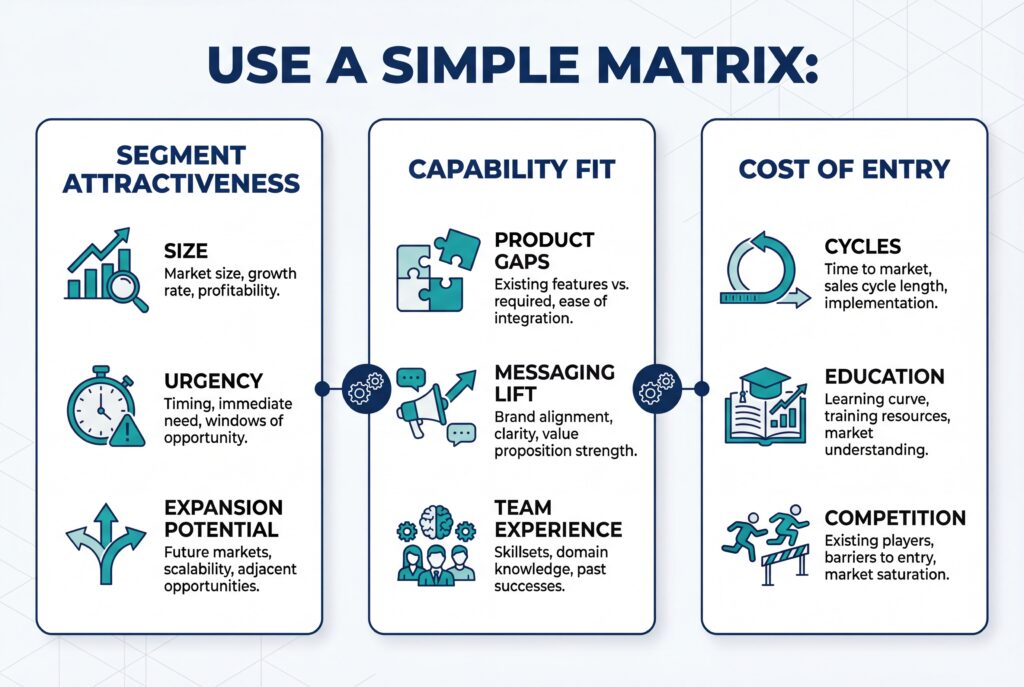
Scale the motion that already works before chasing a new one. Your team feels the shift instantly when leadership jumps too early.
Common Pitfalls That Kill Scale
A few patterns show up in almost every company hitting a ceiling:
- Expanding ICP to “keep pipeline full”
- Hiring too fast
- Letting reps write their own process
- Forecasting by opinion
- Over-relying on hero sellers
All of these are execution failures, not strategy failures.
The cure is clarity. One operating system. Repeatable plays. Tight coaching. Data flowing back to leadership.
The 30-60-90 Implementation Roadmap
First 30 days:
- Clarify ICP
- Define value props
- Tighten stage definitions
- Establish cadence
Days 31–60:
- Roll out updated process
- Launch enablement plays
- Build operating dashboards
Days 61–90:
- Validate capacity plan
- Review pipeline quality
- Adjust strategy based on real signals
How EnableU Makes Strategy Scalable in Practice
A strategy only scales when it becomes execution. Real-time. Daily. In-flow.
EnableU turns your playbooks, signals, coaching frameworks, and data into real-time guidance reps actually follow.
Leaders get:
- Behavior-based forecast signals
- Deal risk visibility
- Methodology adherence
- Manager time back
Reps get:
- Contextual prompts
- Stage-based plays
- Discovery questions
- Buyer intelligence
👉 If you want to see how this works in your own deals, start a free trial and put the system to work immediately.
Frequently Asked Questions
What is a sales strategy framework?
A sales strategy framework is a structured model that defines who you sell to, how you win, and how execution is enforced. It connects ICP, process, methodology, and metrics into one system leaders can inspect and improve.
What does a sales strategy look like in practice?
In practice, a sales strategy shows up as clear stage definitions, enforced behaviors, consistent messaging, and predictable outcomes. You can see it in deal reviews, forecast accuracy, and how quickly new reps ramp.
How do you create a sales prospecting strategy that scales?
A scalable sales prospecting strategy is built on account selection rules, buying signals, and persona-specific messaging. It prioritizes quality conversations over volume and evolves based on conversion data, not activity counts.
What are the different types of sales strategies?
Common sales strategies include transactional, inside sales, enterprise, channel-led, and product-led growth with sales assist. The right choice depends on deal complexity, ACV, buyer maturity, and how decisions are made.
Conclusion
A sales strategy that scales is built to survive pressure. Pressure from targets, from headcount growth, from pipeline gaps, from deals that don’t behave the way the spreadsheet said they would.
Creating a sales strategy is about making deliberate choices. Who you sell to and who you don’t. How value is framed by segment. Which motions fit your buyers. How prospecting, process, and methodology work together as a revenue control system. And how consistency is what unlocks predictable growth.
If you want to see how this becomes daily execution, start a free trial of the Sales Excellence Framework and see how the eight pillars turn strategy into something your team can run on.
Leave a Reply