Some accounts move. Most sit there.
The difference usually isn’t effort.
But timing, signal clarity, and knowing who matters inside the deal.
Account intelligence is how sales teams cut through noise and focus on accounts with real movement – grounded in fit, intent, buying groups, and trigger events.
We’ll break down what account intelligence means in 2026, how to build it properly, and how to use it to drive better conversations and faster deals.
Key Notes
- Five-signal framework separates actionable intelligence from low-value data noise.
- Multi-dimensional scoring outperforms single lead scores for prioritization.
- Account intelligence must map directly to plays, not dashboards.
- Measuring signal-to-action time reveals true system effectiveness.
What is account intelligence?
Account intelligence is a continuous system.
Traditional “research” tends to end as notes. Useful notes sometimes. But notes.
Account intelligence ends as action:
- Prioritize this account today.
- Lead with this initiative and this proof.
- Pull in these stakeholders because you are single-threaded.
- Qualify out because fit is wrong or risk is rising.
- Move the deal because the buying group is moving.
The output is timing + relevance + next-best-action clarity.
Traditional Prospect Research vs Account Intelligence
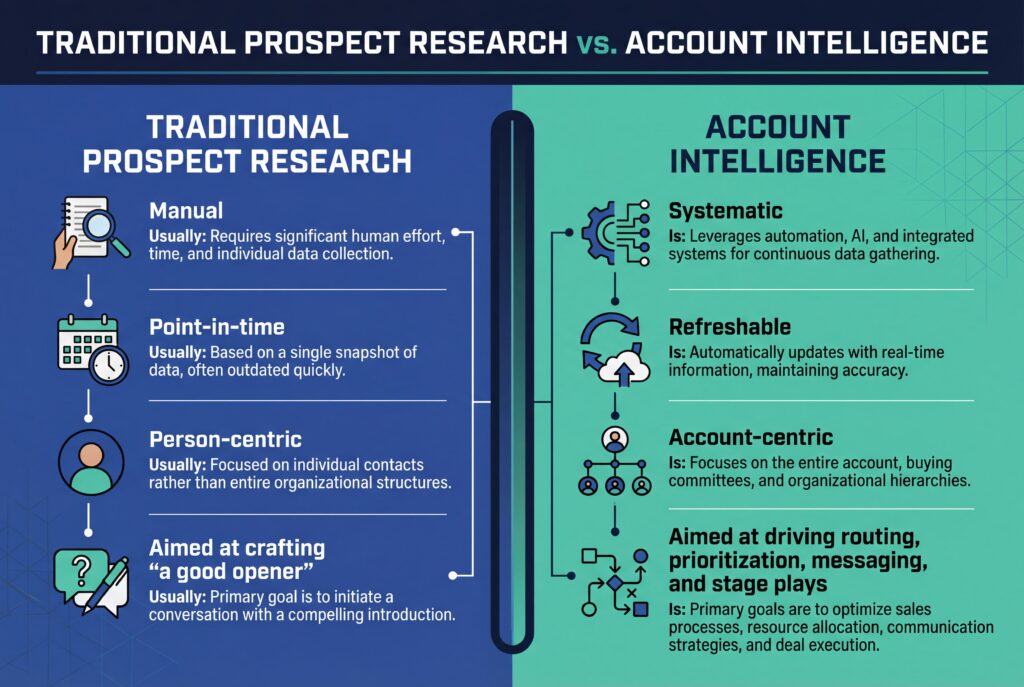
A quick gut check:
- If your work product is a doc, it’s research.
- If your work product is a task queue, an account view, and a play that fires, it’s intelligence.
Account intelligence vs ABM
ABM is the strategy.
Account intelligence is the signal layer.
ABM says “treat these accounts like markets of one.”
Account intelligence answers:
- Which of those accounts are moving right now?
- What are they moving on?
- Who is involved?
- What should sales do today?
ABM without intelligence becomes expensive theater.
Account based intelligence (ABI)
You’ll see “account intelligence” and “account based intelligence” used interchangeably. It’s not worth arguing about terms.
Operationally, account intelligence becomes account based intelligence when it is:
- Formalized against a defined target account universe
- Tiered by value
- Scored by signals
- Connected to repeatable plays
- Shared across Sales, Marketing, and RevOps with clear SLAs
That’s the difference between “some context” and a system the business can run.
What problems Account Intelligence solves that CRM data alone cannot
CRMs are necessary, but they have three hard limits.
1) Data decay.
Contacts move, titles change, initiatives shift, fields go stale.
2) Internal-only perspective.
Your CRM cannot reliably tell you:
- They hired a new CIO and changed priorities.
- They are ramping a team that suggests a new initiative.
- Their stack shifted and your competitor is now exposed.
3) Unstructured sprawl. Notes everywhere, decisions nowhere.
Account intelligence solves those gaps by:
- Monitoring external reality
- Structuring signals
- Making freshness visible
- Turning signals into work
The Account Intelligence Signal Framework
If you don’t define what counts as a signal, your team will collect trivia and call it “insight.”
A strong system covers five signal families. Keep them stable. Everything else hangs off them.
The five signal families:
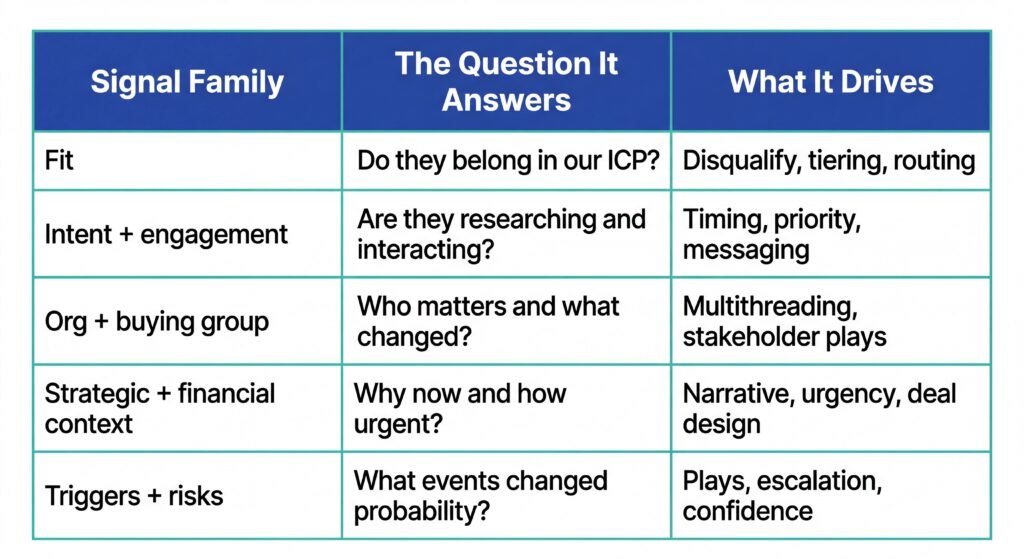
Fit signals (firmographic + technographic)
Fit is the gate. If fit is wrong, intent becomes noise.
High-signal fit inputs usually include:
- Industry and sub-vertical (where you consistently win)
- Employee band and revenue band (ability to pay, deal size proxy)
- Geography (coverage, compliance, support constraints)
- Ownership and growth stage (budget cycles, urgency patterns)
- Technographics (what they run today, and what that implies)
Technographics matter most when you use them as posture:
- A “modernization” posture is different from a “locked-in, long contract” posture.
- A stack consolidation initiative is different from “we bought a tool once.”
Intent & engagement signals (rank them or you drown)
Intent is not magic. It is just a clue.
A pragmatic hierarchy:
- Strongest: first-party high-intent engagement
- Pricing page
- Demo request
- Trial sign-up
- Security docs
- Technical documentation
- Product comparison behavior
- Strong: sustained offsite topic surge
- Multi-week increase in research on your category topics
- Updated regularly, best used with fit and first-party engagement
- Medium: review and community evaluation
- Category comparisons
- Peer validation patterns
- Weak: general social noise
- Broad interest, low buying signal
A clean rule for SDR teams:
Intent without fit is a trap.
Org & buying group signals
In 2026, buying groups are not optional.
Track:
- Buying group shape: which functions are involved
- Centers of influence: where power sits, where blockers sit
- Leadership changes and reorganizations
- Hiring surges by function
- Stakeholder map freshness: who is engaged, who is silent
The most common failure mode is still the same: single-threading.
Your best “account intelligence” might be one simple truth:
You are talking to a user, not a decider.
Then your next step is obvious.
Strategic & financial context
Strategic context is what turns personalization into relevance.
Instead of “I saw you raised funding,” try:
- What does this funding change in their priorities?
- Which initiative is now possible?
- Which constraint is now urgent?
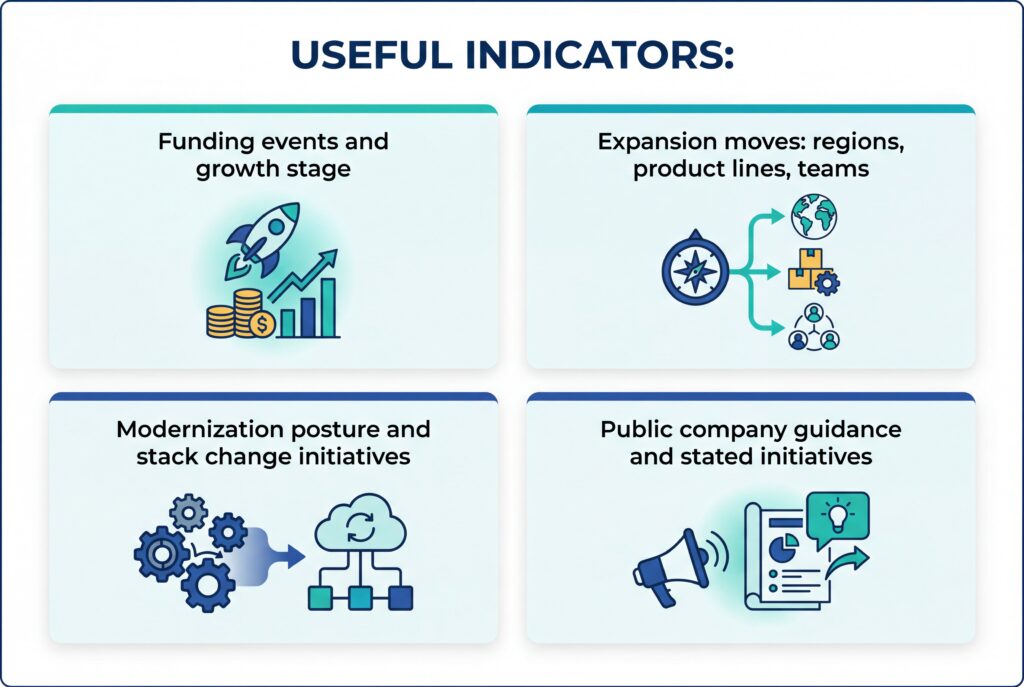
These are urgency proxies.
They are not proof of budget, but they help you ask better questions.
Triggers & risks
Triggers are events that force a decision.
Common triggers:
- Hiring spikes in the department tied to your use case
- Tech stack changes (new adoption, churn, consolidation)
- New executive hires and reorgs
- Competitive pressure signals and RFP patterns
Risks Matter Just As Much:
- Budget freeze
- Exec departure mid-cycle
- Stakeholder churn
- Engagement collapse
- Competitive displacement signals
A mature system does not only chase green lights. It also flags red lights early.
What teams collect that rarely helps
Two categories show up everywhere:
1. Over-collected fields that do not drive a decision.
This creates congested record pages, low adoption, and reps ignoring the system.
2. Unstructured notes with no retrieval strategy.
If managers cannot report on it, and reps cannot find it later, it does not exist.
Designing A System That Produces Actions, Not More Data
A lot of teams start with “what data can we buy?”
Start backwards.
Start from outcomes
Define the actions you want to reliably drive:
- Prioritize accounts
- Trigger outreach
- Multithread the buying group
- Qualify in or out
- Advance stage with next-best actions
Now design the system that produces those actions.
Build the taxonomy & confidence rules
Write down what counts.
Example confidence rules:
- A trigger only counts if sourced and timestamped.
- Intent only counts above a threshold and if fit is confirmed.
- Buying group coverage only counts if critical roles are mapped, not just named.
This sounds pedantic, but it saves you from alert fatigue.
Map sources per signal family
You usually need both first-party and third-party.
First-party sources:
- CRM fields and history
- Sales activity and sequences
- Website and marketing engagement
- Product telemetry (if applicable)
- Call and meeting signals
Third-party sources:
- Firmographic enrichment
- Intent signals
- Technographic data
- Hiring and job postings
- News, strategic moves, competitive shifts
Do not over-index on any single feed. Most feeds are noisy alone.
Standardize storage: summaries vs evidence
This is the part most teams skip.
- Summaries live in fields. They drive decisions.
- Evidence lives as signal records. It preserves history and provenance.
If you overwrite everything with “latest note,” you lose the trail and you lose trust.
Tiering and prioritization (static vs dynamic)
Use two-tier logic:
- Tiering by value (static): revenue potential, strategic logos, expansion potential. Reset quarterly.
- Prioritization by signals (dynamic): intent, engagement, triggers, and risks. Refresh weekly or daily.
This prevents the classic mistake: spending equal time on unequal accounts.
Multi-dimensional scoring (ditch the single magic number)
One score hides too much.
Use a scorecard instead:
- Fit score
- Engagement score
- Intent score
- Buying group coverage score
- Trigger and risk modifier
This makes coaching easier too.
Managers can coach the lever that matters, not argue about a number.
Refresh cadence: match volatility
A practical default:
- Weekly signal refresh
- Monthly account review
- Quarterly tier reset
Fast-moving triggers can shift faster. Just make freshness visible.
Attach plays to signals
This is where intelligence becomes execution.
Examples:
- If fit is high and intent spikes and no first-party engagement, run a light, hypothesis-led outreach play.
- If intent spikes and pricing page visits occur, run a fast-path discovery play.
- If buying group coverage is low, run a multithreading play before pushing stage.
- If risk flags appear (budget freeze), route to manager review and adjust expectations.
If a signal does not map to a play, it will die in a dashboard.
AI In Account Intelligence: What Works & What Breaks
AI is not the point.
Better decisions are.
The shift: from summaries to executed workflows
AI helps in three places:
- Summarization (but structured, not fluffy)
- Pattern detection across sources
- Workflow execution (tasks, routing, next steps)
If your AI output does not drive a next step, it is just a nicer paragraph.
Signals AI can spot that humans miss
Humans miss patterns because we don’t correlate well at scale.
AI can surface:
- Hiring surge + topic surge + first-party engagement happening within a week
- Repeated competitive mentions across calls
- Objection patterns that correlate with churn risk or stall risk
- Stakeholder drift: the champion goes quiet, a blocker shows up
The value is not “a better summary.”
It is “you missed this, and it matters.”
The synthesis pipeline that works
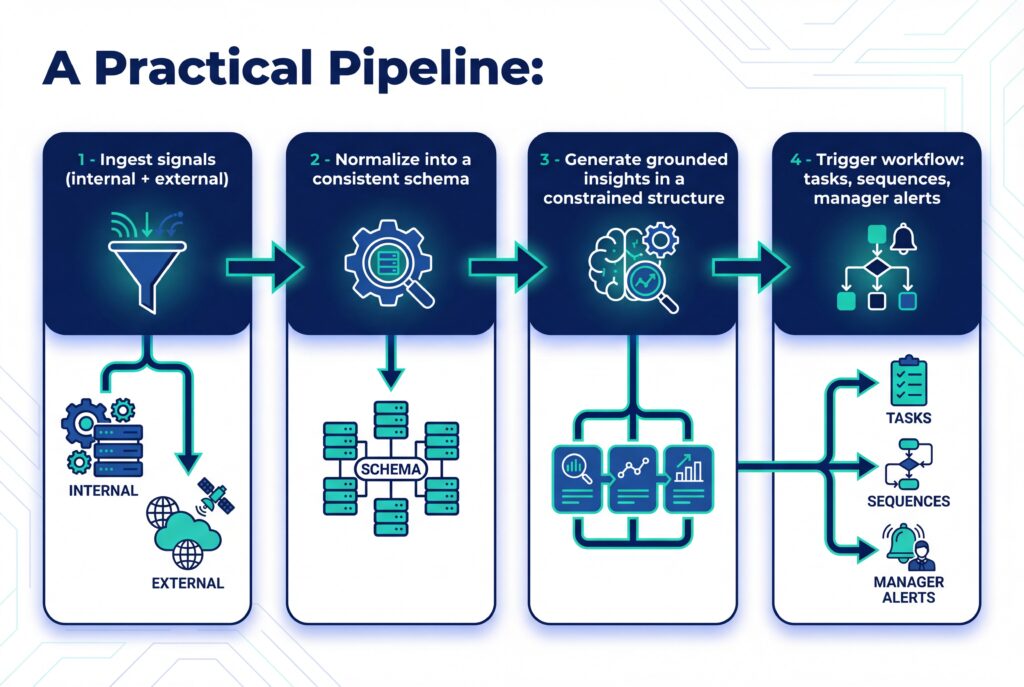
This prevents the classic failure: AI writes a story, reps nod, nothing changes.
Prevent generic AI summaries
Generic summaries happen when the system is allowed to fill gaps.
Controls that help:
- Force structured output: initiatives, buying group, triggers, plays
- Require evidence per claim (source record and timestamp)
- Disallow free-form narratives as the default
If the model can’t point to evidence, it should say “unknown.”
That’s more useful than confident nonsense.
Inputs required for AI to be reliable
AI performance is capped by:
- Clean account and contact structure
- Reliable activity capture
- Consistent signal schema
- Clear ownership of data hygiene
If your CRM is missing, incomplete, duplicated, or expired, AI will amplify that mess.
Risks of over-relying on AI
Fast wrong outreach is expensive.
Key risks:
- Confident fabrication of details
- Governance failures and privacy exposure
- Automation bias: reps stop validating context
A simple guardrail:
AI can draft the move. Humans own the claim.
Using Account Intelligence In Daily Sales Execution
This is where the system pays you back.
Intelligence-driven outreach strategy
Move from persona-first to signal-and-initiative-first.
Persona-first outreach sounds like:
“As a VP of Ops, you care about efficiency.”
Signal-first outreach sounds like:
“Noticed you’re hiring five roles in X team and researching Y. That usually means Z initiative is live. Worth comparing notes?”
This is how you create warm outbound. It is still outbound – it just has timing and a reason.
Multi-threading with buying group clarity
Buying group mapping should not be an AE-only skill.
If you are an SDR, you should be able to answer:
- Who is the likely economic owner?
- Who will validate technically?
- Who will block procurement?
- Who will use the product daily?
Then act.
A practical play:
- If you have one engaged contact, your next goal is not “book a meeting.”
- Your next goal is “confirm the buying group shape and add one more stakeholder.”
Single-threaded deals fail quietly. Until they don’t.
Qualification with evidence
Account intelligence strengthens qualification frameworks because it replaces assumptions.
Instead of “they seem interested,” you can point to:
- Initiative evidence
- Trigger events
- Engagement patterns
- Buying group coverage
- Competitive pressure
It also helps you qualify out faster.
If fit is wrong, stop forcing it.
Stronger discovery conversations
Discovery improves when you enter with hypotheses grounded in signals.
A simple structure:
- What we noticed (signal)
- Why it might matter (initiative hypothesis)
- A question that tests it
Example: “You’ve been hiring in X and evaluating Y tools. Is the goal expansion, consolidation, or something else?”
Now discovery has teeth.
Intelligence across deal stages
Account intelligence should evolve by stage.
Early stage:
- Fit verification
- Trigger context
- Initial stakeholder map
Mid stage:
- Expand buying group
- Track competitive signals
- Monitor momentum and risk
Late stage:
- Security, procurement, and IT blockers
- Consensus risk
- Close plan milestones and decision process clarity
Same account. Different questions.
How intelligence reduces cycle time and lifts win rates
It does not “magically” speed up buyers.
It reduces waste.
- Better timing means fewer dead months.
- Better coverage means fewer last-minute surprises.
- Better qualification means fewer false positives.
That’s where cycle time drops.
Win rate lifts are usually a side effect of fewer bad bets and stronger stakeholder coverage.
Making Account-Based Intelligence Work Across GTM
Sales can’t run ABI alone.
If marketing and RevOps are not aligned, you will get:
- Conflicting scoring
- Duplicate outreach
- Confusing handoffs
- A system nobody trusts
ABI operating model: shared definitions & shared SLAs
This is the boring part that creates results.
- Shared tiers
- Shared score definitions
- Shared trigger thresholds
- Shared plays
- Clear SLAs for when marketing triggers SDR action
If a play is unclear, it won’t fire.
RevOps responsibilities (truth in system)
RevOps owns:
- Taxonomy governance
- Data model and hygiene
- Automation architecture and safety patterns
- Measurement design: coverage, freshness, adoption, outcomes
They keep the system stable when the rest of the business wants speed.
Enablement responsibilities (what to do when)
Enablement owns:
- Plays tied to signals
- Talk tracks and messaging frameworks that align to initiatives
- Coaching patterns and inspection checklists
If the system says “intent spike,” enablement should define the best outreach motion and the proof points to lead with.
Structure that holds up
The roles that make this work:
- A GTM Intelligence owner (often RevOps)
- A play owner (enablement)
- A manager coaching cadence tied to the intelligence dashboards
Without the coaching cadence, adoption fades.
Measuring What Matters & Improving The System
Most teams measure activity because it is easy.
Measure intelligence because it changes outcomes.
Effectiveness metrics: three levels
1) Productivity
- Research time saved
- Tool switching reduced
- Fewer pointless accounts worked
2) Pipeline Impact
- Meeting rate from in-market accounts
- Opp creation rate on triggered accounts
- Velocity changes on intelligence-complete accounts
3) Quality Impact
- Reduced irrelevant outreach signals
- Better reply sentiment
- Lower unsubscribe and complaint rates
Buyers punish irrelevance.
Your metrics should reflect that.
Account Intelligence KPIs that SDRs & managers should track
For SDR teams:
- Intelligence coverage by tier
- Signal-to-action time (median)
- Meeting booking rate on triggered accounts vs baseline
- Pipeline created per rep from intelligence-driven work
For managers:
- Buying group coverage rates
- Stale intelligence by tier
- Adoption by rep and team
- Outcome deltas: intelligence complete vs not
Hygiene warning signs
If you see these, your system is drifting:
- Refresh dates are stale
- Notes are full but fields are empty
- Alerts are ignored because they are noisy
- Duplicate contacts and expired titles everywhere
A good system makes drift visible early.
A clean way to compare intelligence-driven vs not
You do not need a perfect experiment.
Do this:
- Define an “intelligence complete” threshold.
- Tier set
- Fit score present
- Top intent topic captured
- Buying group roles mapped
- Recent trigger or engagement
- Compare outcomes against matched accounts in the same segment.
Track meeting rate, opp rate, cycle time, and win rate deltas over a quarter.
If the deltas are flat, your intelligence might not be connected to plays.
That’s usually the problem.
Common misconceptions & waste patterns
Misconceptions:
- “It’s enrichment.” No, enrichment is one input.
- “It’s intent.” No, intent is one signal family.
- “AI summaries equal intelligence.” Not without evidence and workflow.
Waste patterns:
- Tool sprawl with no centralization
- Buying data without activation plays
- Ignoring data hygiene while asking AI to be accurate
How To Use EnableU For Account Intelligence
If you already have signals, enrichment, and CRM data – the real question is simple:
How do you turn that into better conversations and faster deals?
Here’s where Deal Pilot fits.
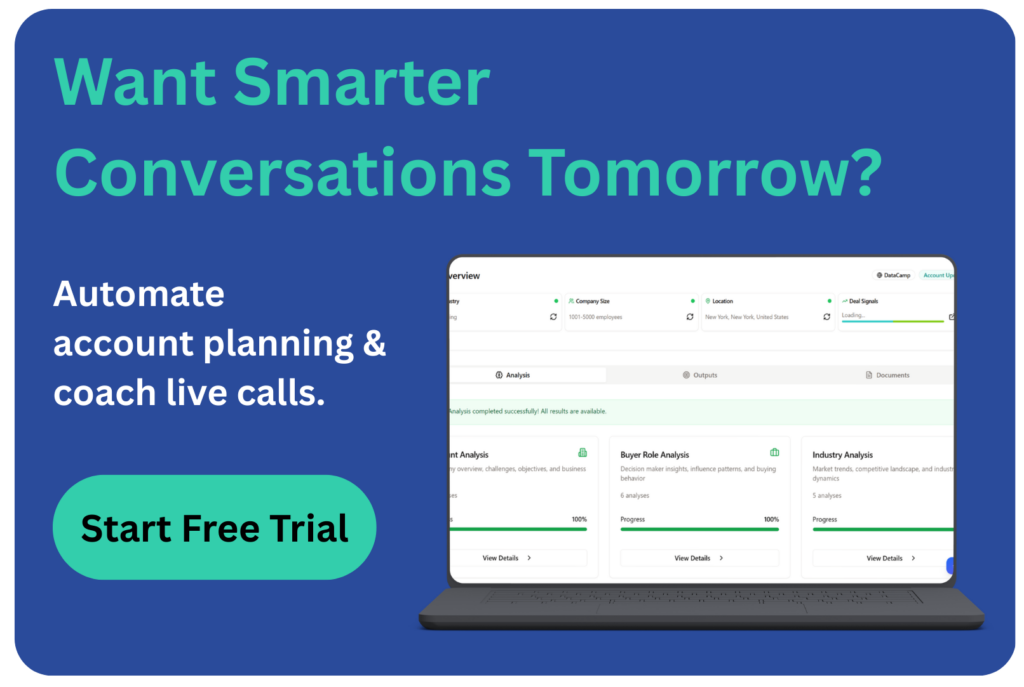
- Generate structured account analysis in minutes. Select the company and buyer role. Get a clean breakdown of company context, buyer priorities, and industry dynamics – ready to use, not buried in tabs.
- Get role-specific buyer insight. See how a CFO thinks differently from a VP Ops. Understand influence patterns, decision dynamics, and likely objections before the call.
- Surface buying signals that matter. Combine intent data, behavioral signals, and competitive movement into one view so you’re not relying on outreach alone.
- Create contextual discovery questions. Generate tailored questions aligned to buyer role, industry, and deal stage – so discovery feels informed.
- Build relevant messaging and collateral instantly. Produce outreach sequences, social messages, decks, or ROI analyses grounded in the account’s reality (not templates).
- Coach in the moment during live conversations. Get real-time guidance and next-best-action suggestions based on conversation flow, buyer role, and deal stage.
- Connect signals to next moves automatically. Turn account context into actionable recommendations – who to involve, what to say next, and how to accelerate momentum.
The point is not “more intelligence.”
It’s usable intelligence that shows up in the workflow and drives action – account planning, messaging, discovery, and deal progression – without adding hours of manual research.
That’s where account intelligence starts compounding.
Frequently Asked Questions
What is account intelligence in sales?
Account intelligence is a structured system that combines internal CRM data, external signals, and buyer context to guide prioritization, messaging, and deal progression. It goes beyond research by continuously updating and triggering actions based on what changes inside an account.
How is account based intelligence different from traditional ABM?
Account based intelligence focuses on signal monitoring and decision support across a defined target account list. ABM defines who to target and how to engage. Account based intelligence determines when to act, who to involve, and what message aligns with real-time buying conditions.
What should an account intelligence view in Salesforce include?
An effective account intelligence view in Salesforce should surface signal changes, buying group coverage, fit and intent scores, and recommended next actions. It should answer “what do I do now?” in under 30 seconds, not overwhelm reps with unused fields.
Is account intelligence only useful for enterprise sales teams?
No. While complex enterprise deals benefit heavily from structured intelligence, mid-market and SMB teams use account intelligence to prioritize limited resources, reduce wasted outreach, and identify high-probability opportunities faster. The value scales with complexity, but it is not limited to it.
Conclusion
Account intelligence is the difference between activity and intention. It moves sales from scattered research and stale CRM notes to structured signals that drive prioritization, multithreading, qualification, and stage progression.
When fit, intent, buying group coverage, triggers, and risk are visible and connected to plays, reps stop guessing. Managers stop coaching from hindsight. And pipeline becomes more predictable because effort is focused where movement is real.
If you want to see how Deal Pilot turns account intelligence into real-time account planning, discovery guidance, and in-call coaching, start a free trial and test it on a live account this week.
Leave a Reply