You can feel it when research is dialed in.
The opener lands. The prospect leans in. The conversation moves.
You can also feel when it’s rushed or overcooked.
Either you sound generic, or you sound like you’re trying too hard.
So the real question behind how do you research a sales prospect is this: how much is enough to be relevant without slowing yourself down?
We’ll break down a practical, time-boxed system that keeps research sharp, fast, and useful.
Key Notes
- Time-box research to 3, 5, or 15 minutes based on deal stage.
- Convert research into three outputs: reason, hypothesis question, next step.
- Automate company, buyer, and industry analysis instantly with AI-powered synthesis.
What “Research a Sales Prospect in Minutes” Means
When people ask how do you research a sales prospect, they usually mean, how do I sound like I did my homework without losing my whole day?
In modern B2B, quick prospect research is time-boxed, decision-oriented preparation.
You collect just enough verified context to:
- Confirm fit
- Find one plausible timing signal
- Understand the prospect’s scope and relevance
- Tailor an opener that is true and specific
- Walk into the first call without doing cold, low-value discovery
Different goal for SDRs vs AEs
- SDR goal: earn attention and book the next step with a credible reason.
- AE goal: walk in with a defensible point of view, a draft stakeholder map, and questions that validate or invalidate your hypothesis.
Same research building blocks. Different depth.
The Prospect Research Operating System
Use four buckets:
- Internal truth: what your org already knows.
- Company reality: what they do, who they serve, how they make money.
- Buyer context: scope, incentives, and decision proximity.
- Signals and timing: why now, intent, and competitive context.
If you keep your notes in these buckets, two good things happen:
- You stop duplicating effort.
- You can standardize research across the team.
Mission-critical vs nice-to-have
A clean filter:
- Mission-critical information changes what you do next.
- Nice-to-have information is interesting but does not change your opener, CTA, or discovery plan.
Mission-critical In Most Outbound:
- Correct understanding of what the company does and who they serve.
- One credible trigger or priority clue.
- Correct understanding of the prospect’s scope.
- One safe, public detail you can reference without guessing.
Nice-To-Have In Most Outbound:
- Deep competitor analysis for a low-likelihood cold touch.
- Personal “fun facts.”
- Anything you cannot cite back to something public and business-relevant.
The X-Minute Frameworks (Pick Your Time Box)
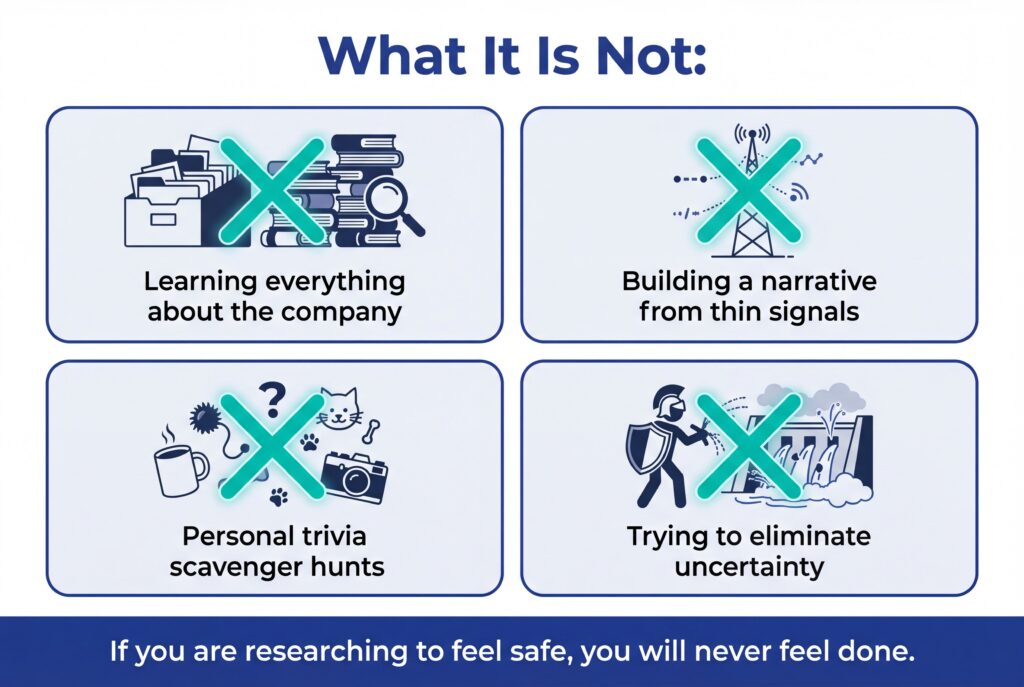
Without a time box, research becomes anxiety management.
You open more sources. You still do not know what to say.
Here are three time boxes that map to how real prospecting works:
The 3-Minute 3×3 Sprint (Pure speed)
Use when:
High-volume outbound, list work, cold call blocks.
Goal:
3 relevant pieces of information, then stop.
3 minutes, 3 inputs:
- One company signal (growth, hiring, launch, expansion).
- One buyer signal (scope language, recent post, role responsibility).
- One fit signal (segment, department size, customer profile clues).
Output:
One hypothesis question you can ask on call or use in email.
If you cannot turn the info into a hypothesis question, it was not relevant.
The 5-Minute Sprint (Best default for SDR outbound)
Use when:
You want personalization without killing volume.
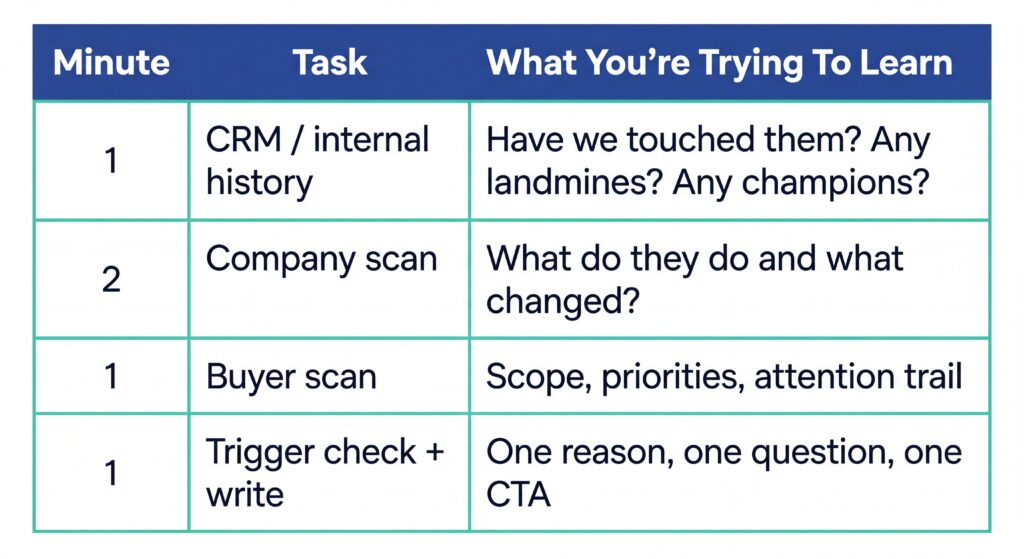
You are not trying to be brilliant.
You are trying to be specific and safe.
The 10 to 15-Minute Sprint (AEs, higher-value accounts, first calls)
Use when:
Meeting booked, referral intro, higher ACV, complex buying committee.
Adds three things:
- A draft stakeholder map.
- Two to three hypotheses.
- A short discovery plan that avoids basic questions.
Stage-based depth (how to avoid over-investing early)
- Cold outbound: Keep research light. Earn the right to go deeper.
- Meeting booked: Go deeper. You can now justify the time.
- Active opportunity: Deepen around buying committee, constraints, and competition.
This is how you protect volume while still sounding like you belong in the conversation.
Step 1: Start With Internal Truth (Fastest wins)
This is the step most reps skip.
Then they waste time relearning what their own org already knows…
Start with your CRM and internal tools.
What to pull fast
- Prior touches and notes.
- Any open or closed opportunities.
- Past champions.
- Email engagement or inbound activity.
- Call recordings and summaries.
- “Already using competitor” notes.
Quick checks that prevent embarrassment
- Are they already in pipeline?
- Did someone already reach out this week?
- Did they already say no, and why?
- Is there a current support or implementation issue that makes your timing terrible?
Output from Step 1
Write this in one line:
- Internal truth: “We have / have not engaged them before, and here’s what happened.”
And one line:
- Landmine: “Avoid this claim or angle because we already know X.”
That is it. Move on.
Step 2: Company-Level Research (What the business is doing)
This is where you build the anchor.
If you do not understand the business, the rest of your personalization becomes random.
The 60-second website scan
Do not read the whole site.
Scan for:
- What they sell.
- Who they sell to.
- Outcomes they claim.
- Proof signals like customer stories, logos, or case studies.
- Any obvious strategic shift (new product, expansion, partnership).
The goal is to avoid lazy outreach errors.
How to research a company for sales without guessing
Ask four questions and write short answers:
- What do they do? One sentence.
- Who do they do it for? Segment clues.
- What do they promise? The outcomes they sell.
- What is the proof? Logos, case studies, quantified claims.
If you cannot answer those in minutes, you are not reading. You are wandering.
How they make money (model signals)
You do not need their P and L.
You need model cues that change how you approach:
- Self-serve vs sales-led language.
- “Request a demo” gating.
- Pricing structure if public.
- Partner or reseller programs.
- Implementation language.
These cues help you avoid pitching like the wrong category.
Directional growth or struggle indicators
Fast prospecting prefers directional signals over perfect signals:
- Headcount trend.
- Hiring concentration by function.
- New leadership hires.
- Sudden hiring spikes.
None of these are “proof.”
They are context.
Red flags that signal low intent
Quick prospecting red flags are mostly mismatch:
- No credible trigger and no visible initiative.
- Your angle requires assuming internal problems.
- The company is clearly outside your fit.
If you do not have a plausible why now, do not force it.
Move to the next account.
Step 3: Buyer-Level Research (Scope, incentives, relevance)
This is where you stop selling to a title and start selling to a person’s remit.
You are rarely proving authority in minutes.
You are estimating decision proximity.
Decision-maker vs influencer signals
Look for scope language:
- Own
- Lead
- Responsible for
- Budget
- Reporting to
A title can lie. Scope language usually does not.
What to look for on LinkedIn beyond job title
This is the high ROI stuff:
- Attention trail (what they post or comment on. It tells you what they want to be associated with)
- Tenure and “prove myself fast” moments (new in role, recent promotion, lateral move)
- Shared connections (warm paths matter more than clever copy)
Keep it simple.
You are gathering angles, not writing a biography.
Safe personalization vs creepy personalization
If you want a rule that holds up:
If you cannot explain why the detail matters to their business outcomes, do not use it.
Good personalization is:
- Public
- Role-relevant
- Explainable
Bad personalization is:
- Surveillance-y
- Overly personal
- Based on guesswork
If you feel a tiny bit weird writing it, your prospect will feel worse reading it.
The highest-impact mistakes reps make here
- Wrong assumptions stated as facts.
- “Congrats on X, so you must be struggling with Y.”
- AI-generated details used without verification.
If you only change one habit: turn interpretations into questions.
Step 4: Signals, Timing & Competitive Context (The why-now layer)
Trigger events matter because most outreach fails on timing, not value.
A good trigger event has two traits:
- It plausibly changes priorities or budget.
- It creates urgency or a deadline.
Trigger events that usually matter
- Funding.
- Leadership change.
- Product launch.
- New market entry.
- Expansion, new office, new region.
- M and A.
- Hiring spikes in a function tied to your value.
Not every trigger is good.
A trigger only matters if it connects to a plausible problem you can help solve.
Should you research competitors?
Yes, selectively.
Do it when it changes your hypothesis or your positioning:
- You suspect displacement is the path.
- The prospect is reacting to a competitor move.
Skip deep competitor research when:
- You are doing low-likelihood cold outreach.
- You do not yet have engagement.
Earn the right to go deeper.
Fast signals they already use a competing solution
- Technographic checks that hint at their stack.
- Job postings listing tools or workflows.
- Review and research intent signals.
This is not about dunking on competitors, but about having a credible why change.
Job postings are underrated research
A job posting can tell you three things fast:
- Priority. They are investing now.
- Capability gap. What they do not have yet.
- Stack dependencies. What tools or skills are already in play.
This is why scanning the careers page belongs in minutes-based research.
When to use public filings & earnings (Enterprise only)
If the account is public or enterprise-grade, investor materials can show:
- Strategic priorities.
- Constraints.
- Risk language they will not put in marketing copy.
Use this sparingly. It is powerful, but it is not a default move.
Turn Research Into Action (The only part that matters)
Research is not a hobby.
If you do not convert it into a clean reason and a clean question, it did not happen.
The Required Outputs Of Every Research Sprint
You need three artifacts. Short. Repeatable.
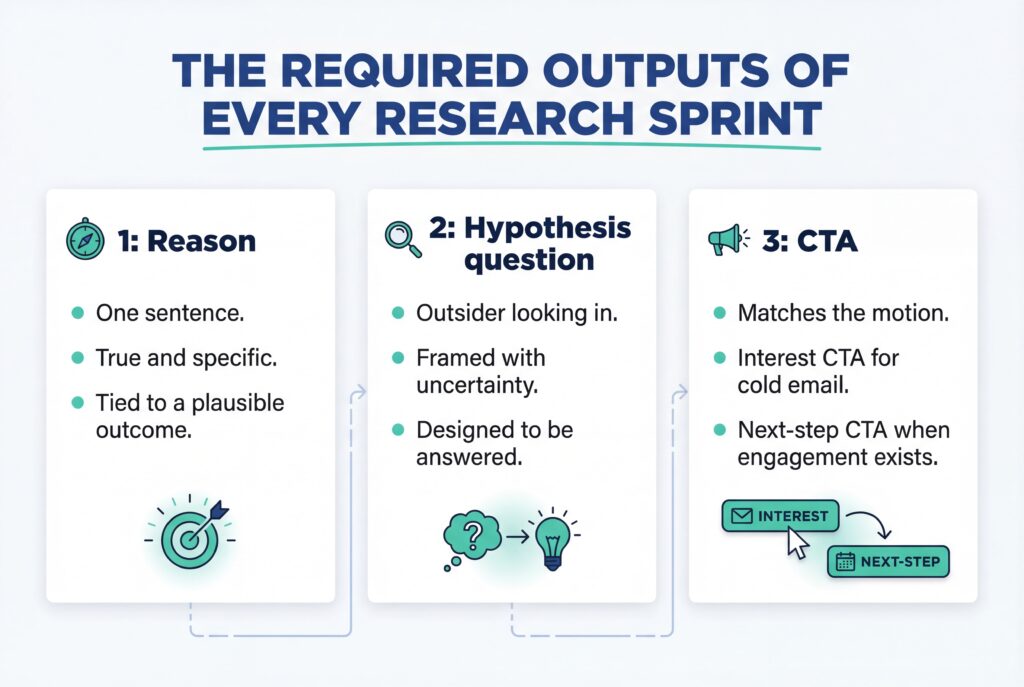
If you cannot write these in 60 seconds after researching, you researched the wrong things.
A simple template you can copy
Reason:
“I noticed [observable signal]. Reaching out because teams usually run into [plausible problem] when that happens.”
Hypothesis question:
“As an outsider looking in, is [hypothesis] something you are focused on this quarter?”
CTA (interest-based):
“Worth a quick compare, or should I disappear?”
That last line sounds blunt. It works because it respects time.
Cold email opener pattern (3×3 to hypothesis)
Keep it tight.
- Line 1: observable.
- Line 2: plausible impact.
- Line 3: question.
Example pattern:
“I saw you are hiring [role] and your team has grown over the last [period]. When that happens, consistency in [process] usually breaks before anyone notices.
Are you tightening that up this quarter, or is the focus elsewhere?”
Then your CTA should be interest-based, not a calendar shove.
Cold call opener pattern (less content, more control)
A cold call is not an essay.
- Permission.
- One reason.
- One question.
Example:
“Hey [Name], this is [You]. Quick one. I saw [signal] and figured you might be looking at [area]. Am I totally off?”
If they say “off,” you learned something.
If they say “no,” you have a thread.
Discovery call prep outputs (AEs)
For a booked first call, you should walk in with:
- Call objective.
- Two to three hypotheses.
- The first three questions that validate the hypotheses.
- A draft stakeholder map and multi-thread plan.
This stops discovery from being a generic checklist.
How To Automate Prospect Research
Everything above assumes you are manually stitching signals together.
That works. It just does not scale.
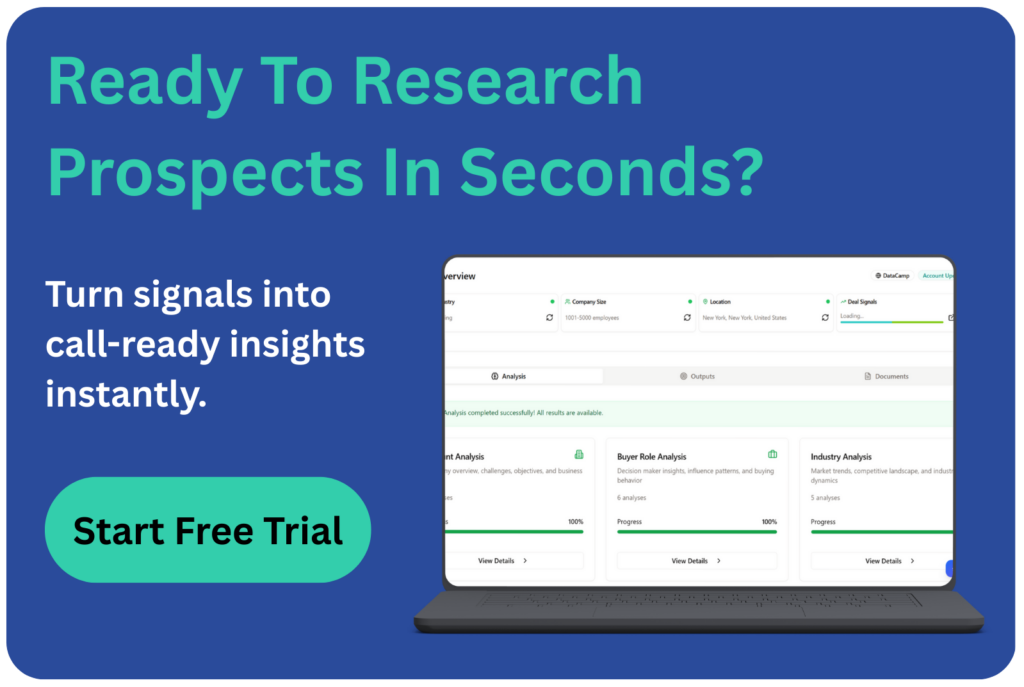
A tool like Deal Pilot compresses the entire research workflow into one input: company + buyer role.
In seconds, it generates:
- Account Analysis: Clear overview of company priorities, objectives, and likely challenges.
- Buyer Role Analysis: Decision proximity, influence patterns, buying behavior, and pressure points.
- Industry Analysis: Market dynamics, competitive landscape, and macro forces shaping urgency.
- Buying Signals: Real-time intent indicators and behavioral clues that suggest readiness.
Instead of opening five tabs, you get structured intelligence in one view.
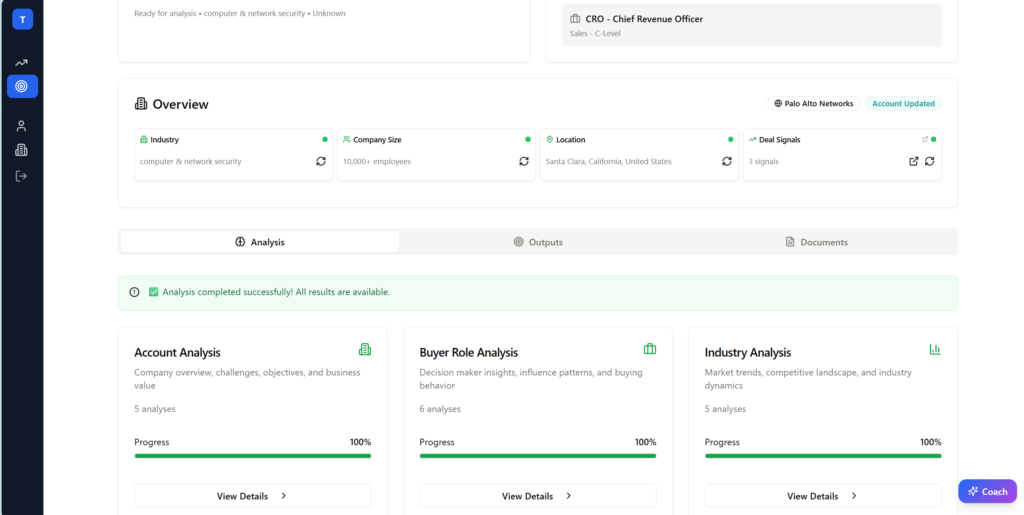
What EnableU’s Deal Pilot Replaces
Manual prospect research typically involves:
- Scanning websites
- Checking LinkedIn
- Digging through CRM notes
- Searching for triggers
- Guessing at industry pressures
- Writing discovery questions from scratch
Deal Pilot does that synthesis instantly.
You no longer have to spend 30–60 minutes preparing for a call. 3–5 minutes is all you need to review insights and refine the angle.
👉 See what instant, signal-driven prospect research looks like in your own accounts – start your free trial.
Walkthroughs (What this looks like in real minutes)
These are not perfect scripts.
They are examples of “enough” research.
Walkthrough 1: VP of Sales at a mid-market SaaS company (AE first call)
Goal:
Open with a credible why now, avoid wrong assumptions, map a buying group.
Internal truth (1 minute):
- Check CRM for prior touches.
- Look for old champions, old losses, or competitor notes.
Company reality (3 minutes):
- Website scan: positioning, segment, customer stories.
- Any launch or announcement.
- Careers scan: are they hiring RevOps, enablement, sales ops?
Buyer context (3 minutes):
- LinkedIn – what does the VP talk about? Hiring, pipeline, process, GTM changes?
- Scope language in profile.
Org map (2 minutes):
- Identify likely partners: RevOps leader, enablement, finance partner.
Outputs:
Reason:
“I saw you are hiring [RevOps role] and pushing headcount up. Reaching out because process drift shows up fast when teams scale.”
Hypothesis question:
“As an outsider looking in, is forecast discipline the priority, or is it pipeline creation right now?”
Call opening line:
“I may be off, but it looks like you are scaling the team and tightening ops at the same time. Where is the biggest leak right now?”
Notice what is missing – no grand claims, no assumed pain. Just a credible angle.
Walkthrough 2: Manufacturing operations leader (SDR outbound)
Goal:
Connect public operational signals to measurable ops outcomes.
Company scan (2 minutes):
- What do they produce and for which industries?
- Any plant footprint or expansion.
Trigger scan (2 minutes):
- Careers page: maintenance, automation, quality roles.
- Any operational announcements.
Buyer scan (1 minute):
- Role scope and what they talk about.
Pick one common KPI anchor:
In manufacturing, a safe common language metric is OEE. You are not teaching it. You are using it to ground the conversation.
Outputs:
Reason:
“Noticed you are adding automation and maintenance roles. Reaching out because that usually signals a push on uptime and throughput.”
Hypothesis question:
“Is the priority improving uptime, or is quality and yield the bigger push this quarter?”
Email opener:
“Saw the automation hiring. When plants ramp that kind of investment, the first win is usually fewer unplanned stops. Are you aiming at uptime this quarter, or quality yield?”
This is what industry tailoring looks like. It narrows the hypothesis space.
Walkthrough 3: Referral intro (SDR or AE)
Referral intros reduce distrust. They do not remove the need to be prepared.
Research changes in two ways:
- You index on the introducer context.
- You keep the message shorter.
In a referral intro, the goal is alignment, not persuasion.
Outputs:
- “Here’s what I understand about your priorities based on [introducer context].”
- One question.
- One low-friction next step.
Walkthrough 4: Multi-threading plan for a live deal (AE)
When you multi-thread, research stops being person-based.
It becomes:
- Role-based pain mapping across functions.
- Identifying gaps in the buying committee.
A quick structure that works:
- Tier 1: economic buyer and direct reports.
- Tier 2: functional owners who feel the workflow pain.
- Tier 3: technical or risk stakeholders.
Research each tier for:
- What success looks like.
- What they are measured on.
- What could block them.
That is how you avoid the single-thread stall.
Quality Control & Metrics (How to know research is working)
Research is “good” only if it changes outcomes.
Rep-level signs it is working
- Your openers are specific without being overconfident.
- You spend less time on basic discovery.
- You get to real constraints faster.
- You expand stakeholders earlier.
Team-level metrics worth tracking
If you want this to scale beyond top reps, measure it.
- Research time per account by tier.
- Reply rate by tier.
- Meetings booked per hour.
- Meeting-to-opportunity conversion.
- Cycle time for researched vs non-researched deals.
Standardize the output, not the browsing
Do not police how people research.
Standardize what gets recorded:
- One-field prospect brief in CRM.
- One sentence reason.
- One hypothesis question.
- One next step.
This is how you enforce quality without turning everyone into librarians.
Frequently Asked Questions
What is the difference between sales prospect research and lead research?
Sales prospect research is deeper and role-specific. It focuses on decision proximity, timing signals, and hypotheses you can test. Lead research is often surface-level qualification. Prospect research is about relevance and progression, not just contact validation.
How do you balance researching prospects with hitting daily activity targets?
Time-box it. Tier your accounts. High-value or engaged prospects get 10–15 minutes. Cold list work gets 3–5. The goal is not maximum information. It is maximum usable insight per minute.
What’s the best way to research a company for sales in a new industry?
Anchor on business model, customer segment, and hiring patterns first. Then learn the 2–3 KPIs that matter most in that industry. You do not need mastery. You need enough context to form a credible hypothesis.
How does prospect research change when you’re learning how to prospect for sales at scale?
At scale, consistency beats creativity. Standardize the output format, not the browsing process. A repeatable brief template ensures researching prospects improves reply rates without killing volume.
Conclusion
If you’re wondering how do you research a sales prospect, the real question is how to get relevant fast without killing volume.
The answer is structured, time-boxed research across four buckets: internal truth, company reality, buyer scope, and timing signals. Three minutes for list work. Five for solid outbound. Ten to fifteen when a deal earns it.
Then convert it into what moves pipeline: one reason, one hypothesis question, one next step. No tab spirals, and no guesswork dressed up as personalization.
If you want that level of research quality without the manual lift, start a free trial of Deal Pilot. Provide the company and role, and see how structured, signal-driven prospect research changes your next conversation.
Leave a Reply