Sales quota conversations tend to get tense fast.
The number drives hiring, comp, forecasting, and board conversations in one shot.
Set it right and the system hums.
Miss the math and you spend the year explaining variance instead of managing performance.
We’ll break down what a sales quota is, how different models behave in practice, and how to set sales quotas using real operating data.
Key Notes
- Healthy quota attainment depends on balanced distribution, not headline percentages.
- Quota type must match role control: revenue, volume, activity, margin, or hybrid.
- Coverage math links quota to win rates, deal size, and pipeline reality.
What Is A Sales Quota?
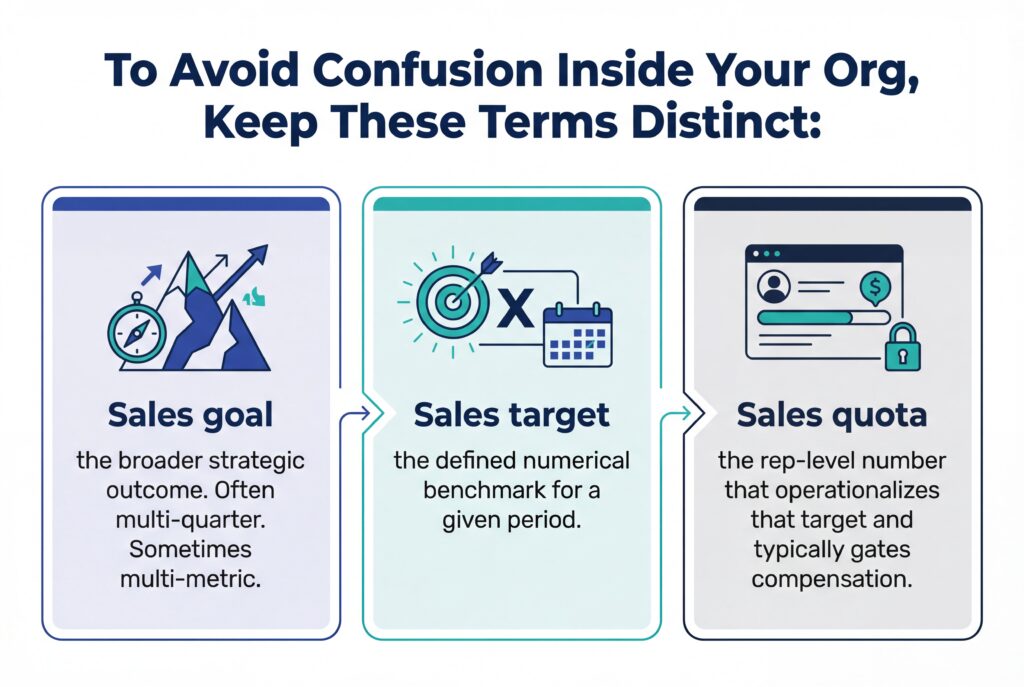
At its core, a sales quota is an assigned, measurable, time-bound performance expectation for a seller or team.
It is used for performance evaluation and incentive pay.
That definition sounds simple.
But the implications are not.
In practical terms, a sales quota is:
The operational translation of the company’s revenue target into seat-level production.
It answers one question:
What must this specific role, in this specific territory, produce for the company to hit plan?
Keep sales terms distinct
How Often Do Reps Actually Hit Quota?
There are two different conversations that often get blended together.
- Attainment percentage. Actual divided by quota. Example: 85% to plan.
- Percent of reps hitting quota. The share of sellers at or above 100%.
Modern B2B reality is sobering.
In many SaaS environments, fewer than half of reps hit quota in a given period. Low 40% attainment rates are not unusual in certain markets.
Does that automatically mean your team is broken?
No.
The distribution matters more than the headline number.
Healthy quota design typically aims for a distribution where a meaningful majority can hit in a normal year, but not so many that quota stops differentiating performance or incentive costs explode.
As a working heuristic, many mature orgs target something like 55–65% of fully ramped reps at or above plan.
That is not universal. It depends on volatility, market maturity, and role design.
Interpretation matters:
- If 80% of reps hit quota, either quotas were conservative, the market delivered a tailwind, or crediting rules are generous.
- If 30% hit quota, it is rarely a pure coaching issue. It is usually structural – territory potential mismatch, capacity exceeding TAM, pipeline starvation, extended sales cycles.
Types of Sales Quota
Most sales quota models fall into a small number of measurement categories. The type you choose determines behavior.
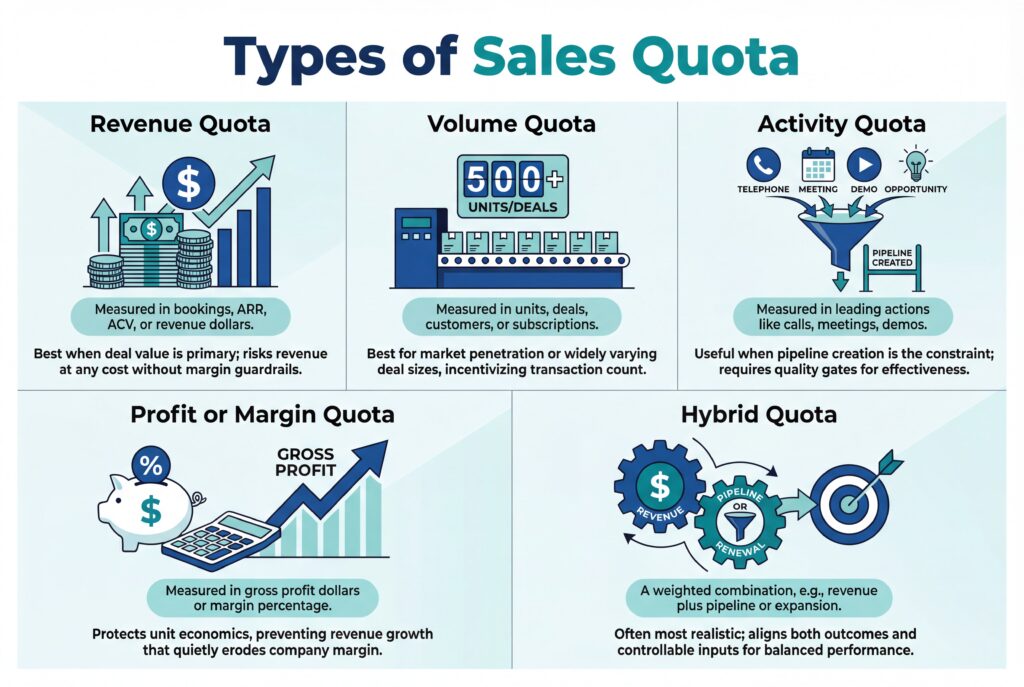
Revenue Quota
The most common structure. Measured in bookings, ARR, ACV, or revenue dollars.
Revenue quotas work best when deal value is the primary growth lever and revenue crediting is clean. Enterprise SaaS is the classic example.
The risk is revenue at any cost. Without margin or mix guardrails, sellers can discount aggressively and still hit revenue.
Volume Quota
Measured in units, deals, customers, or subscriptions.
Volume quotas make sense when saturation or market penetration is the objective, or when deal sizes vary so widely that deal count is a better behavioral lever than revenue.
Transactional sales environments often rely on this structure.
Activity Quota
Measured in leading actions such as calls, meetings, demos, or opportunities created.
Activity quotas are useful when pipeline creation is the constraint or when deal outcomes lag too much to manage weekly.
But they require quality gates. Meetings held, not just booked. ICP fit, not just calendar fills. Otherwise you incentivize noise.
Profit or Margin Quota
Measured in gross profit dollars or margin percentage.
This model protects unit economics. As companies scale and CFO scrutiny increases, profit-based quotas prevent revenue growth that quietly erodes margin.
Hybrid Quota
A weighted combination.
For example, revenue plus pipeline creation, or expansion revenue plus renewal rate.
Hybrid structures are often the most realistic because they align both outcomes and controllable inputs.
Role-Based Quota Design
Where most quota programs break is not the number, but misalignment between role and measurement.
SDR or BDR Quotas
SDRs typically do not control closed revenue. Their quota is often meetings held, SQLs accepted, or pipeline created.
A serious SDR quota includes:
- Meetings held, not just scheduled.
- Clear acceptance criteria for quality.
- A backtest of meeting to SQL to closed-won conversion.
If historical conversion math shows that 20 meetings produce one closed deal and you need five deals per month to justify AE quotas, then SDR quota is not a vanity metric. It is part of the revenue chain.
AE Quotas
AEs are usually quota’d on revenue or bookings.
In more complex models, you may add:
- Product mix weighting.
- Margin thresholds.
- Multi-year contract multipliers.
The most common mistake is ignoring coverage math.
If the AE’s win rate is 25%, the rep needs roughly 4x pipeline coverage to break even. If you assign a revenue quota that implies impossible coverage, coaching becomes theater.
Account Management & Customer Success Quotas
Renewals, expansion revenue, and net retention often sit here.
Comp mix matters. Many CS roles run heavier base, lighter variable to avoid turning relationship managers into aggressive sellers.
You can design expansion quota with a renewal floor gate.
Example:
- Primary quota: expansion ARR.
- Secondary gate: minimum renewal rate.
That protects retention while still rewarding growth.
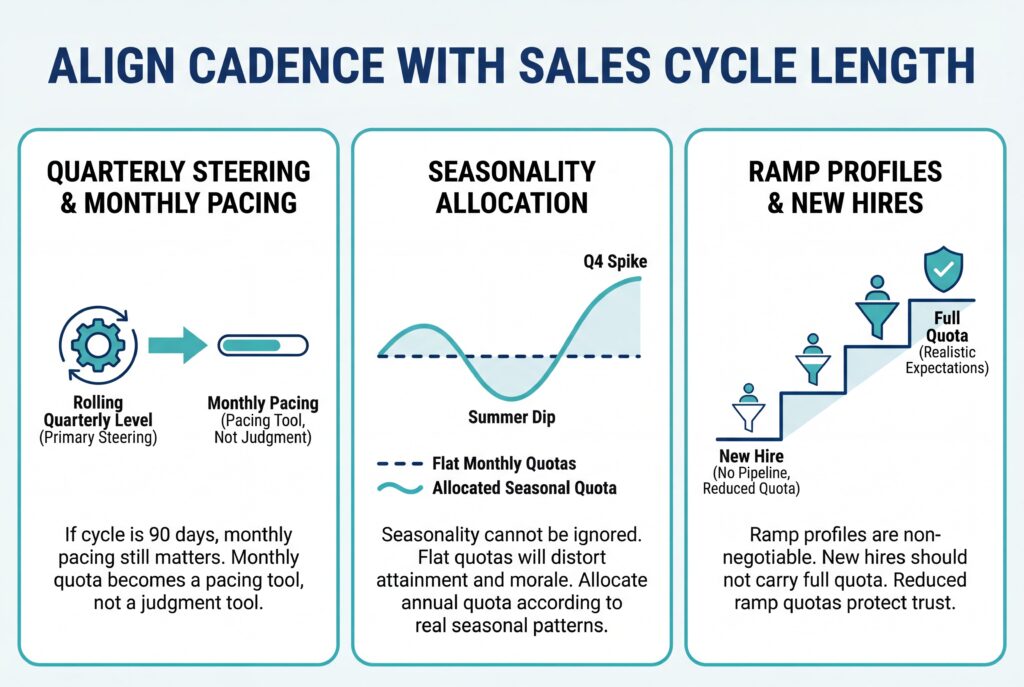
Quota Cadence & Time Horizons
Monthly. Quarterly. Annual.
The cadence you choose shapes selling behavior.
Monthly
Monthly quotas create tight feedback loops. They also create end-of-month compression and can distort behavior in longer-cycle sales.
Quarterly / Annual
Quarterly or annual quotas better match enterprise cycles but require stronger pipeline management discipline because slippage risk increases.
Sales Quota Examples
Examples are useful only if they reflect real math.
Example 1: Monthly Quota for a SaaS AE
Assume an annual quota of $800,000 in ACV.
Simple monthly pacing equals about $66,700.
But that is just arithmetic.
If average deal size is $20,000 and win rate is 25%:
- Required closed deals per month: about 3 to 4.
- Required qualified pipeline: roughly 4x quota, or about $267,000 in pipeline slated to close.
If the territory historically only supports $150,000 of late-stage pipeline per month, the quota is not realistic. It implies either a win rate increase or territory expansion.
Example 2: SDR Monthly Quota
Assume historical data shows:
- 10 meetings lead to 3 qualified opportunities.
- 3 opportunities lead to 1 closed deal.
If each closed deal averages $25,000 and the AE needs 4 deals per month to hit quota, the SDR team must produce roughly 40 high-quality meetings per month across assigned AEs.
Example 3: Expansion Quota for Customer Success
Assume a book of business worth $5M.
- Expansion target: 10% growth, or $500,000.
- Renewal gate: minimum 90% gross retention.
This structure prevents expansion at the cost of churn.
Bad quota example in contrast:
Assigning a rep $3M in annual quota in a territory that historically never exceeded $1M.
That is not stretch. That is disengagement waiting to happen.
How to Set Sales Quotas Using Operating Math
Start with clean historical inputs:
- Win rate by segment and source.
- Average deal size distribution.
- Sales cycle length and slippage rate.
- Pipeline creation rates.
- Ramp time and hiring plan.
- Historical attainment distribution.
Step 1: Establish Baseline Productivity
What did a fully ramped rep in a normal territory produce last year?
Not the top performer.
Not the bottom.
The median ramped seller.
That number is your reality anchor.
Step 2: Run the Achievability Test
For each rep:
- Required deals = quota divided by average deal size.
- Required pipeline = quota divided by win rate.
- Required pipeline creation = required pipeline divided by meeting to opportunity efficiency.
If this math implies impossible activity levels or unrealistic conversion rates, the quota is structurally flawed.
Step 3: Validate Territory Potential
Top-down revenue targets must reconcile with bottom-up capacity.
If finance needs $20M and current ramped quota capacity is $15M at realistic attainment, the gap is not solved by increasing quotas.
It is solved by hiring, territory redesign, or growth levers elsewhere.
Step 4: Stress-Test Distribution
Look at last year’s attainment distribution.
Was it bi-modal? A few reps far above 150% and many below 50%?
That signals territory imbalance or comp distortion.
Balanced distributions reduce incentive cost volatility and turnover risk.
Step 5: Lock Governance
Quota is a contract.
Define crediting rules, adjustment policies, and exception processes before the period begins. Avoid mid-period goalpost movement unless survival-level events require it.
Trust is cumulative.
So is distrust.
Common Quota Mistakes
- Dividing the corporate target by headcount without modeling territory potential.
- Over-hiring so that capacity exceeds demand.
- Automatic annual quota ratchets without revisiting assumptions.
- Changing quota or comp mid-period.
- Incentivizing one metric without guardrails and then acting surprised when behavior distorts.
These mistakes are not tactical.
They are systemic.
The Cultural Impact of Quotas
Quotas shape culture more than most leaders admit.
Fair, transparent quotas create clarity and motivation.
Sellers know what winning looks like.

Quota design is not just financial modeling, but also risk management.
Scaling Your Quota Model
As companies grow, quota design evolves.
- Early-stage companies focus on capacity math. Do we even have enough ramped quota to hit plan?
- Mid-stage companies focus on segmentation. SMB versus mid-market vs enterprise quotas. Different ramp curves. Different coverage expectations.
- Later-stage companies focus on distribution quality, incentive cost control, and tighter integration between RevOps and finance planning.
In uncertain markets, scenario planning becomes mandatory.
Model what happens if win rate drops by five points. Or sales cycle extends by 30 days.
Adjust quotas proactively rather than blaming sellers for macro headwinds.
Frequently Asked Questions
What is a sales quota and how is it different from a sales target?
The sales quota definition refers to the specific, time-bound number assigned to an individual seller or team that determines performance and compensation. A sales target is broader. Quota is the operational contract a rep is measured and paid against.
What percentage of sales reps hit quota in most B2B companies?
In many modern B2B and SaaS environments, fewer than half of reps hit quota in a given year. Healthy organizations often design for roughly 55–65% of fully ramped reps to hit plan, depending on market volatility and maturity.
Should a monthly quota always roll up evenly to an annual quota?
Not necessarily. A monthly quota should reflect seasonality, sales cycle length, and pipeline reality. Flat monthly allocations often distort performance and morale if demand fluctuates across quarters.
How often should companies revisit how to set sales quotas?
At minimum, annually. But companies should re-evaluate how to set sales quotas whenever there are material shifts in win rates, sales cycle length, pricing, hiring capacity, or market conditions. If the operating math changes, the quota model must change with it.
Conclusion
A strong sales quota does more than assign a number. It converts company targets into seat-level accountability, links compensation to real production, and exposes whether your territory, coverage, and capacity model can carry the plan.
Healthy quota systems align win rates, deal size, ramp curves, and seasonality into one disciplined structure. They produce balanced attainment distributions, protect margin, and give managers something real to coach against.
When quota math is grounded, forecasting stabilizes and trust follows. The number becomes credible because the operating inputs support it.
If you want to model quotas against real capacity, territory potential, and compensation impact before locking them in, start a free trial of our Sales Excellence Framework and see how structured planning across all eight pillars strengthens your revenue engine.
Leave a Reply