Pricing decisions shape how your business runs.
They influence who buys, how deals move, and where margins quietly disappear.
In B2B, pricing isn’t just a number on a quote, but a set of trade-offs that signal value, set boundaries for sales, and determine whether growth compounds or leaks.
We’ll break down how B2B pricing strategy really works, the models behind it, and how leaders design pricing that holds up in the real world.
Key Notes
- Pricing strategy is a GTM system combining value metrics, models, packaging, and governance.
- Pricing models succeed or fail based on how customer value grows, not billing convenience.
- Strong pricing discipline requires testing, phased rollout, and continuous performance monitoring.
What B2B Pricing Strategy Means in Practice
B2B pricing strategy is the set of rules that determine how value is monetized across segments, deals, and time.
That includes:
- List prices and price metrics
- Packaging and entitlements
- Discount bands and approvals
- Contract terms and commitments
- Renewal logic and escalators
- Expansion and add-on paths
It is not the same as a pricing model.
It is not just packaging. And it is definitely not a static price sheet.
Inputs You Need Before Touching The Price Sheet
Before changing a single number, you need clarity on five inputs:
Business objectives & trade-offs
Every pricing strategy optimizes for something. Growth. Margin. Market share. Retention. Speed.
You cannot optimize for all of them equally.
A pricing strategy designed to accelerate logo acquisition will look very different from one designed to maximize EBITDA in a mature portfolio company. The mistake is pretending you don’t have to choose.
👉 Be explicit about what you are optimizing for in the next 12–24 months.
Cost structure & price floors
Know your true unit economics – not blended averages – actual delivery costs by segment, usage, and support burden.
This sets your floor.
Without it, sales will eventually find it for you. Usually the hard way.
Market reference points
Competitive pricing is context, not strategy.
Benchmarks help you avoid being wildly out of range. They do not tell you what you should charge.
If your product is meaningfully differentiated, matching the market is a tax on your differentiation.
Customer segmentation & willingness to pay
Different customers get different value. Full stop.
Segment by what drives value. Company size alone is rarely enough. Usage patterns, urgency, risk exposure, and operational complexity matter more.
Pricing should make your best customers obvious.
The value model
What outcome do you drive?
Revenue uplift. Cost reduction. Risk mitigation. Time saved.
If you cannot explain how value is created in economic terms, pricing will always drift toward cost-plus or competitor matching.
Core Pricing Frameworks & When Each One Works
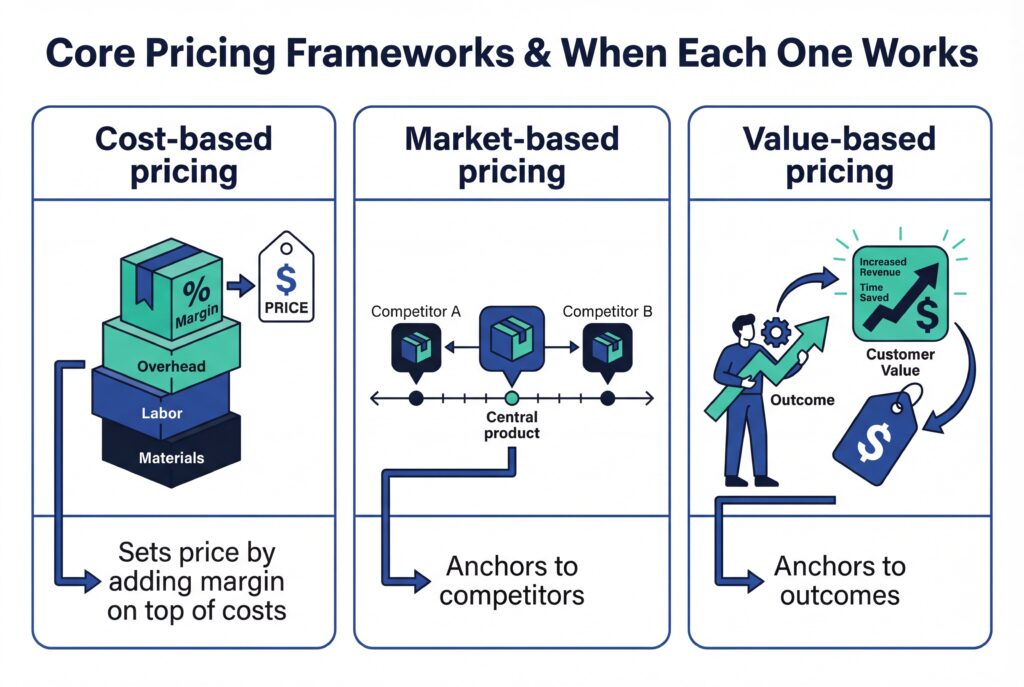
Most B2B companies use all three frameworks.
The question is which one leads.
Cost-based pricing
Cost-plus pricing sets price by adding margin on top of costs.
It works when:
- Costs are predictable
- Differentiation is low
- Buyers compare on price
It fails when value exceeds cost. Which is often.
Market-based pricing
Market-based pricing anchors to competitors.
It works when buyers are highly price sensitive and alternatives are truly comparable.
It fails when you have differentiation but price like you don’t.
Value-based pricing
Value-based pricing anchors to outcomes.
It works when:
- Value is measurable
- Buyers care about ROI
- You can defend the metric
It fails when value is vague or impossible to quantify.
The pricing corridor
In practice, strong pricing strategies operate inside a corridor.
- Floor: cost and margin requirements
- Ceiling: economic value to the customer
- Sanity check: market expectations
The goal is not to find the perfect number.
It is to operate consistently inside that corridor without leakage.
B2B Pricing Models & Their Trade-offs
Pricing models determine how customers experience price.
Choose the wrong model and even the right price will feel wrong.
Subscription pricing
Predictable. Budget-friendly. Familiar.
Best when value is steady over time.
Seat-based pricing
Simple and intuitive.
Breaks when automation increases value without increasing users.
Usage & consumption pricing
Aligns price to value.
Creates volatility if not governed properly.
Outcome-based pricing
Strong alignment. High trust requirement.
Hard to scale without robust measurement.
Negotiated & contract pricing
Inevitable in enterprise.
Requires guardrails or margin evaporates.
Hybrid models
Increasingly common.
Base subscription plus usage or add-ons balances predictability and upside.
The takeaway:
The model should reflect how value grows for the customer, not how easy it is to bill.
B2B SaaS Pricing Strategy in the Real World
SaaS pricing is where theory meets operational reality.
Start with packaging
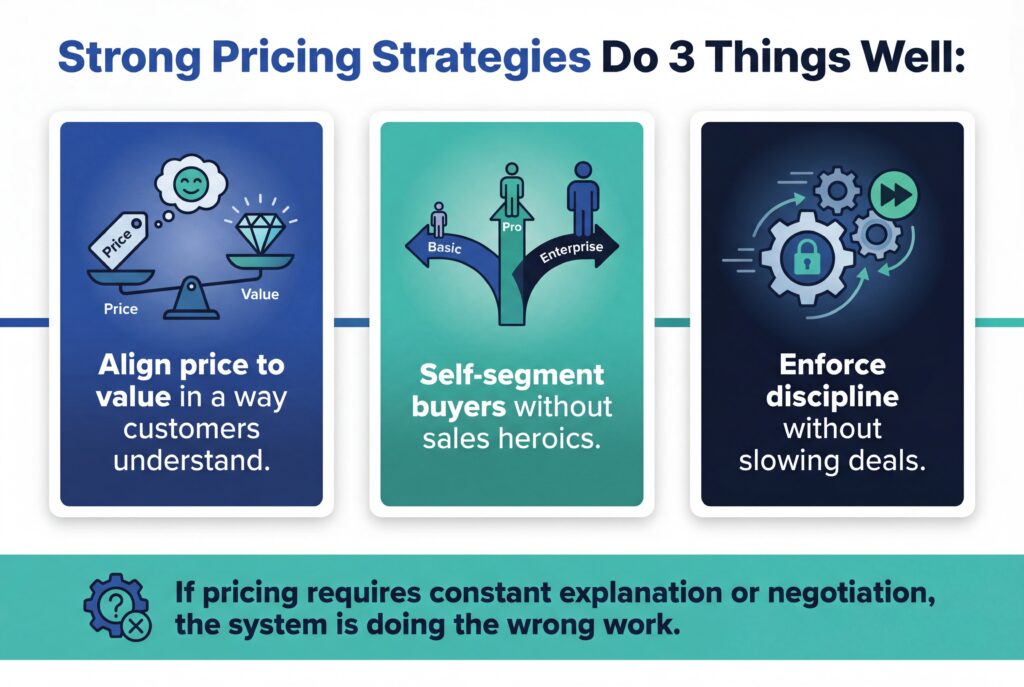
Packaging does the segmentation work before sales gets involved.
Good packaging lets SMB buyers self-serve and routes enterprise buyers into conversation.
Bad packaging forces sales to explain everything.
Seat vs usage decisions
Ask one question: Does value scale with people or activity?
If activity, seats will cap revenue.
If people, usage will confuse buyers.
Add-ons & modules
Add-ons should expand value, not patch gaps.
If customers need add-ons to make the product usable, packaging is broken.
Free trials & freemium
Free is a pricing decision, not a marketing trick.
Free should prove value and create urgency to convert. If free users never hit a meaningful limit, they will never pay.
Metrics pricing must improve
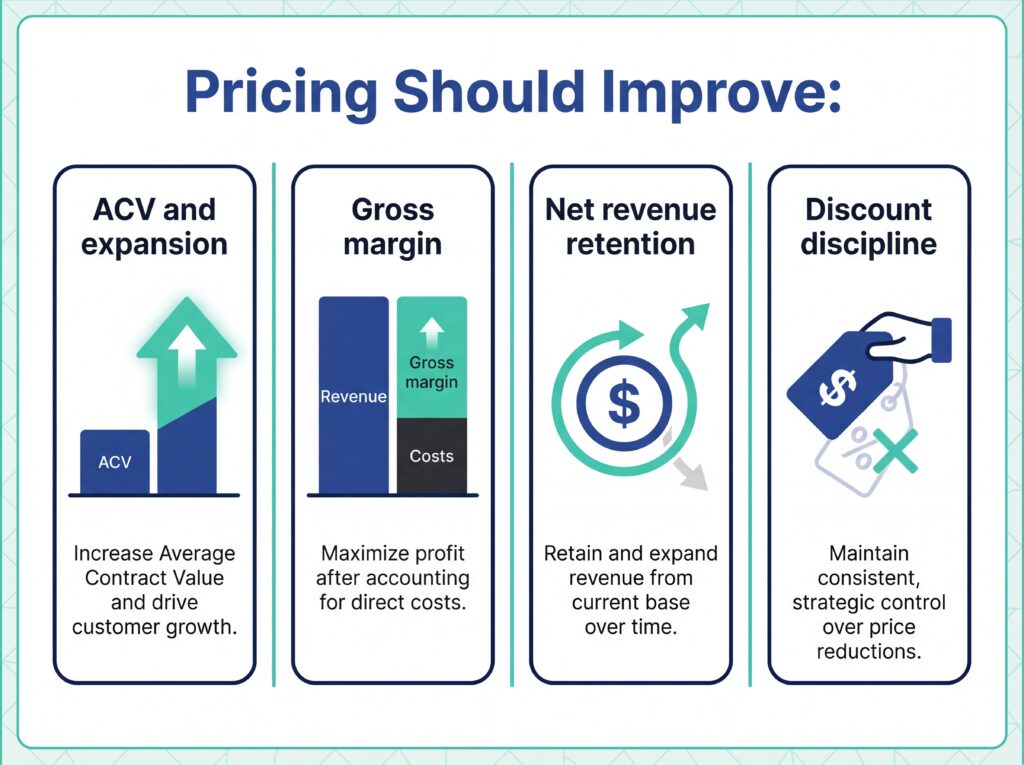
If those metrics are flat, pricing is not doing its job.
B2B Product Pricing Strategy for New Products
New products expose weak pricing thinking fast.
Pricing without history
Use reference products, early pilots, and willingness-to-pay testing.
Start simple. Leave room to move.
Lifecycle pricing
Launch pricing should be simple.
Scale pricing should segment. Mature pricing should optimize.
Platform vs point solution
Platforms justify bundles and higher ACVs.
Point solutions need clarity and focus.
Hardware & software bundles
Hardware anchors cost.
Software captures value.
Separate the economics even if the buyer sees one price.
Research, Validation & Pressure-Testing
Pricing assumptions are opinions until tested.
Qualitative research
Customer interviews reveal value drivers sales decks miss.
Listen for trade-offs, not compliments.
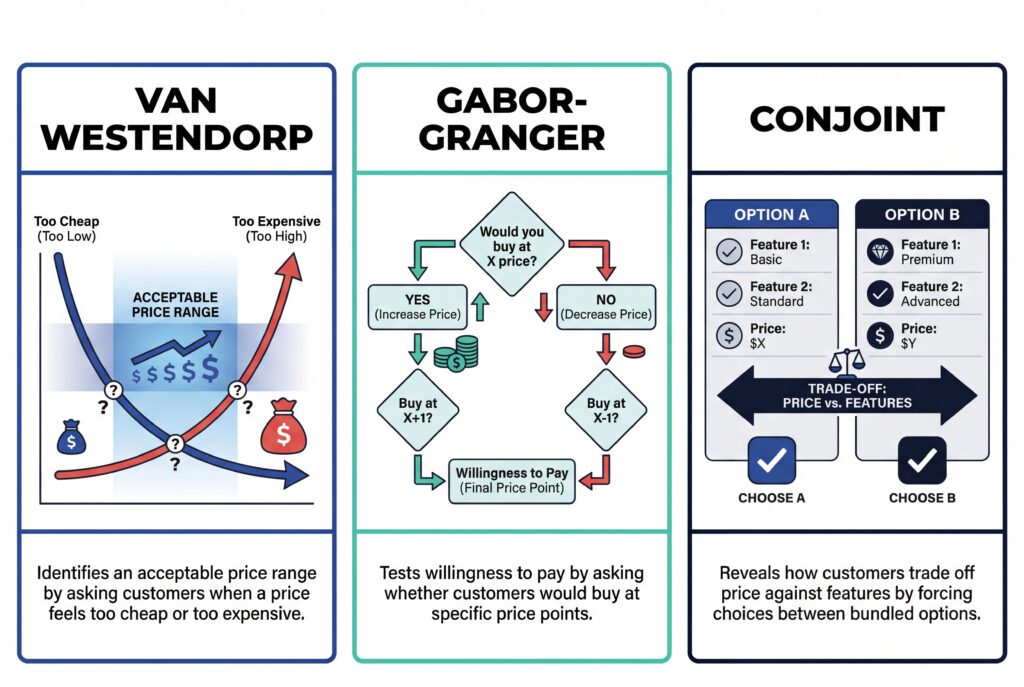
Quantitative methods
Van Westendorp. Gabor-Granger. Conjoint.
Each answers a different question. None replace judgment.
Live experiments
Pilot pricing with friendly segments.
Shadow price through deal desk approvals.
Let data argue, not anecdotes.
Signals pricing is broken
- Everyone buys the cheapest tier
- Deals only close with discounts
- Renewals stall
- Sales overrides pricing constantly
These are symptoms. Not causes.
How To Execute Pricing Changes Without Chaos
Pricing changes fail on execution, not math.
The real risks
- Customer backlash
- Sales confusion
- Competitive noise
Customer communication
Explain why.
Anchor to value.
Grandfather where needed.
Sales enablement
If reps cannot explain the price, they will discount it.
Equip them with talk tracks, ROI logic, and boundaries.
Cross-functional ownership
Pricing touches product, finance, sales, marketing, CS, and legal.
No single owner means no discipline.
Phased rollout
New customers first. Renewals later.
Learn before scaling.
Pricing Governance & Ongoing Optimization
Pricing discipline erodes quietly.
Governance prevents that.
What to monitor
- ASP and discount rates
- Tier distribution
- Win rates by price point
- Net retention
Deal exceptions
Exceptions should be visible and rare.
If they are common, pricing is wrong.
Continuous iteration
Treat pricing like a product:
Small changes. Measured impact. Regular reviews.
Common Pricing Mistakes That Destroy Value
A short list. All expensive.
- Copying competitors without understanding value
- Over-discounting to hit short-term targets
- Over-segmenting until nothing scales
- Confusing tier logic
- Leaving pricing untouched for years
If pricing feels political, it is already broken.
Frequently Asked Questions
What’s the difference between a B2B pricing strategy and a B2B pricing model?
A B2B pricing strategy defines how and why you price across segments, deals, and time. A B2B pricing model is just the mechanism you use to charge, like subscription, usage-based, or seat-based pricing. Strong strategies often use multiple models.
How often should a B2B SaaS pricing strategy be reviewed or updated?
At minimum, pricing should be reviewed annually. High-growth or PE-backed companies often review quarterly. Triggers include margin compression, rising discount rates, shifts in usage patterns, or entering new customer segments with different willingness to pay.
Can B2B pricing strategy improve sales execution, not just revenue?
Yes. Clear pricing reduces discounting debates, shortens deal cycles, and improves forecast reliability. When reps know where price flexibility exists and where it doesn’t, execution becomes more consistent and less reactive.
What’s the biggest mistake companies make with B2B product pricing strategy?
Treating pricing as static. Products evolve, value delivery changes, and markets shift. Companies that don’t adjust pricing over time end up undercharging their best customers or relying on discounts to close deals.
Conclusion
B2B pricing strategy isn’t about picking a model and moving on. You need to decide how value is created, how it grows, and how consistently your organization captures it.
The right pricing model reflects real customer value, supports your go-to-market motion, and holds up as usage, scale, and complexity increase. The wrong one introduces friction, forces discounting, and quietly erodes margin.
The common thread across every framework and example is this: pricing works best when it’s designed deliberately, tied to value, and treated as a core GTM decision, not a downstream fix.
If you want to design and pressure-test your B2B pricing strategy inside a structured go-to-market system, start a free trial of EnableU’s Sales Excellence Framework to see how the 8 pillars help turn pricing decisions into a clear, scalable GTM foundation.
Leave a Reply