GTM rarely breaks in obvious ways. It frays. A little confusion in messaging. A few deals that feel harder than they should. Pipeline that looks fine until the quarter closes.
None of it feels urgent in the moment, but together it compounds.
We’ll break down the GTM mistakes that quietly stall growth, why they keep repeating, and how to fix them before they show up as missed numbers.
Key Notes
- Most GTM mistakes compound from weak ICP, motion, and execution standards.
- Pipeline issues usually trace back to misaligned positioning, qualification gaps, or deal-stage discipline breakdowns.
- GTM models fail when buyer behavior, deal economics, and sales motion are mis-matched.
What Great GTM Looks Like
A strong GTM is not a set of tactics. It is a closed-loop system.
It has:
- Boundaries. Who you win with, and who you do not.
- A narrative that sales can repeat. Not a brand story, but a buying decision story.
- A motion that matches buyer preference and deal economics. Not wishful thinking.
- Clean handoffs and stage exit criteria. So pipeline means something.
- Metrics tied to reality. Not proxy metrics that feel good.
- Feedback loops. From sales and customer outcomes back into product, messaging, and planning.
If any one of these is missing, you will still make progress – until you try to scale. Then the same GTM mistakes compound.
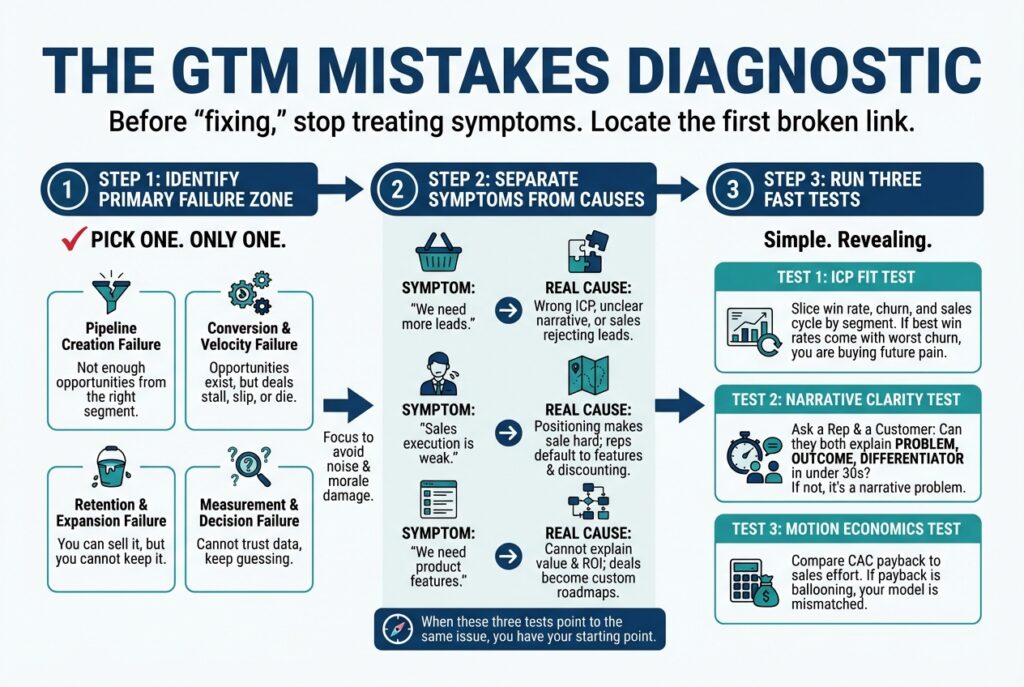
The GTM Mistakes Diagnostic
Before you “fix” anything, do one thing: stop treating symptoms. GTM mistakes are usually chained together. You have to locate the first broken link.
GTM Mistakes in Market and ICP Selection
Most GTM mistakes begin here, because every downstream decision assumes you picked the right customer.
Mistake 1: Your ICP Is Broad, Abstract, Or Defined By “Who Bought First”
This is the classic “we can serve anyone who needs X.”
It feels safe.
It is not.
A broad ICP creates:
- Vague messaging
- Low conversion
- Unclear product prioritization
- Sales cycles that drag because the buyer story keeps changing
It also creates internal confusion.
Marketing markets to one person. Sales sells to another. Product builds for the loudest customer.
Mistake 2: Misjudging Market Readiness
Early adopters are generous. They will:
- tolerate rough edges
- buy for novelty
- take internal risk
But mainstream buyers are different…
They want reliability, proof, and low change-management cost.
A common GTM mistake is treating early adopter enthusiasm as evidence of scalable demand. The warning sign is subtle – you keep getting “interesting” conversations, but you do not get repeatable conversions.
Mistake 3: Chasing Vanity Logos That Distort Your Roadmap
Some revenue dollars cost more than they look. The first enterprise logo can feel like a breakthrough, but if that customer is not a fit, they will:
- Demand roadmap commitments
- Pull your team into bespoke work
- Force a heavy sales motion
- Create messaging debt because you start telling a story that only that logo cares about
Six months later, you have a product no one fully understands, and a pipeline full of lookalikes you cannot win.
How to Prevent and Fix ICP Mistakes
Use an ICP definition that is enforceable, not aspirational.
Create an ICP doc that includes:
- Trigger event: what makes them buy now
- Urgent pain: what is costly today
- Constraints: budget, systems, compliance, internal friction
- Buying committee: who says yes, who blocks
- Success metrics: what they measure
- Disqualifiers: who you do not sell to
Then do the uncomfortable part: write “not for” rules.
Example disqualifiers:
- No executive sponsor
- No clear business problem tied to a metric
- No ability to change process
- No adoption path
If you cannot disqualify, you will keep selling yourself into churn.
GTM Mistakes in Positioning and Messaging
If ICP is the target, messaging is the arrow. This is where a lot of teams bleed… quietly.
Mistake 1: Feature-led Narrative
When your story is feature-led, the prospect has to do the work. They have to translate your product into business value. And most will not.
So the deal stalls or dies in no decision.
The sales team then responds in predictable ways:
- More slides
- More demos
- More follow-ups
- More discounting
None of that fixes the narrative.
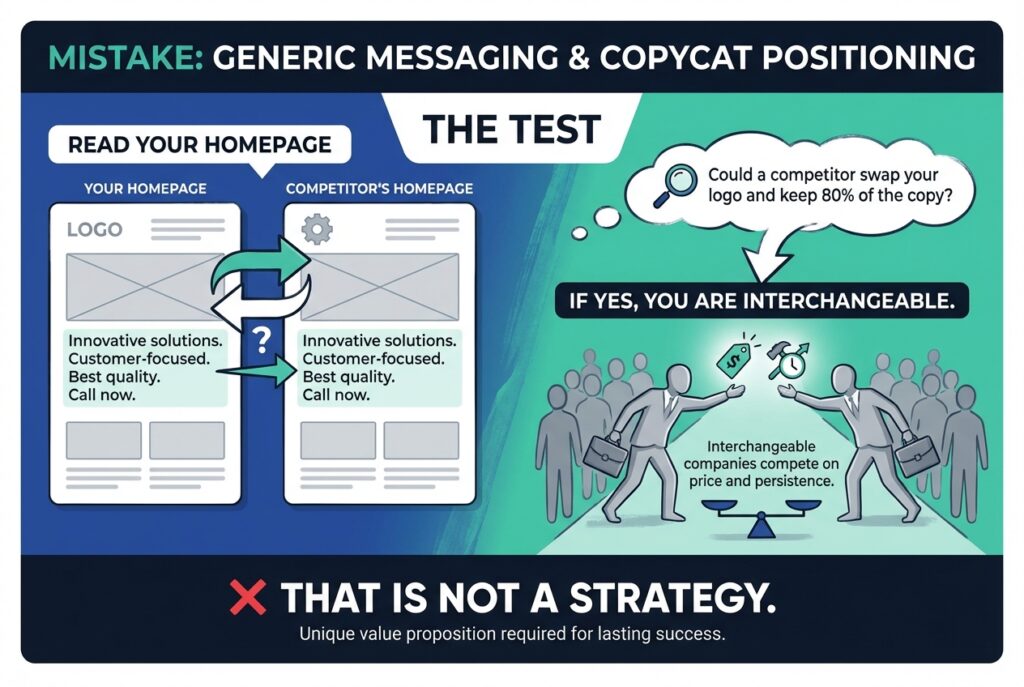
Mistake 2: Generic Messaging & Copycat Positioning
A good test:
Mistake 3: Message Drift Across The Org
When the narrative is unclear, everyone improvises (sales invents their own pitch, marketing promises something else, product gets stuck answering for both).
Over time, your company becomes hard to trust, because buyers hear a different version of you every time.
How to Prevent and Fix Positioning Mistakes
Build a positioning one-liner that the field can use.
Template:
- For [ICP] who [struggle with]
- [Company] helps you [achieve measurable outcome]
- By [mechanism]
- Unlike [alternative] because [difference buyers care about]
Then make it tougher. Add a “why now” sentence.
If you cannot explain why urgency exists, pipeline will always feel soft.
Also, run a no-decision reduction check. If you are losing to a no-decision, you are not making the status quo feel expensive.
GTM Model and Motion Mistakes
This is where economics punishes you.
Mistake 1: Choosing A Motion That Fights How Buyers Want To Buy
Forcing sales-led onto a low-friction product creates cost and slows adoption. Forcing PLG onto a complex product creates confusion, stalled evaluations, and hidden churn.
A motion is not a preference.
It is a fit decision.
Mistake 2: Introducing Sales Too Early Or Too Late
Too early:
- Sales reps call users before they have adopted
- You kill organic growth dynamics
- You accidentally become sales-led, with all the cost
Too late:
- You leave bigger deals on the table
- Enterprise buyers want humans, procurement, and confidence
The rule is simple: match sales investment to segment readiness and volume.
Mistake 3: Hybrid Without Rules
Most SaaS ends up hybrid – some self-serve; some sales-assisted; some expansion motion.
Hybrid breaks when:
- Motions become separate silos
- No handoff criteria exists
- Comp plans create turf wars
Mistake 4: Deal Size & Motion Mismatch
This is expensive.
A $500 ARR customer cannot support a heavy-touch enterprise sales motion.
A $250K deal rarely closes through a self-serve website funnel alone.
A telltale sign is CAC payback stretching out. If payback is moving toward 2 to 3 years, you have a model issue, and not an execution issue.
How to Prevent and Fix Motion Mistakes
Use a motion selection rubric:
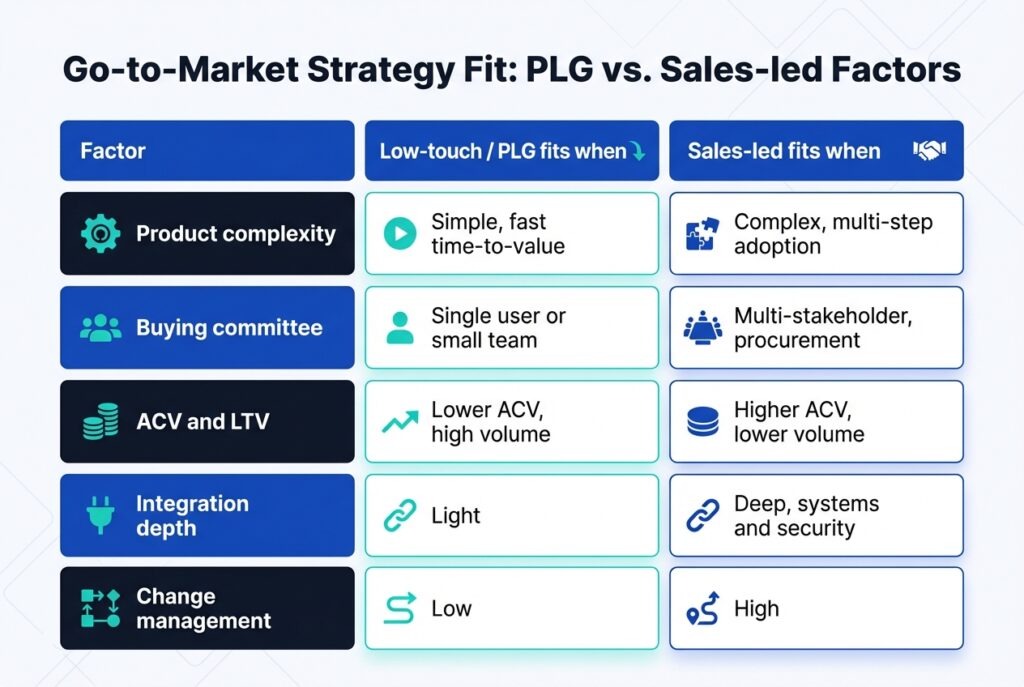
Then define handoff rules, for example:
- A user becomes a sales lead when:
- Usage hits X
- Seats hit Y
- An admin invites a finance stakeholder
- A target account matches ICP and shows intent
No rules means politics. Politics means wasted effort.
Marketing Execution GTM Mistakes
Marketing is often blamed for “not enough leads.”
Half the time, marketing is producing the wrong kind of demand.
The other half, sales is not absorbing it.
Mistake 1: Channel Sprawl
Doing a bit of everything feels like progress, but it’s usually avoidance, and the cost is that nothing compounds.
Instead of asking “what channels are working for others,” you need to ask:
- Where does our buyer actually learn?
- And what proof do they need to move?
Mistake 2: Vanity Metrics & Attribution Blind Spots
It is easy to win on metrics that do not pay the bills, such as traffic, MQL volume, CTR.
Three months later, pipeline is empty.
The deeper issue is decision-quality. If your attribution model is weak, you will keep allocating budget based on false confidence.
Mistake 3: Content Without Funnel Intent
A lot of content exists to be published, not to be used.
Content that is not tied to objections, proof points, or conversion moments becomes noise.
How to Prevent and Fix Marketing Execution Mistakes
Build a channel plan around ICP discovery paths.
Pick three.
Then tie content to funnel intent:
- Awareness: problem clarity and stakes
- Consideration: category framing and comparison
- Evaluation: proof, ROI, case stories, security, implementation
- Enablement: talk tracks, objection handling, internal sell tools
If you do not include enablement assets, sales will invent their own (and you will lose consistency).
Sales Execution and Enablement GTM Mistakes
This is where “we have pipeline but we cannot close” lives.
Mistake 1: Pipeline Bloat From Weak Qualification
A bloated pipeline feels healthy until it is time to forecast.
If pipeline is full of deals without:
- a budget owner engaged
- a defined problem tied to a metric
- a mutually agreed next step with date
… you do not have pipeline, you’re just hoping.
Mistake 2: Message Drift In Live Deals
When reps are unsure, they default to the product (feature tours, generic discovery, a demo that tries to be everything).
The buyer leaves with one thought:
“Not sure.”
Mistake 3: Scaling Sales Too Early
Headcount does not fix a broken sale. In fact, it multiplies it.
Bad narrative + more reps = more messy conversations.
Bad qualification + more reps = bigger pipeline fog.
How to Prevent and Fix Sales Execution Mistakes
Install stage exit criteria.
Not suggestions. Rules.
For example, Stage 2 cannot exist without:
- confirmed problem and impact
- identified decision process
- at least one economic buyer path
Also, change how deal reviews work. If your deal reviews are “what happened” and “what is the next step,” you will keep missing the real problem.
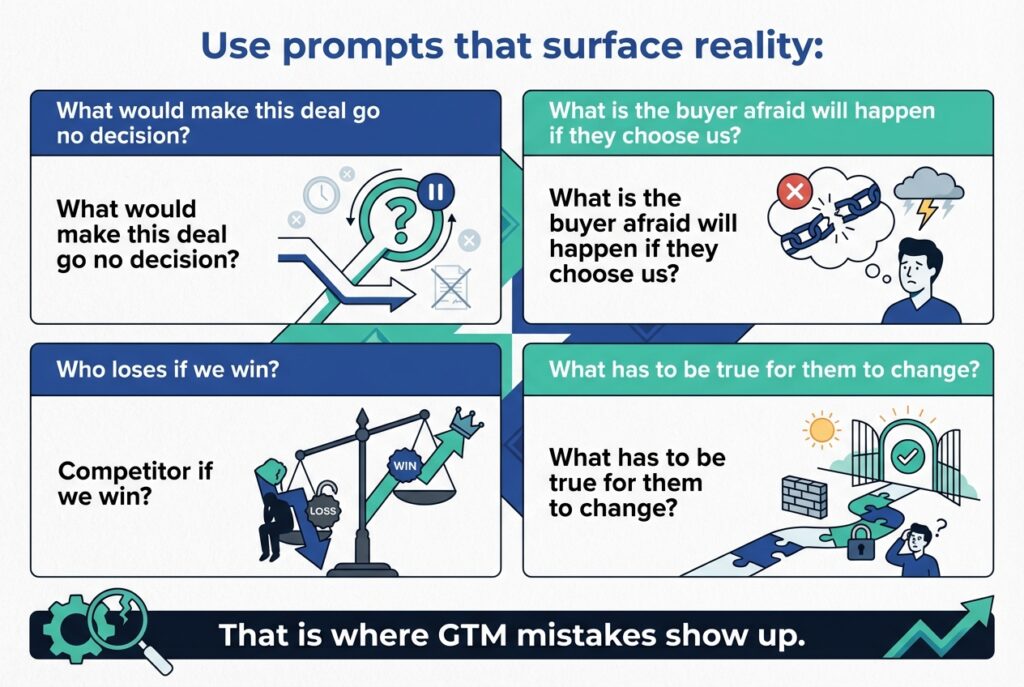
Product and GTM Misalignment Mistakes
GTM does not fail only in the field. It fails when product reality and sales story drift apart.
Mistake 1: Roadmap Driven By Internal Enthusiasm
Shipping is easy to celebrate. Adoption is harder.
If the product team celebrates output metrics while activation and retention stay flat, you are building noise.
Mistake 2: Onboarding & Activation Failure
A leaky bucket is not a marketing problem. If customers do not reach first value quickly, acquisition becomes a treadmill.
You can keep pouring spend in, but you will still feel stuck.
Mistake 3: Ignoring Product Usage Signals
SaaS gives you a gift: usage data.
If a “differentiator” is not being used, it is not a differentiator.
If sales keeps touting it, you are setting up disappointment.
That disappointment becomes churn.
How to Prevent and Fix Product and GTM Misalignment
Create a simple cadence.
Monthly, review:
- adoption of key features
- time-to-first-value
- top reasons customers stick
- top reasons customers churn
Then make one commitment – either change the product or change the story.
Doing neither is a hidden GTM mistake.
RevOps, Data & Measurement GTM Mistakes
Bad data hides problems.
Sometimes it creates them.
Mistake 1: Inconsistent Definitions
If your funnel definitions are not consistent, your GTM is not measurable.
If one team calls something “qualified” and another team throws it away, you are wasting effort.
Mistake 2: Optimizing The Wrong KPIs
It is possible to win the metrics and lose the game:
- Pipeline dollars can be inflated.
- Lead volume can be inflated.
- Feature velocity can be inflated.
If close rates, activation, and retention do not move, you are celebrating theatre.
Mistake 3: Siloed Data Creates Blind Spots
Marketing knows lead source. Sales knows deal size. CS knows adoption.
If these are not connected, you cannot see the real patterns.
You cannot see that one channel produces churn.
Or that a segment converts but never expands.
How to Prevent and Fix Measurement Mistakes
Do the unglamorous work:
- Integrate systems where it matters
- Enforce data hygiene
- Audit key reports for accuracy
Then pick a balanced KPI set.
If one KPI is soaring while others tank, something is off.
AI and Tooling GTM Mistakes
AI can help, but it can also scale your mistakes.
Mistake 1: Treating AI As Autopilot
The danger is not that AI makes mistakes. It is that it makes them believable.
If your team ships AI-written messaging without review, you will damage trust at scale.
If you let AI automate poor targeting, you will alienate an entire segment faster than a human team ever could.
Mistake 2: Tools Before Strategy
The SaaS world loves tools.
Tool stacks grow. Data fragments. Process becomes a maze.
Then everyone complains about “CRM hygiene.”
No one fixes why it broke.
How to Prevent and Fix AI and Tooling Mistakes
Use AI as a copilot. Human-in-the-loop.
A practical rule set:
- AI can draft. Humans approve.
- AI can suggest. Humans decide.
- AI can surface signals. Humans own the follow-through.
Also rationalize your stack. If your systems do not talk, your decisions will not be real.
Leadership and Org Design GTM Mistakes
This is the part people avoid, because it implicates leadership.
Mistake 1: Strategy Churn
If the strategy changes every month, execution never compounds. Teams stop believing direction is real, and they start optimizing for survival.
Mistake 2: Unclear Ownership
If everyone owns the funnel, no one owns it.
Leads sit. Deals slip. Customer issues bounce.
Then the blame cycle starts.
Mistake 3: Incentives That Reward The Wrong Behavior
Tell me how someone is measured and I will tell you how they behave.
- If sales is paid for land only, they will land bad-fit customers.
- If marketing is paid for lead volume, they will flood the CRM.
- If CS is paid for ticket closure, they will avoid expansion.
This is not a people problem.
It is a system problem.
How to Prevent and Fix Leadership Mistakes
Run an incentive audit.
Ask:
- What behavior does this comp plan create?
- What behavior do we actually need?
Then create shared metrics:
- When marketing and sales share pipeline outcomes, the argument changes.
- When product and CS share retention outcomes, roadmap decisions improve.
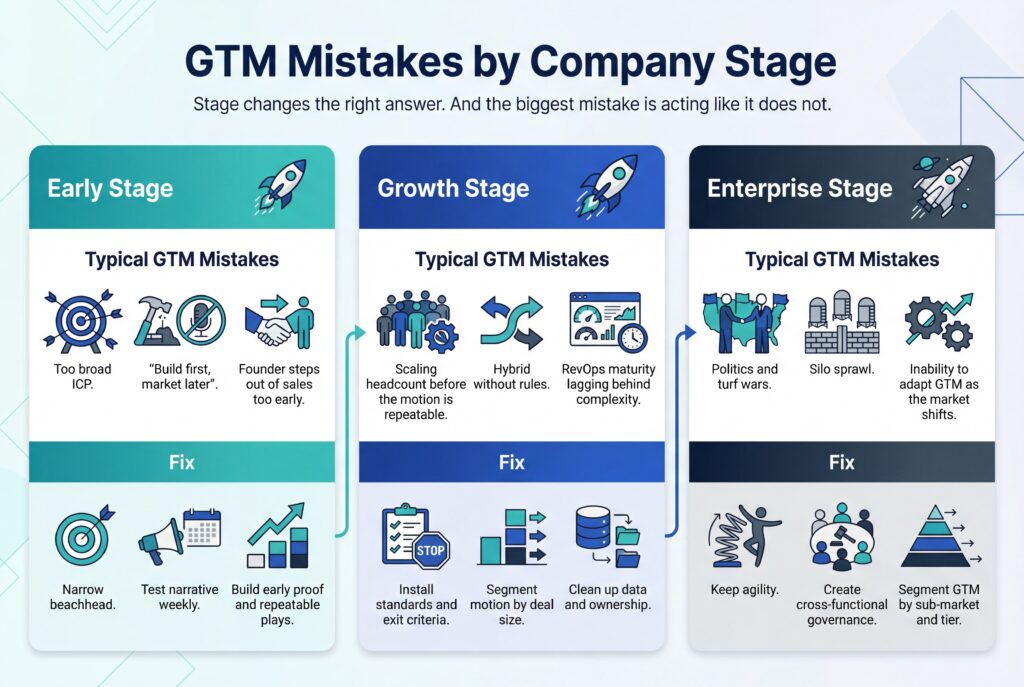
GTM Mistakes by Company Stage
How to Prevent GTM Mistakes
If you want fewer GTM mistakes, you need fewer “one-off fixes.”
You need standards.
A GTM Pre-Flight Checklist
Use this before you scale spend or headcount:
- ICP boundaries and disqualifiers are documented and enforced
- Narrative can be repeated by sales and customers
- Motion matches buyer preference and deal economics
- Stage exit criteria exist and are used
- Data definitions are consistent
- Feedback loop cadence is in place
If two of these are missing, do not scale as you’ll just scale waste.
Early Warning System
Pick a small set of indicators and set triggers.
Example triggers:
- Win rate drops 20% in a segment
- No-decision rate climbs for two quarters
- CAC payback increases by 6+ months
- Early churn spikes for a cohort
When a trigger fires, leadership reviews root causes.
Not anecdotes.
Reality.
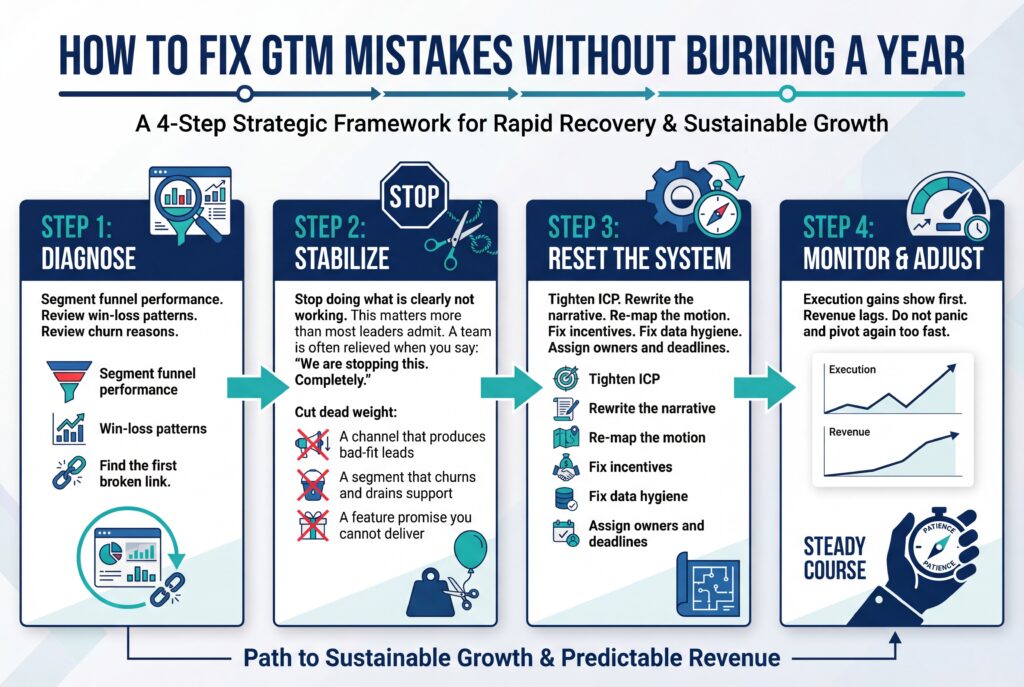
How To Fix GTM Mistakes Without Burning A Year
Fixing GTM is a sequence. Do not skip steps.
How EnableU Removes the Root Causes of GTM Mistakes
GTM mistakes rarely come from one place.
Sometimes the strategy is wrong.
Sometimes execution breaks down.
Often, the problem is that decisions made in planning don’t survive contact with real deals.
EnableU is built to change that.
- Playbook enforcement. GTM standards are applied deal by deal. Gaps in discovery, stakeholder coverage, or stage progression are flagged early.
- Real-time guidance. Prompts and risk signals appear in-flow, during live opportunities, not buried in training or docs.
- Signal-driven coaching. Deal reviews are grounded in observed behavior, not confidence or optimism.
- Closed-loop improvement. Deal outcomes continuously refine playbooks, messaging, and coaching so GTM improves based on evidence.
EnableU is a Sales Excellence System.
It makes GTM decisions durable under pressure.
Strategy, execution, coaching, measurement.
Connected.
👉 Start a free trial and see which GTM mistakes are hiding in your pipeline.
Frequently Asked Questions
What are the most common GTM mistakes in SaaS companies?
The most common GTM mistakes include poor ICP definition, misaligned sales motions, weak qualification standards, and unclear ownership across marketing, sales, and product. These issues usually surface as stalled pipeline, no-decision losses, and inconsistent forecasting.
How do GTM mistakes impact revenue growth and forecasting?
GTM mistakes distort pipeline quality, inflate forecasts, and hide risk until late in the quarter. When qualification and stage progression aren’t enforced, forecast accuracy drops and revenue becomes harder to predict quarter over quarter.
Why do GTM strategies fail even with experienced leadership teams?
GTM strategies fail when decisions aren’t reinforced during execution. Without systems that guide behavior in live deals, even strong leadership teams rely on hindsight instead of early signals, allowing small breakdowns to compound.
How can companies identify GTM mistakes early?
Early GTM mistakes show up in rising no-decision rates, longer sales cycles, declining win rates by segment, and growing CAC payback periods. These indicators point to systemic issues before revenue misses become visible.
Conclusion
Most GTM mistakes fail quietly. A slightly fuzzy ICP. Messaging that sounds fine but doesn’t move decisions. Pipeline that looks healthy until it isn’t. Over time, those small cracks turn into missed quarters, longer cycles, and teams working harder for less return.
The common thread across every GTM mistake in this guide is durability. Decisions that can’t survive real deals, real buyers, and real pressure don’t scale. Fixing that means tightening focus, enforcing standards, and closing the loop between strategy and execution.
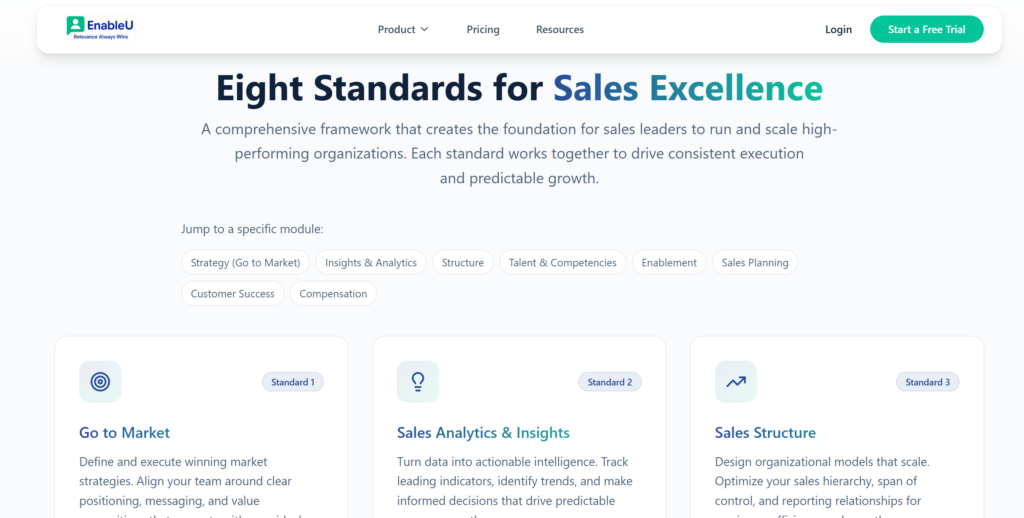
To see how GTM mistakes get prevented in practice, start a free trial and see how our Sales Excellence Framework’s eight pillars keep strategy, execution, and decision-making aligned.
Leave a Reply